
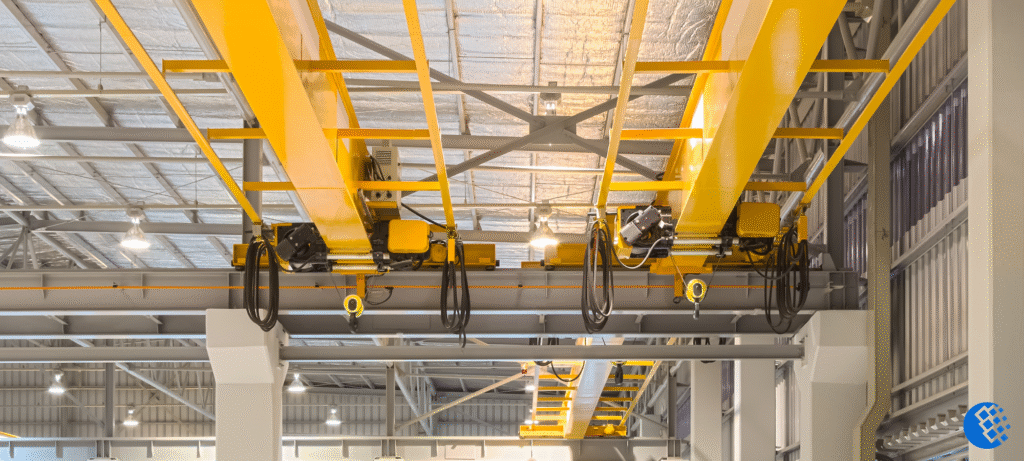
If you have ever watched a novice crane operator try to move a heavy load across a factory floor, you have seen the dance. They accelerate the trolley. The load lags behind. They stop the trolley. The load swings forward. They try to “catch” the swing by jogging the controls, but they mistime it, and the oscillation gets worse. The 10-ton steel coil swings wildly like a wrecking ball, threatening to smash into million-dollar machinery or, worse, a person.
This is the “Pendulum Effect.” It is the nemesis of efficiency in material handling.
For decades, the only solution to this problem was skill. A master operator learns to anticipate the physics. They know exactly when to accelerate to cancel out the back-swing. It is a “feel” that takes years to master.
But in a modern industrial environment, where skilled labor is scarce and speed is critical, we can no longer rely solely on “feel.” We need the crane to think. This has led to the development of sophisticated Electronic Sway Control systems—algorithms designed to defeat physics.
The Physics of the Pendulum
To understand the solution, you have to understand the enemy. A suspended load acts as a simple pendulum. The period of the swing is determined by the length of the cable (the hoist height). A short cable swings fast; a long cable swings slow.
The problem arises from inertia. When the bridge or trolley accelerates, the load wants to stay put (Newton’s First Law). This creates a lag angle. When the crane stops, the load wants to keep moving.
Manual correction is counter-intuitive. To stop a forward swing, you actually have to move the crane forward to get the hook over the center of gravity, then stop again. It requires split-second timing. If you are off by half a second, you amplify the energy instead of dampening it.
The Algorithmic Counter-Punch
Modern “Anti-Sway” technology works by predicting the future.
The system uses a mathematical model of the crane. It knows the length of the rope (via an encoder on the hoist drum) and the weight of the load (via a load cell). Using these variables, the computer calculates the exact natural frequency of the pendulum.
When the operator pushes the joystick forward, the crane doesn’t just blindly obey. The drive system modulates the acceleration curve. It might inject a tiny, imperceptible “micro-pulse” of speed at the exact moment required to cancel out the swing before it even starts.
It works similarly to noise-canceling headphones. The headphones listen to outside noise and generate an “anti-wave” to silence it. The crane “listens” to the sway (or the potential for sway) and generates an “anti-move” to kill the energy.
The “Open Loop” vs. “Closed Loop” Debate
There are two ways to achieve this wizardry.
- Open Loop (Predictive): This system doesn’t actually see the load. It assumes the load behaves according to the math. It modifies the operator’s commands to ensure smooth acceleration and deceleration curves that prevent sway from initiating. This is cheaper and robust but can be fooled by external forces like wind or an off-center lift.
- Closed Loop (Active Feedback): This is the high-tech frontier. Cameras or infrared sensors mounted on the trolley look down at the hook. They measure the angle of the cable in real-time. If the load starts to swing due to an external bump, the system sees the deviation and actively moves the bridge or trolley to get back over the center of gravity. It is essentially an “auto-pilot” for stability.
The Productivity Dividend
The real value of this technology isn’t just safety; it’s speed.
Without sway control, an operator might spend 50% of the cycle time just waiting for the load to settle before they can lower it. They have to “creep” into position.
With sway control, the operator can drive the crane at full speed, let go of the stick, and the load stops dead center. No waiting. No “catching the swing.” This can reduce cycle times by 25% or more. In a high-volume steel mill or automotive plant, that time savings translates to millions of dollars in throughput.
The Human Element
Some veteran operators resist this technology. They feel it interferes with their control, or that it makes the machine feel “sluggish” because it ramps up speed smoothly rather than jerking into motion.
However, the data is undeniable. Sway control systems reduce structural fatigue on the crane itself (less side-loading on the girders) and drastically reduce collision incidents. It allows a novice operator to perform like a veteran on day one.
Conclusion
Gravity is a formidable opponent. For centuries, we have fought it with brute force and human dexterity. But as loads get heavier and production schedules get tighter, the margin for error disappears.
By integrating intelligence into the lifting mechanism, we change the nature of the job. The operator stops being a juggler and starts being a manager. Whether utilizing standard overhead systems or specialized equipment like a jaso industrial crane, the goal remains the same: to make the movement of massive weight boring, predictable, and perfectly still.