Finding out how much material you need shouldn’t feel like a math exam. Honestly, most people get intimidated by kitchen measurements, but it is actually just a game of rectangles. Whether you are eyeing a sleek slab of granite or a budget-friendly laminate, getting your numbers right is the difference between a smooth install and an expensive headache. If you are trying to figure out your budget, this countertop square footage calculator guide will walk you through the process without the confusing jargon. Let’s break down how to measure your space like a pro.
Planning a kitchen renovation involves many moving parts, but none is quite as critical as the surface area of your counters. It dictates your material costs, the complexity of the installation, and even the type of sink you can support. Most homeowners assume that a professional needs to come in just to give a rough estimate, but that isn’t true. By using a few simple techniques and understanding the math behind the stone, you can walk into any showroom with your head held high and your data ready.
The Cheat Sheet Formula
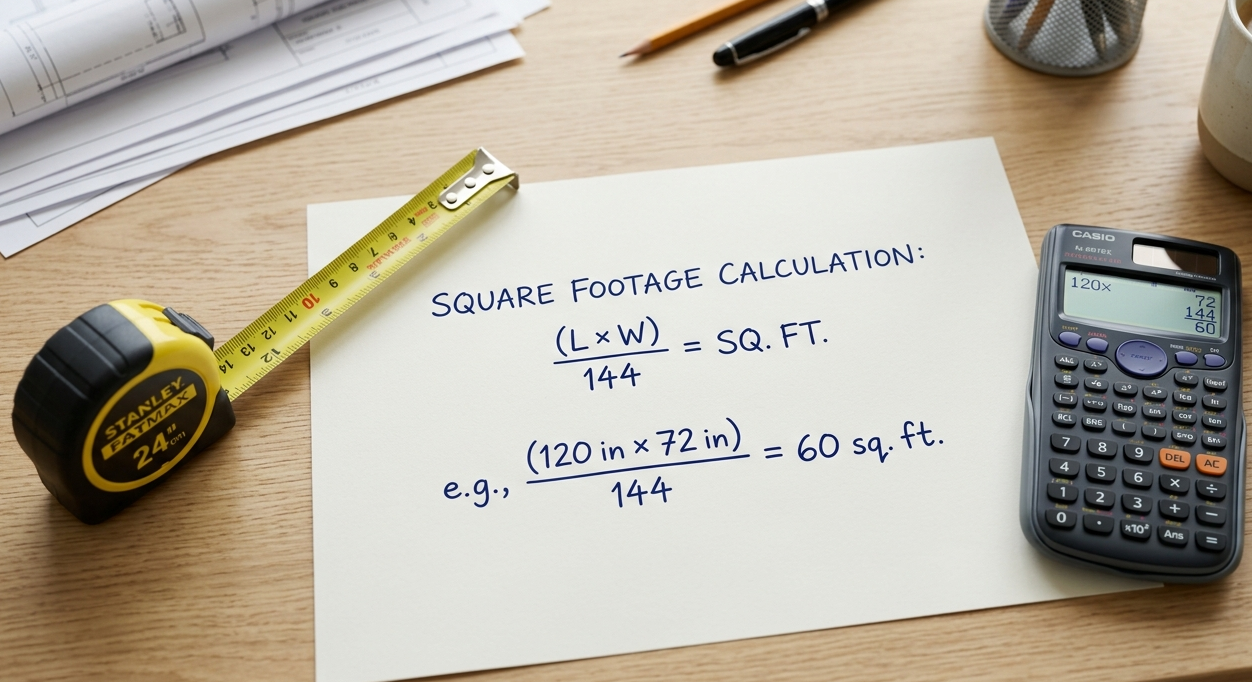
You don’t need to be a math genius here. Since most measuring tapes use inches, we stick to inches for the heavy lifting and convert to feet at the very end. The reason we use inches is for precision; kitchen counters often have small overhangs or odd lengths that don’t fall perfectly on a foot marker.
The Golden Formula:
$$Length (inches) \times Width (inches) \div 144 = Square Feet$$
Example:
Let’s say your main kitchen island is 96 inches long and 25 inches wide.
- $96 \times 25 = 2,400$ square inches.
- $2,400 \div 144 = 16.67$ square feet.
It is really that simple. Just remember that 144 is the magic number because a square foot is $12 \times 12$ inches. When you are buying expensive natural stone, those decimals matter. A few inches off can lead to a gap in your backsplash or a slab that simply doesn’t fit the cabinet run.
How to Calculate Countertop Square Footage (Step-by-Step)
If you are wondering how to calculate countertop square footage manually, just follow this flow. I always tell people to draw a rough sketch of their kitchen on a piece of paper first—it makes keeping track of sections way easier. Don’t worry about artistic skill; a “birds-eye view” of rectangles is all you need.
1. Measure the Length
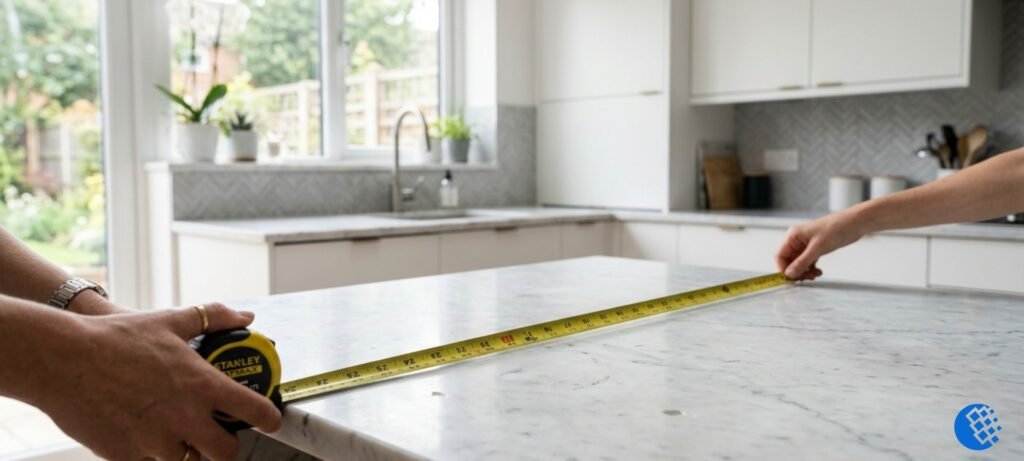
Run your tape measure along the back wall where the counter meets the splash. Get the total inches. If you have a long run of cabinets, it is often easier to have a second person hold the other end of the tape to ensure it stays flat and tight. Accuracy starts here.
2. Measure the Width
Standard counters are usually 24 to 25 inches deep. This accounts for a 24-inch deep base cabinet and a 1-inch to 1.5-inch overhang to prevent spills from running down your cabinet faces. If you have an overhang on an island for seating, it might be 30, 36, or even 48 inches. Always measure to the edge of the intended surface, not just the cabinet box.
3. Multiply Length by Width
This calculation gives you the total square inches of that specific section. If you have multiple pieces (like an island and a main wall), keep these totals separate for now.
4. Convert to Square Footage
Take that total and divide it by 144. Much like how a ez grader calculator helps a student see where they stand by processing raw numbers into a meaningful result, this formula gives you a clear picture of your material needs before you hit the showroom.
Measuring Different Countertop Layouts
Not every kitchen is a simple straight line. In fact, most modern homes feature corners, peninsulas, or tiered surfaces. If you have a complex layout, the trick is to “divide and conquer.”
L-Shaped Countertops
Don’t try to measure the whole “L” at once. Break it into two separate rectangles. Calculate the square footage for each piece, then add them together.
- Section 1: (e.g., 120 inches x 25 inches) = 20.8 sq ft
- Section 2: (e.g., 48 inches x 25 inches) = 8.3 sq ft
- Total: 29.1 sq ft
Important Note: When measuring L-shapes, do not measure the corner square twice. If you measure one side all the way to the wall, start your measurement for the second side from the edge of the first countertop piece.
U-Shaped Kitchens
Same rule applies. Treat it as three separate rectangles. This layout is common in smaller kitchens to maximize prep space. Just stay consistent with your corner measurements to avoid over-ordering material.
Island and Peninsulas
Islands are often the “hero” of the kitchen and usually require a larger, single slab. Because they often have seating, make sure you measure the width including the overhang where the stools will go. If the island has a “waterfall” edge (where the stone goes down the side to the floor), you must measure the height of the cabinets and add that square footage as well.
Comparison: Countertop Materials at a Glance
Choosing a material is just as important as the measurement. Each stone or surface has a different “yield” from a slab. Here is how the top options stack up in terms of cost and durability for 2026.
| Material | Cost per Sq Ft | Durability | Maintenance |
| Laminate | $20 – $50 | Moderate | Low |
| Granite | $40 – $100 | Very High | High (Needs Sealing) |
| Quartz | $50 – $120 | Very High | Very Low |
| Butcher Block | $35 – $80 | Moderate | High (Needs Oiling) |
| Marble | $75 – $200 | Moderate | High (Porous) |
Pro Tip: If you have a high-traffic kitchen with kids, Quartz is usually the winner because it doesn’t stain or require annual sealing like Granite. However, if you love the look of natural veins, Granite or Quartzite are unbeatable for heat resistance.
The Hidden Costs of Installation
When you use a countertop square footage calculator, you are finding the “net” area. However, the price you pay at the store often includes more than just the raw stone. Understanding these extras will keep your budget from exploding.
- Edge Profiles: A standard square or “eased” edge is usually free. But if you want a Bullnose, Ogee, or Mitered edge, expect to pay an extra $10 to $30 per linear foot.
- Cutouts: Fabricators charge for every hole they have to make. Sinks, cooktops, and even soap dispensers usually carry a flat fee per cutout.
- Support Brackets: If your island overhang is more than 10-12 inches, you will need steel brackets to prevent the stone from cracking or tipping. These aren’t usually included in the “per square foot” price.
- Slab Minimums: Some high-end shops require you to buy the whole slab (usually 50-60 sq ft). If your kitchen only needs 35 sq ft, you might still have to pay for the “waste” or keep the leftover piece for a bathroom vanity.
Common Measuring Blunders to Avoid
I’ve seen a lot of DIY projects go sideways because of small oversights. Here is what to watch out for:
- Forgetting the Backsplash: If you want your countertop material to go up the wall a few inches (a standard 4-inch splash), you have to measure and add that area too. Many people forget this and end up short on material.
- Ignoring the Sink Cutout: Most fabricators charge for the full slab even if they cut a hole for the sink. Don’t subtract the sink area from your total square footage when estimating your budget.
- Rounding Down: Never round down. If you get 22.2 sq ft, call it 23. Most pros suggest adding 5-10% extra for waste, especially if your kitchen has a lot of angles or corners.
- Measuring in Feet: If you measure in feet but use the 144 formula, your numbers will be wrong. Stay in inches until the final division.
For those managing complex projects and trying to keep track of various data points, checking out Grading Tips for Teachers can actually offer some great perspective on staying organized and precise with data—a skill that definitely translates to home renovation and project management.
Quick Reference Table (Standard 25″ Width)
| Length (Inches) | Width (Inches) | Total Square Feet |
| 48 | 25 | 8.3 |
| 72 | 25 | 12.5 |
| 96 | 25 | 16.7 |
| 120 | 25 | 20.8 |
| 144 | 25 | 25.0 |
FAQ
How do you calculate square footage of a countertop?
Multiply the length by the width in inches, then divide that resulting number by 144 to get the total square footage.
How to calculate countertop square footage for an island?
Islands are often wider than standard counters. Measure the full length and the full width (including any seating overhang), multiply them together, and divide by 144.
Do I subtract the stove or sink area?
Generally, no. You usually have to pay for the material that is cut out for sinks and cooktops because the fabricator still has to process that portion of the slab.
What is the standard width for kitchen counters?
Most standard kitchen base cabinets are 24 inches deep, so the countertop is usually 25 or 25.5 inches wide to allow for a slight overhang over the cabinet doors.
Can I use marble for a kitchen?
You can, but be aware that marble is porous and soft. It will etch from lemon juice and stain from red wine unless you are extremely diligent with sealing and cleaning.
Final Thoughts
Using a countertop square footage calculator or following the manual steps above makes the whole renovation process way less stressful. Accurate numbers mean accurate quotes, and accurate quotes mean no surprise bills at the end of the month. Take your time, draw your map, and measure at least twice before committing to a purchase.
When you’re ready to buy, always visit the fabrication yard in person. Seeing a small sample is one thing, but seeing the full slab allows you to spot natural pits or veins that you might want to avoid—or highlight—in your final layout. For more technical details on stone quality and grading, you can visit resources like the Natural Stone Institute or check out buying guides on Consumer Reports for the latest material testing results.