

In 2026, digital marketing for service businesses has moved past the era of just collecting leads. It’s no longer enough to have a basic website and a few Google Ads; today, the market is defined by “Trust Currency.” Customers aren’t just looking for a service; they are looking for proof, authority, and empathy before they even think about picking up the phone. If you are running a plumbing company, a law firm, or a niche consultancy, your marketing needs to shift from “pitching” to “problem-solving.” Let’s break down the strategies that actually move the needle this year, focusing on how to build a presence that turns casual browsers into lifelong clients.
The reality of the current landscape is that people are exhausted. They are tired of being followed around the internet by “buy now” ads for services they only needed once. They are tired of clicking on a result only to find a wall of text that doesn’t answer their specific question. To win today, you have to be the most helpful person in the room. You aren’t just competing with the guy down the street; you are competing with the customer’s skepticism.
Table of Contents
- The Shift: From Lead Gen to Trust Building
- Local SEO: Dominating the “Near Me” Economy
- Technical SEO: The Hidden Billboard of Search
- Google Local Services Ads (LSA): Pay for Leads, Not Clicks
- Service Business Marketing Comparison: Where to Spend Your Budget
- The “Proof Stack”: Content and Social Validation
- Common Service Marketing Pitfalls to Avoid
- Final Thoughts: Your Journey Starts Here
- FAQs
The Shift: From Lead Gen to Trust Building
The old way of doing things—blasting ads and hoping for the best—is officially dead. In 2026, success isn’t measured by traffic spikes but by relevance and authority. People are smarter now. They can spot a generic, AI-written sales pitch from a mile away. If your content looks like everyone else’s, you are effectively invisible.
For service businesses, your website shouldn’t just be a brochure. It needs to be an educational hub. Think about the last time you hired a contractor. Did you pick the one with the flashiest ad, or the one who had a video explaining exactly how they fix a foundation leak? Exactly. Much like how a grade calculator provides a definitive result from raw data, your marketing should provide definitive answers to customer pain points. You aren’t just selling a “service”; you are selling the confidence that the job will be done right the first time.
When a potential client lands on your page, they have three silent questions: Can you fix my specific problem? Have you fixed it for someone like me before? And will I get ripped off? Your marketing strategy must answer all three before they even see your “Contact Us” button.
Local SEO: Dominating the “Near Me” Economy

For service businesses, local search is your bread and butter. About 46% of all Google searches are now looking for a local service. If you aren’t in the “Map Pack,” you basically don’t exist to half your potential market. But being in the Map Pack isn’t just about proximity anymore; it’s about activity and semantic relevance.
Optimize Your Google Business Profile (GBP)
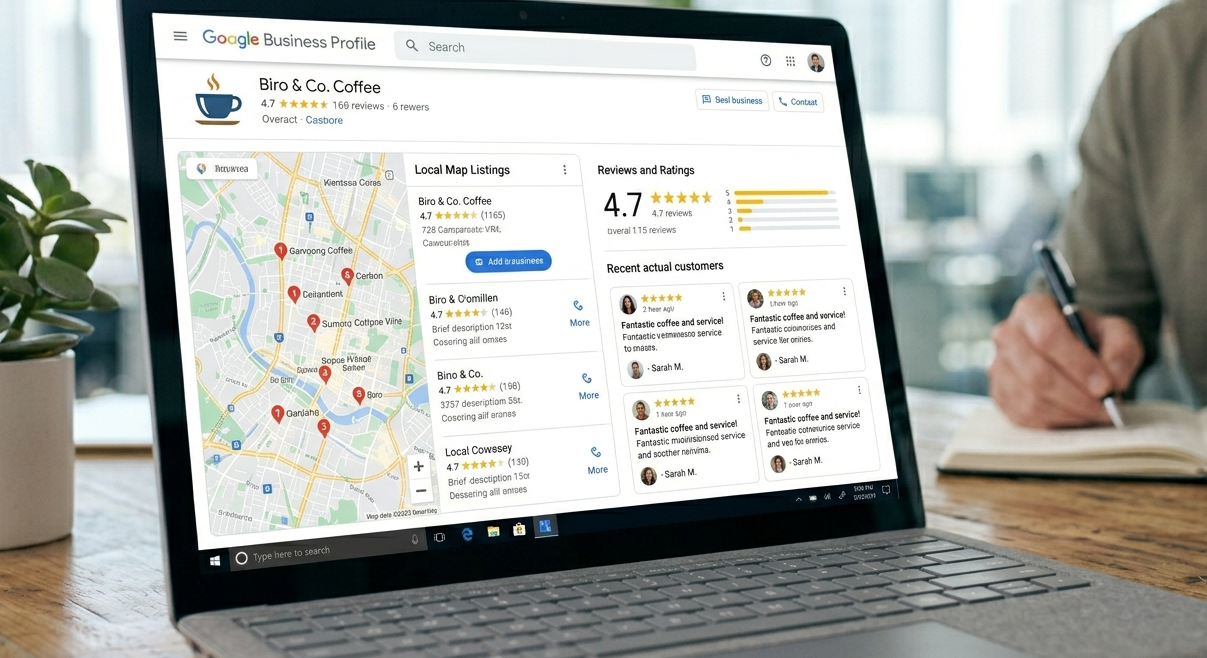
Your GBP is often more important than your actual website in 2026. Google wants to see that you are an active, real member of the local community.
- Hyper-Local Updates: Don’t just post once a month. Post photos of recent jobs in specific neighborhoods. If you just finished a roof in a specific suburb, mention it. Uploading a photo with a caption like “Completed a shingle repair in the Highlands today” sends a massive geographic signal to search engines.
- Ask Smarter for Reviews: Don’t just ask for a “review.” Ask for a story. “Would you mind leaving a quick Google review about how our team handled your emergency electrical repair?” When a customer mentions the specific service (e.g., “emergency electrical repair”) and the location, it acts as a secondary ranking signal that no amount of paid ads can beat.
Semantic Mapping
Google now understands the “relationship” between services. If you are a plumber who also does “water heater installation,” your website and GBP need to link those concepts together. If you want to understand how deep this logic goes, studying Ben Stace Semantic SEO Case Studies can show you how topical authority—not just keywords—drives visibility in the modern age. It’s about proving you are an expert in the entire category, not just a single keyword.
Technical SEO: The Hidden Billboard of Search
Before you can rank for high-intent keywords like “best estate lawyer near me,” your site needs to be technically sound. Many service providers neglect the “under the hood” work, thinking that a pretty homepage is enough. It’s not. If Google can’t read your site easily, it won’t show it to anyone.
Google’s crawlers need to understand the context of your pages instantly. This means having proper Title Tags and Meta Descriptions that tell search engines exactly who you are and where you work. These aren’t just technical checkboxes; they are your “billboards” in the search results. If your meta description is boring or generic, users will skip right over you, even if you’re in the top three results. Each page of your site should serve a specific purpose and target a specific intent—whether it’s an emergency service or a long-term maintenance plan.
Google Local Services Ads (LSA): Pay for Leads, Not Clicks
If you are a service provider and you aren’t using Local Services Ads, you are leaving money on the table. These are the “Google Guaranteed” ads that appear at the very top of the search results—even above the traditional PPC ads.
The beauty of LSAs is that you only pay for actual leads (calls or messages), not just random clicks from people “just looking.”
- The Trust Badge: The green checkmark “Google Guaranteed” badge builds instant psychological trust.
- Review Integration: Your Google reviews are pulled directly into the ad, making your social proof visible before the user even clicks.
- Voice Search: LSAs are the primary source for voice search results. When someone asks their phone for a “handyman near me,” Google pulls from the LSA pool first.
Service Business Marketing Comparison: Where to Spend Your Budget
Not every channel is right for every business. Use this comparison to see where your 2026 budget should go based on your specific goals and industry type.
| Channel | ROI Potential | Effort Level | Best For |
| Local SEO | Very High | High (Long-term) | Dominating local competition for years. |
| Google Ads (LSA) | High | Low | Immediate “emergency” leads (plumbing, towing). |
| Email Marketing | High | Low (Automated) | Referrals and keeping the “seasonality” away. |
| Short-Form Video | Moderate | Medium | Building a face for the brand and showing expertise. |
Marketing Strategy Note: If you have a high-ticket service (like roof replacement or legal counsel), prioritize SEO and Video. These services require a longer “trust-building” cycle. If you have a low-ticket, urgent service (like lockouts or burst pipes), put your money into Google Local Services Ads for immediate phone calls. You need to balance the “faucet” (paid ads) with the “orchard” (SEO).
The “Proof Stack”: Content and Social Validation
In a world filled with deepfakes and AI-generated fluff, real human proof is your greatest competitive advantage. This is what we call the “Proof Stack.” It is a layer of evidence that makes it impossible for a customer to choose your competitor.
- Video Walkthroughs: You don’t need a film crew. An iPhone video of your lead technician explaining why a certain pipe corrodes is worth more than a $10,000 corporate video. People want to see the face of the person coming into their home.
- Pricing Transparency: In 2026, hiding your prices is a major red flag. Customers feel like they are being “set up” for a sales pitch. Even if you can’t give an exact quote, give a “Starting at” range or explain the variables that affect the final cost.
- Educational Content: If you help your customers understand their problem, they will naturally trust you to provide the solution. For more tips on organizing information clearly for your clients, Grading Tips for Teachers offers great advice on making complex topics easy to digest. When you educate, you remove the “fear of the unknown.”
Common Service Marketing Pitfalls to Avoid
I’ve seen a lot of local businesses waste thousands of dollars because they missed the basics. Here is what you should avoid at all costs:
- Slow Lead Response: If you don’t respond to a web lead within 5 minutes, your chances of closing that lead drop by 80%. In 2026, if you aren’t fast, you’re last. Use automated SMS tools to ensure every lead gets an immediate “We got your message” response.
- Ignoring Negative Reviews: Don’t delete them and don’t ignore them. Respond with empathy and a public solution. Potential customers aren’t looking for a perfect 5.0 rating; they are looking to see how you handle a mistake. A professional response to a 1-star review can actually build more trust than a 5-star review.
- Neglecting Mobile Performance: 80% of service searches happen on a smartphone. Usually, the person is in a state of mild panic. If your site takes 10 seconds to load or the “Call Now” button doesn’t work, they are going to the next guy on the list.
- Bad Visuals: Stock photos are the death of trust. Use real photos of your trucks, your team, and your actual completed projects. If your “About Us” page uses a picture of people who don’t work for you, the customer will feel it.
FAQs
What is the most effective marketing channel for service businesses in 2026?
Local SEO combined with Google Business Profile optimization is the gold standard for long-term growth. However, if you need leads today because your schedule is empty, Local Services Ads (LSAs) are the most direct and cost-effective route.
How much should I spend on digital marketing?
Most successful service businesses allocate between 7% and 12% of their gross revenue to marketing. If you are a new business trying to break into a competitive market, you might need to push that closer to 15% for the first year to build initial momentum.
Is social media worth the time for contractors?
Yes, but don’t overcomplicate it. You don’t need to be an influencer. Instagram and TikTok are visual portfolios. One “Before and After” video per week is enough to build a massive amount of social proof.
Do I need a blog for a service-based company?
You don’t need a “blog” in the sense of company news. You need an “Answer Center.” Write content that addresses the 50 most common questions your customers ask on the phone. This helps you rank for specific long-tail searches.
Final Thoughts: Your Journey Starts Here
Digital marketing for service businesses isn’t about being the loudest person in the room; it’s about being the most helpful. Start by fixing your technical foundations—ensure your title tags and site speed are perfect. Then, move on to claiming your local presence through GBP and active review gathering.
If you stay consistent and focus on building trust rather than just chasing clicks, the leads will follow naturally. The goal is to make your business the “obvious choice” before the customer even speaks to you. For deeper insights into the technical side of search, you can keep an eye on industry leaders like Search Engine Journal or check out the latest marketing benchmarks from HubSpot.