
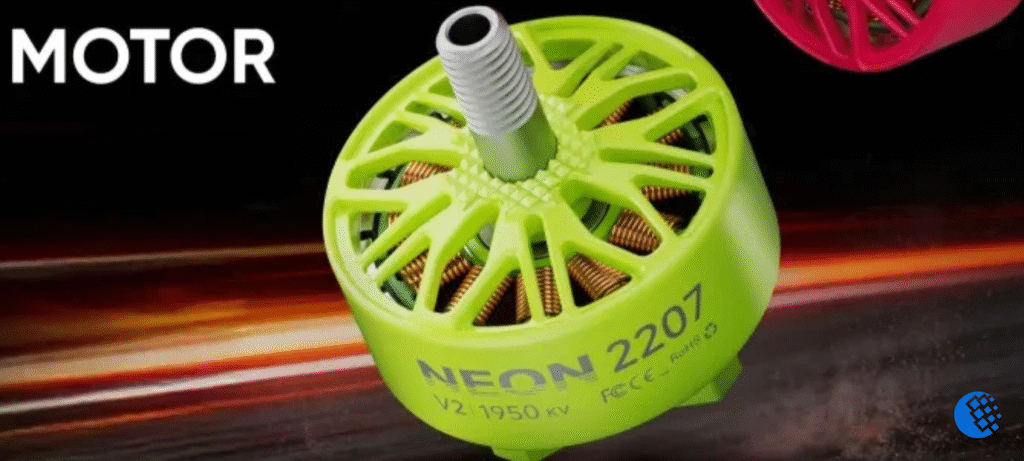
A drone motor plays a fundamental role in determining how a drone behaves in the air. From lift capability and flight efficiency to control precision and long-term reliability, motor characteristics directly influence overall performance. Whether used in FPV drones, aerial photography platforms, or DIY multirotor projects, motors must operate under demanding conditions while maintaining consistent output.
Rather than focusing on brand-specific recommendations, this article explores how drone motor work, the design factors that matter most, and how different motor choices affect real-world flying outcomes.
Understanding the Role of a Drone Motor in a Multirotor System
In a multirotor aircraft, each motor is responsible for generating thrust and responding instantly to flight controller commands. Unlike fixed-wing aircraft, where propulsion is mostly constant, multirotors rely on continuous motor speed adjustments to maintain stability and maneuverability.
Because of this, drone motors must balance several competing requirements:
- Fast throttle response
- Stable operation at varying RPM levels
- Efficient power usage
- Mechanical durability
A well-matched motor setup contributes not only to better flight performance, but also to smoother tuning and reduced stress on electronic components.
Brushed vs Brushless Motors: Why Design Matters
Most modern drones use brushless motors, especially for aerial platforms that require efficiency and precise control. Brushless designs eliminate physical brushes, reducing friction and heat while increasing efficiency and lifespan.
Brushed motors are still occasionally found in very small or toy-grade drones, but they are generally limited by:
- Shorter lifespan
- Lower efficiency
- Reduced power output
For performance-oriented or long-term drone use, brushless motors are widely regarded as the more practical option.
Core Parameters That Define a Drone Motor
Motor Size and Stator Geometry
Motor size is typically described by stator diameter and height (for example, 2207 or 2806). These dimensions influence torque generation and power delivery characteristics.
- Larger stators usually provide stronger torque
- Taller stators can support sustained power output
- Smaller motors prioritize weight savings and efficiency
There is no single “ideal” size; the correct choice depends on drone weight, propeller size, and intended use.
KV Rating and Its Practical Implications
KV represents the motor’s theoretical RPM per volt under no load. While higher KV motors tend to spin faster, this does not automatically translate into better performance.
In practice:
- Higher KV motors may suit lower-voltage systems or smaller propellers
- Lower KV motors often pair better with higher-voltage setups and larger props
The relationship between KV, voltage, and propeller load should always be considered together.
Motor Weight and Rotational Mass
Motor weight affects both flight efficiency and handling characteristics. Heavier motors may provide smoother rotational stability, while lighter motors often improve agility and responsiveness.
However, reducing weight too aggressively can sometimes compromise durability or heat dissipation. As with most drone components, balance is key.
How Drone Motors Interact with Propellers
A drone motor does not operate in isolation. Propeller choice dramatically influences how the motor behaves under load.
Factors such as:
- Propeller diameter
- Pitch
- Blade count
can change current draw, thrust output, and motor temperature. An efficient motor-propeller combination can improve flight time and reduce component wear, while a mismatched setup may lead to overheating or reduced reliability.
Drone Motor Efficiency and Thermal Management
Efficiency is often discussed in terms of flight time, but it also impacts long-term system health. Motors that operate efficiently tend to:
- Run at lower temperatures
- Reduce stress on ESCs and batteries
- Maintain more consistent performance across flights
Excessive heat is often a sign of imbalance, overloading, or improper component pairing rather than a defect in the motor itself.
Application-Specific Considerations for Drone Motors
Motors for FPV and High-Agility Drones
FPV drones place unique demands on motors due to rapid throttle changes and aggressive maneuvering. In these setups, responsiveness and torque delivery often take priority over maximum efficiency.
That said, motor preferences vary widely depending on flying style, propeller selection, and tuning approach.
Motors for Aerial Photography and Cinematic Drones
For camera platforms, smooth power delivery and vibration control are often more important than raw thrust. Motors used in these applications typically operate at lower RPM ranges and prioritize stability.
Motors for DIY and Experimental Builds
DIY drone builders often experiment with unconventional motor and propeller combinations. In these cases, understanding motor limits and monitoring temperature and current draw becomes especially important to avoid premature failure.
Durability, Bearings, and Long-Term Reliability
Motor longevity depends on several factors beyond basic specifications:
- Bearing quality
- Shaft material
- Manufacturing tolerances
- Environmental exposure (dust, moisture, impacts)
Regular inspection and maintenance, such as checking for bearing noise or shaft play, can help extend motor service life regardless of application.
Exploring Drone Motor Options and Configurations
For builders and pilots comparing different configurations, reviewing a categorized motor selection can be useful for understanding what specifications are commonly paired together. Dedicated component sections—such as this overview of drone motor options—can provide reference points for size, KV ranges, and intended use cases without requiring immediate purchasing decisions.
Using such resources as research tools rather than definitive recommendations allows for more informed decision-making.
Final Thoughts on Selecting a Drone Motor
Choosing a drone motor is not about finding a single “best” option. Instead, it involves evaluating trade-offs between efficiency, responsiveness, durability, and compatibility with the rest of the system.
Pilots and builders who take the time to understand motor fundamentals—and how those fundamentals translate into real-world behavior—are better equipped to build reliable, well-performing drones tailored to their specific needs.