
People hear the word sprain and usually shrug it off. No cast. No surgery, most of the time. Just rest it, right? That assumption sticks around longer than it should. I’ve seen sprains derail entire seasons, disrupt normal movement for months, and quietly turn into chronic joint problems because the initial injury wasn’t understood properly.
Grading sprains exists to give structure to something that’s actually quite messy. Ligaments don’t fail in neat stages—they stretch, fray, partially tear, or give way completely. The grading system tries to capture that, but it’s only a starting point, not a crystal ball.
What a Sprain Really Means Inside the Joint
A sprain isn’t just pain. It’s a mechanical problem. Ligaments act like anchors. They guide motion and stop joints from moving too far in directions they shouldn’t. When those anchors stretch or tear, movement changes, even if subtly.
That’s why two people with similar injuries can feel completely different. One feels sharp pain but keeps stability. Another feels loose, unstable, unsure, even if pain fades quickly. The grading system focuses on structural damage, not comfort.
Why Grading Sprains Matters More Than Most People Think
Doctors use grades to decide next steps. Physical therapists use them to pace rehab. Patients often use grades to judge seriousness. That’s where misunderstandings creep in.
A Grade I sprain can still disrupt daily movement. A Grade III sprain might stop hurting sooner than expected. Pain doesn’t equal severity—stability matters more.
Understanding grading sprains helps prevent two common mistakes: rushing back too soon because the pain seems manageable or freezing activity entirely out of fear, which leads to stiffness and weakness.
Grade I Sprains and the Misleading Comfort of “Mild”
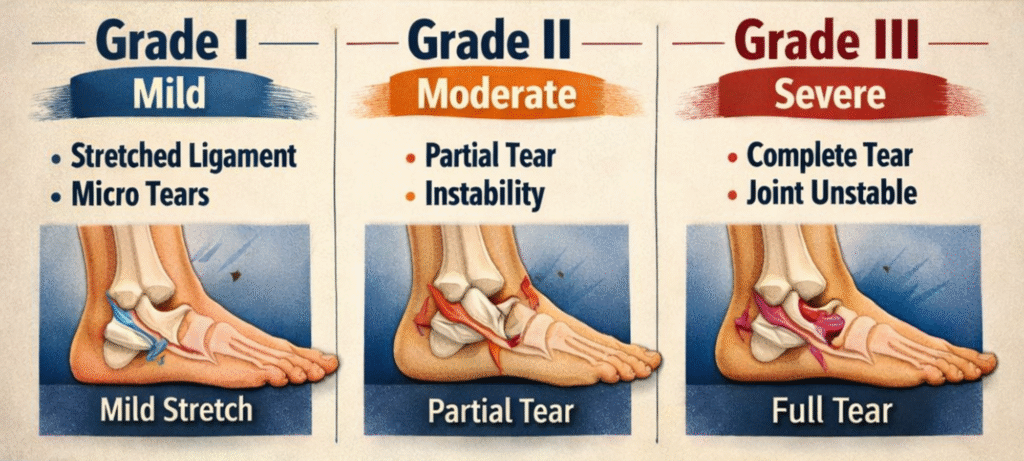
Grade I sprains involve stretching and tiny tears within the ligament. Structurally, the joint holds together. Functionally, things feel off.
Swelling is usually limited. Pain appears with movement rather than at rest. Many people continue activity, assuming it will settle on its own. Sometimes it does, other times it doesn’t.
Rest, ice, compression, and elevation (RICE) usually suffice early on. Gentle movement follows quickly. Healing often takes around two to three weeks, though stiffness can linger if movement is avoided.
Grade II Sprains and the Uncomfortable Middle Ground
Grade II sprains involve partial tearing. Here, uncertainty shows up. The joint isn’t fully unstable, but it doesn’t feel trustworthy either.
Swelling increases. Bruising appears. Weight-bearing feels cautious. People often ask whether it’s serious. The answer is somewhere in between.
Bracing or temporary immobilization is common. Rehab focuses on restoring strength and control, not just reducing pain. Recovery often spans four to six weeks, though setbacks are common when rehab is rushed or skipped.
Grade III Sprains and Complete Ligament Failure
Grade III sprains involve a full tear. The ligament no longer stabilizes the joint. Movement becomes unpredictable.
Swelling is significant early on. Weight-bearing may be impossible initially. Pain sometimes decreases faster than expected, which can confuse people into underestimating the injury.
Some Grade III sprains heal without surgery. Others don’t. The joint involved, activity level, and associated injuries all matter. Recovery commonly stretches beyond three months.
How Sprains Are Actually Diagnosed
Diagnosis starts with a hands-on examination. Providers assess tenderness, swelling, range of motion, and joint stability. Specific stress tests reveal which ligament is compromised.
Imaging supports, but doesn’t replace, clinical judgment. X-rays rule out fractures. MRIs clarify ligament damage when instability persists.
This kind of evaluation isn’t unlike structured academic review, where evidence carries more weight than surface impressions, similar to how educators evaluate homework and practice answers rather than guessing understanding.
Treatment Approaches and Why Recovery Timelines Shift
RICE still plays a role early, though prolonged rest is no longer encouraged. Controlled movement helps ligaments heal with better alignment.
Physical therapy restores strength, coordination, and balance. This phase matters more than most people realize. Skipping balance training increases reinjury risk significantly.
Return-to-activity decisions should be based on function, not calendar dates. This mirrors structured systems explained in the AP English Literature and Composition syllabus, where progression depends on demonstrated capability, not time spent.
Common Myths About Grading Sprains
One myth is that Grade I injuries don’t need care. Another is that Grade III injuries always require surgery. Neither is consistently true.
Comparing pain between people is another misconception. Pain tolerance varies. Ligament damage doesn’t announce itself the same way every time.
Understanding these limits prevents frustration and unrealistic expectations.
Medical Consensus on Sprain Severity
Clinical guidance consistently emphasizes severity-based classification. According to the Cleveland Clinic overview of sprains, stability and function guide treatment more than labels. Orthopedic resources from OrthoInfo by the AAOS reinforce that untreated sprains increase long-term joint risk.
Frequently Asked Questions
What does grading sprains mean?
It refers to classifying ligament injuries based on the extent of stretching or tearing.
Is a Grade II sprain serious?
It’s moderate but significant, often requiring structured rehab.
Do all Grade III sprains need surgery?
No. Many heal with immobilization and therapy.
Why does pain sometimes decrease before healing?
Nerve response changes faster than ligament repair.
Can sprains cause long-term problems?
Yes, especially if stability and strength aren’t restored.
Final Thought
Sprain grades provide guidance, not guarantees. Bodies heal unevenly. Ligaments respond to movement, load, and patience in ways that don’t always follow charts. Understanding the grade helps, but paying attention to how the joint behaves day to day matters just as much.