
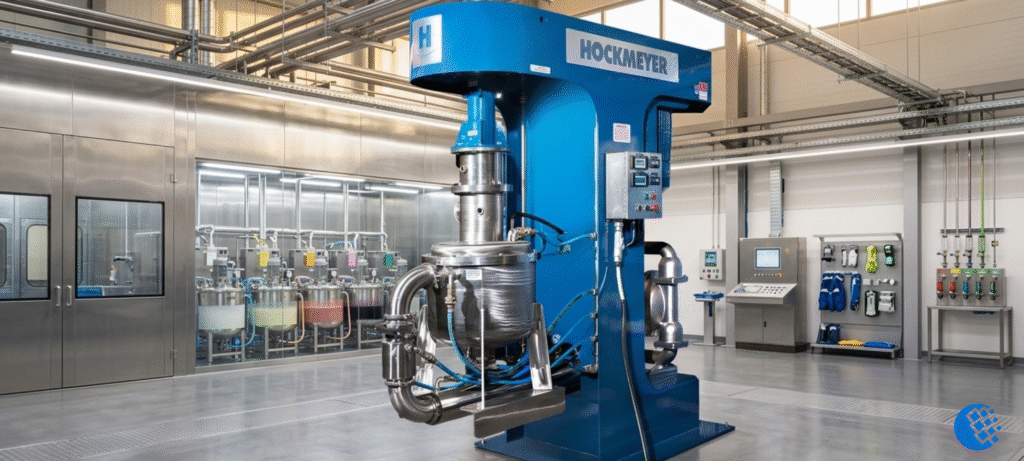
In modern material processing, achieving precise particle size and uniform dispersion is critical across industries ranging from coatings to advanced materials. Among the technologies designed to meet this need, immersion mills stand out for their efficiency and ability to handle demanding formulations. Understanding how immersion mills work reveals the sophisticated balance of fluid dynamics, mechanical energy, and material science that drives wet grinding and particle size reduction.
The Core Concept of Immersion Milling
At its foundation, immersion milling is a wet grinding process where a milling device is directly submerged into a batch of material. Unlike traditional milling systems that rely on external circulation loops, immersion mills operate within the same tank that holds the product. This setup allows for continuous processing while maintaining close control over dispersion quality.
The system typically includes a rotating shaft fitted with an agitator and a specialized milling chamber containing grinding media. As the shaft rotates, it generates intense mechanical forces that break down particles and distribute them evenly throughout the liquid medium.
Recirculation Principles: Continuous Flow Within a Single Vessel
One of the defining features of immersion milling is its internal recirculation mechanism. Instead of pumping material through external equipment, the mill creates a dynamic flow pattern inside the vessel.
As the agitator spins, it draws material into the milling chamber where particle size reduction occurs. The processed material is then expelled back into the tank, where it mixes with unprocessed material. This continuous loop ensures that all particles are repeatedly exposed to the grinding zone.
This internal recirculation offers several advantages:
- Reduced material loss
- Simplified system design
- Consistent exposure to shear forces
- Improved energy efficiency
Shear Zone Dynamics: Where Size Reduction Happens
The heart of immersion milling lies in the shear zone—the region inside the milling chamber where the most intense forces are generated.
Within this zone, grinding media (small beads made of ceramic, glass, or steel) collide with particles at high speed. These collisions create multiple forces:
- Impact forces break larger particles into smaller fragments
- Shear forces refine particle size further
- Attrition smooths and stabilizes particle surfaces
The effectiveness of the shear zone depends on several variables, including rotational speed, media density, and chamber design. Properly optimized, this zone can achieve extremely fine particle sizes, even reaching nanoscale dispersions in specialized applications.
Media Selection: Matching Materials to Performance
Grinding media plays a crucial role in determining the outcome of the milling process. Selecting the right type of media involves balancing several factors:
- Size: Smaller beads create finer grinding but may require higher energy input
- Density: Denser media increases impact force but can generate more heat
- Material composition: Ceramic media is often preferred for contamination-sensitive applications
The interaction between media and material directly affects particle size distribution, processing time, and overall efficiency. For high-viscosity formulations, larger or denser media may be necessary to maintain effective movement inside the milling chamber.
Particle Distribution: Achieving Uniform Results
A key goal of immersion milling is not just reducing particle size, but achieving a narrow and uniform particle size distribution. This is essential for product stability, appearance, and performance.
Because immersion mills continuously recirculate material through the shear zone, they minimize the risk of over-processing or under-processing certain particles. The result is a more consistent dispersion compared to batch-only or single-pass systems.
Uniform particle distribution also enhances:
- Color consistency in coatings
- stability in emulsions and suspensions
- performance in advanced material applications
Adaptability to Complex Formulations
Immersion mills are particularly effective when working with challenging materials, including high-viscosity mixtures and formulations requiring ultra-fine grinding. Their ability to operate directly in the processing vessel allows for better temperature control and reduced exposure to contamination.
When discussing the evolution of this technology, companies like Hockmeyer have developed patented immersion mill designs tailored for demanding applications, including high-viscosity systems and nanoparticle production. These innovations reflect ongoing advancements in milling efficiency and precision without altering the core principles of immersion processing.
Why Immersion Mills Matter Today
As industries demand tighter tolerances and higher-quality dispersions, immersion milling continues to play a vital role in wet grinding technology. Its combination of internal recirculation, controlled shear forces, and flexible media selection makes it a powerful solution for achieving consistent particle size reduction.
For those exploring the technical aspects or product configurations of immersion mills, additional details can be found here: immersion mills.
Final Thoughts
Immersion mills represent a sophisticated approach to particle size reduction, combining mechanical engineering with fluid dynamics to deliver reliable results. By understanding the principles behind recirculation, shear zones, media selection, and particle distribution, it becomes clear why this technology remains essential in modern material processing.
Rather than relying on complex external systems, immersion milling achieves precision through simplicity—bringing the process directly into the material itself.