
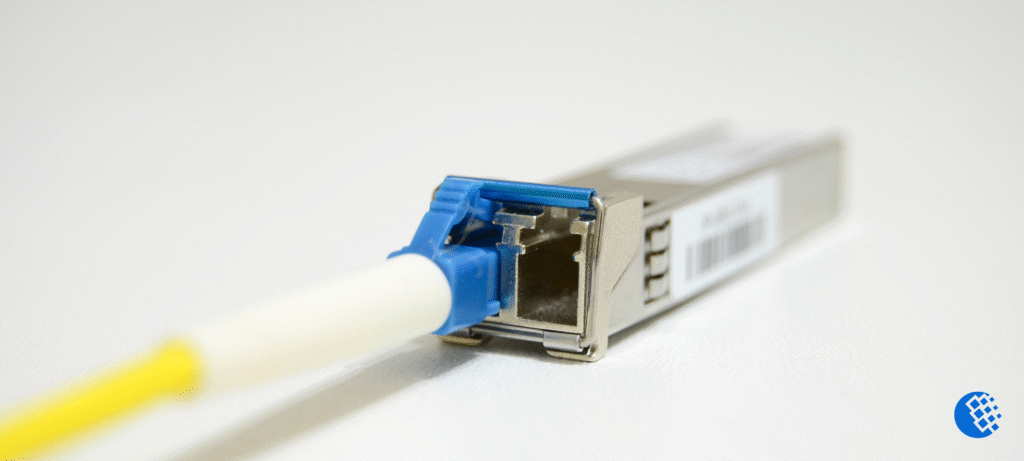
In many enterprise data centers, network upgrades rarely happen all at once. New switches are introduced to support higher bandwidth, while a large number of existing servers continue to operate on 10G interfaces. Budget constraints, application dependencies, and hardware refresh cycles all contribute to this mixed-speed environment. As a result, network teams are often tasked with connecting legacy 10G servers to modern 25G-capable switches without disrupting operations or driving up costs.
What Makes Dual-Rate SR Modules Different
Unlike fixed-rate optics, 10G/25G SR modules are designed to operate at either 10Gbps or 25Gbps, depending on the port configuration of the connected device. The same module can support older 10G server NICs today and seamlessly transition to 25G when those servers are upgraded in the future.
This flexibility allows enterprises to standardize on a single optical module type while supporting multiple generations of equipment. Instead of maintaining separate inventories for 10G and 25G optics, IT teams can simplify procurement and reduce operational complexity.
Supporting Legacy Servers Without Holding Back the Network
One of the biggest challenges during network modernization is ensuring that legacy servers do not become a bottleneck. With 25G dual-rate SR modules, new 25G switches can be deployed at the access layer while continuing to support 10G servers. The switch ports can be configured to operate at 10G, allowing smooth interoperability without requiring immediate server upgrades.
At the same time, the underlying switching infrastructure is already prepared for higher speeds. When servers are eventually replaced with 25G-capable hardware, the same optical modules and fiber cabling can be reused, minimizing downtime and additional investment.
Leveraging Existing Multimode Fiber Infrastructure
Another advantage of 10G/25G SR modules is their compatibility with existing multimode fiber, such as OM3 and OM4. Most enterprise data centers already rely on this fiber type for short-reach connections. Dual-rate SR modules support standard distances on these fibers, making it possible to upgrade switching hardware without touching the physical cabling.
This approach significantly reduces upgrade costs and avoids the risks associated with large-scale recabling projects. For enterprises operating in live production environments, this is often a critical consideration.
Reducing Upgrade Risk and Operational Complexity
Network upgrades always involve some level of risk. Dual-rate SR modules help reduce that risk by enabling gradual, controlled transitions. Enterprises can deploy next-generation switches rack by rack, or even port by port, while maintaining full compatibility with existing servers.
From an operational perspective, using the same module type across different speeds simplifies troubleshooting, sparing, and documentation. Network engineers spend less time managing hardware variations and more time focusing on performance and reliability.
Conclusion
10G/25G SR dual-rate modules are not just a transitional convenience; they are a practical tool for real-world enterprise networks. They recognize the reality that legacy and next-generation systems must coexist for years, not months. By enabling seamless connectivity between old servers and new switches, these modules provide a cost-effective, low-risk path toward higher bandwidth. For enterprises looking to modernize their networks without unnecessary disruption, dual-rate SR optics offer a balanced and future-ready solution.