
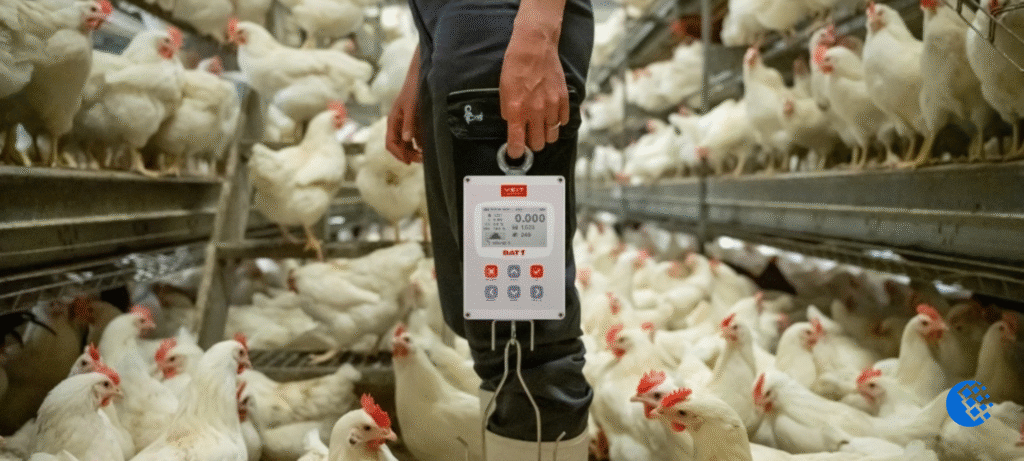
You’ve heard that weighing matters. But what exactly do modern digital poultry weighing scales measure – and how does that data help your farm? Let’s look under the hood at how these systems work and what they can report.
More Than Just Numbers on a Screen
Traditional poultry scales give you one thing: a weight reading. You write it down, maybe enter it into a spreadsheet, and move on.
Modern digital systems are different. They don’t just measure – they collect, store, analyze, and report. The scale becomes a monitoring tool that works around the clock.
For anyone in small scale poultry farming, this shift changes everything. You get insights that were once available only to large industrial operations.
How Digital Poultry Weighing Scales Work
The basic principle is simple. A platform scale sits inside the poultry house. Birds step onto it voluntarily throughout the day.
But what happens next is where the technology shines:
Continuous sampling – The system captures weights whenever birds use the platform. That might be dozens or hundreds of measurements daily.
Automatic filtering – Algorithms distinguish between valid readings and noise. Partial weights, multiple birds, or disturbances get filtered out.
Data logging – Every valid measurement is stored with a timestamp. You build a complete weight history over days, weeks, and entire production cycles.
Real-time calculation – The system calculates averages, trends, and distributions automatically. No manual math required.
This combination of hardware and software turns a simple scale into a powerful monitoring system.
What Reports Can You Get?
Here’s where data logging proves its value. Modern digital poultry weighing scales can generate reports on:
Average flock weight
The most basic metric. But unlike manual spot-checks, automated systems calculate true averages from large sample sizes. The number actually represents your flock.
Daily weight gain
How much are birds gaining each day? This trend line shows whether growth is on track or slowing down. A sudden drop signals problems before they become visible.
Weight distribution
Not all birds weigh the same. Distribution reports show uniformity – the spread between lightest and heaviest birds. High uniformity means efficient processing. Low uniformity means some birds are underperforming.
Growth curves
Compare your flock’s growth against breed standards or your own historical data. See exactly when performance diverges from expectations.
Feed conversion estimates
When integrated with feed data, the system can estimate FCR in real time. You’ll know if feed efficiency is improving or declining.
Projected harvest weight
Based on current growth rates, when will birds hit target weight? Accurate projections help schedule processing and logistics.
Alerts and exceptions
Set thresholds and receive notifications when something goes wrong. Weight drop below expected? Growth rate declining? The system tells you immediately.
Why Data Logging Changes the Game
Without data logging, you’re working from memory and scattered notes. With it, you have a complete record of flock performance.
This matters for several reasons:
Cycle comparison – How does this flock compare to the last one? Or the one from the same season last year? Historical data reveals patterns.
Problem diagnosis – When did performance start declining? Logged data lets you pinpoint timing and correlate with other events – feed changes, weather, disease outbreaks.
Continuous improvement – You can’t improve what you don’t measure. Detailed records show whether management changes are working.
Documentation – Buyers, certifiers, and regulators increasingly want data. Automated logs provide it without extra work.
For small scale poultry farming operations, this level of insight used to require expensive consultants or enterprise software. Now it comes built into the scale.
Practical Benefits for Smaller Farms
You might wonder if all this data is overkill for a smaller operation. It’s not.
Poultry scales with reporting features help small farms:
- Catch problems earlier, when they’re easier to fix
- Optimize feed costs with accurate conversion data
- Time processing better for maximum value
- Build credibility with data-backed performance records
- Compete with larger operations on efficiency
The investment pays back through better decisions – not just better data.
Tip: Start by focusing on two or three key reports: average weight, daily gain, and uniformity. Master those before diving into advanced analytics.
What to Look for in a Reporting System
Not all digital poultry weighing scales offer the same reporting capabilities. When evaluating options, consider:
- Data export options – Can you download data as CSV or connect to farm management software?
- Visualization – Are reports presented as clear charts and graphs, or just raw numbers?
- Remote access – Can you check reports from your phone or computer?
- Alert customization – Can you set your own thresholds for notifications?
- Historical storage – How far back does the system keep data?
The best systems make data accessible and actionable – not just available.
Conclusion
Modern poultry scales do far more than weigh birds. With built-in data logging and reporting, they become management tools that track performance, spot problems, and guide decisions.
Digital poultry weighing scales bring enterprise-level insights to farms of any size. For anyone serious about efficiency in small scale poultry farming, that’s a capability worth having.
The question isn’t whether you can afford smart weighing technology. It’s whether you can afford to manage without it.
Photo source: https://poultryscales.com/