DTF printing is becoming popular in the custom apparel and merchandise printing. It also provides quality prints in diverse fabrics without the restriction of conventional processes. However, to begin with DTF printing, one is not only going to need a printer. You must have the correct equipment, materials, and method to get professional results.
Direct-to-Film (DTF) printing is a new technology to create vivid designs on any fabric. In contrast to conventional printing, it can be used to print high-resolution prints on different materials.
It is necessary to evaluate available DTF printers for sale before investing. To ensure they match your quality requirements and production volume.
DTF printing is changing the customization of the garment decoration. Knowing the basics would save time and waste. Every component, from printers to powders and heat presses, plays its role.
DTF Printer as the core of the Process
· The backbone of custom apparel is a DTF printer. Not all printers work for DTF. These printers use special inks and heat transfer films. This printer provides quality prints speedily with color accuracy.
· Small production is best suited to desktop models. These models are small and economical.
· Resolution matters a lot. With larger DPI, images are sharper, particularly when dealing with detailed designs.
· Industrial printers are more appropriate for the higher volumes. They have bigger print beds and higher throughput.
Choosing the Right DTF Film
· The material by which your design goes out of the printer onto fabric is called DTF transfer film.
· Flat, dry, and dust-free films will prevent flaws in your prints.
· Films have to fit in the ink of your printer. Clear films can be used on both light and dark garments for brighter prints.
· Not all films are equal. Good films provide excellent ink adhesion.
The Role of Inks
· The printing on coloured fabrics requires white ink.
· High-quality inks enhance print stability and resistance to washing.
· DTF heat transfer inks are designed for heat transfer. Standard inks will not work.
· Color inks should match your printer. It prevents clogging and irregular results.
· To prevent blockages and color variation, shake white inks prior to use.
Maintenance and Quality Control
· Maintenance saves time and maintains the quality of print.
· Regular maintenance ensures your setup is working properly.
· Print heads are to be cleaned on a regular basis.
· There should be a check on the rollers and filters.
Use of Adhesive Powder to Make Prints Stick
· Fine and uniform powder is used to achieve easy adhesion. Good quality powder makes the designs free of patches.
· For smaller operations, manual powder application is suitable.
· The ink is attached to the fabric with the help of adhesive powder in the heat transfer.
· It is sprayed onto the wet print and then left to dry.
· Other systems come with automatic powder applicators, which enhance efficiency and uniformity.
Heat Press for Transfer
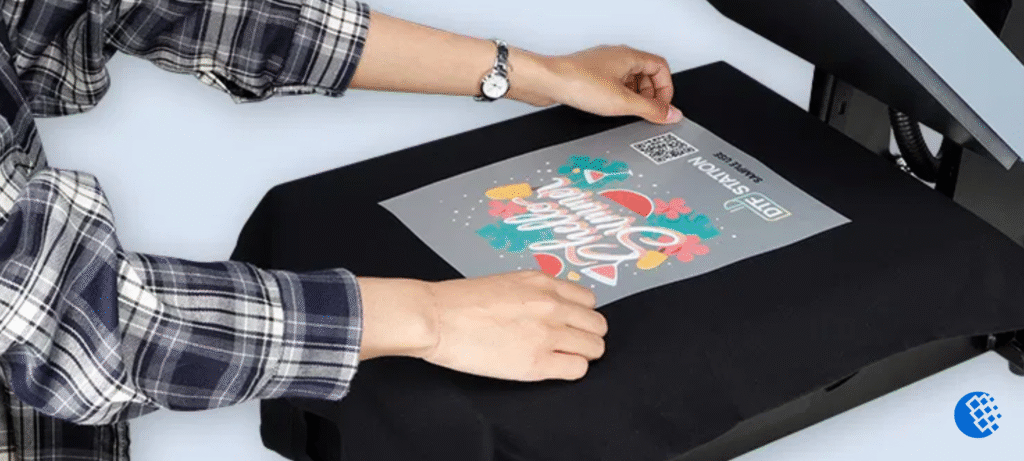
· To apply the design on a piece of fabric, a heat press is needed.
· Digital heat presses provide more precise control.
· Pressing can be followed by one more short press using parchment paper. It allows the design to pass through several washes.
· It is important to have proper temperature, pressure, and time settings for long-lasting results.
· Ordinary irons are not advisable as they cannot be used to give even pressure and heat.
Software and Design Management
· Designing with software is not a mere convenience. It makes the artwork print correctly.
· Learning how to use software is a component of creating regular, professional prints.
· In the majority of DTF printers, RIP software regulates the position of ink, white ink layers, and color profiles.
· Crisp, scalable graphics can be produced with software like Adobe Illustrator or CorelDRAW, which is used to create vectors.
· Proper color management minimizes the wastage of material and designs.
Reliable Supply Sources
· It is important to source quality materials. For stable results, films, powders, and inks are supposed to be supplied by reliable suppliers. Even a good printer system can be spoiled by poor-quality supplies.
· Some websites, such as dtflinko.com, offer good material, tutorials, and support. Collaboration with trusted suppliers will contribute to a reduced cost of operations.
Conclusion
DTF printing can be used on a variety of fabrics to produce long-lasting, vibrant designs with the proper configuration. DTF printing integrates creativity and precision. With quality at each stage, you will be able to provide the prints of the most professional quality and meet the expectations of clients.
It is better to compare the specifications with the support services of DTF printers available in the market. So that you make a satisfactory purchase and meet the requirements of the production process.
The right printer, films, inks, adhesive powders, and heat press are needed to get professional prints. Knowledge of software and pre- and post-printing steps is important too. Knowledge of every part will help ensure an efficient and profitable process. Durability and color accuracy are guaranteed by regular maintenance and suppliers.