

We have all been there—you get an email notification that your laboratory results are ready, you log in with a bit of a racing heart, and suddenly you are staring at a screen that looks more like a complicated math test than a health report. Right there near the top, usually nestled between your red blood cell count and your hemoglobin, is a three-letter acronym: MCV.
If you are looking at that number and wondering if you should start worrying, just take a second to breathe. Mean Corpuscular Volume (MCV) is actually one of the most practical and “human” parts of your report. It isn’t some abstract, high-level theory; it is a literal measurement of the average size of your red blood cells.
Why does the physical size of a microscopic cell even matter in the grand scheme of things? Because in your body, size determines everything. It dictates how efficiently your system can move oxygen from your lungs to your brain, your heart, and every single muscle that keeps you moving.
Table of Contents
- The “Delivery Truck” Analogy: How Your Blood Works
- Reading the Results: What is Actually Considered “Normal”?
- The Lowdown on Low MCV (The Tiny Cell Problem)
- When the Number is High (The Oversized Load Issue)
- How You Actually Feel: Symptoms You Can’t Ignore
- Fixing the Factory: Taking Your Next Steps
- The Big Picture of Your Long-Term Blood Health
- Frequently Asked Questions (FAQs)
The “Delivery Truck” Analogy: How Your Blood Works
Think of your body as a massive, bustling city that literally never sleeps. Every organ—from your heart to your liver—needs a constant, 24/7 supply of oxygen “fuel” just to keep the lights on and the engines running. Your red blood cells are the delivery trucks making those rounds.
When your “factory” (the bone marrow) is running at peak performance, it pumps out trucks that are exactly the right size for the highway. They are nimble enough to zip through the tiny “back alleys” of your smallest blood vessels but large enough to carry a full load of oxygen to the destination.
When your doctor looks at your MCV, they are essentially inspecting your delivery fleet. They want to see if the trucks are coming out too small (meaning they can’t carry enough fuel) or way too bulky for the road (meaning they are clunky and prone to getting stuck).
Much like how you might plan your week by asking How Long Does an Eye Exam Take? to stay on top of your wellness, keeping tabs on your MCV is simply about being the proactive manager of your own biological logistics.
Reading the Results: What is Actually Considered “Normal”?
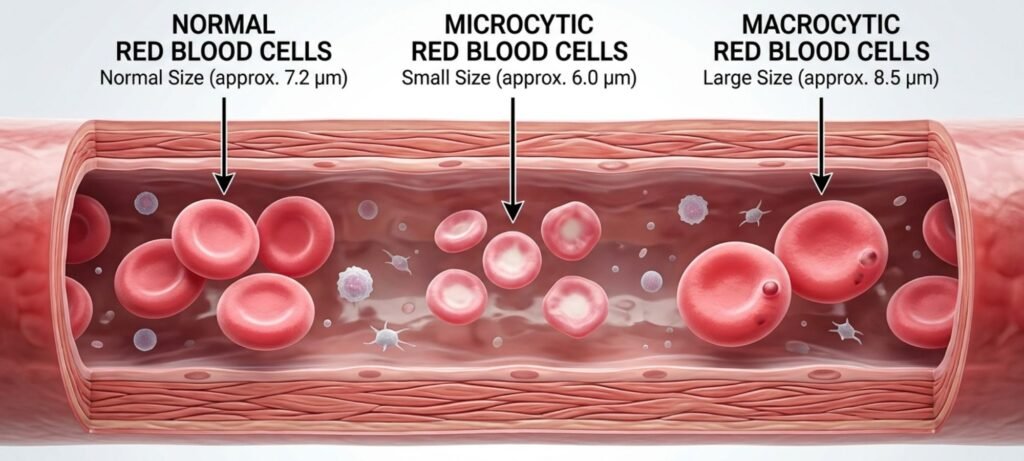
On your lab report, the MCV is measured in femtoliters (fL). For most adults, the “Goldilocks Zone” is generally between 80 and 100 fL.
- The Sweet Spot (80–100 fL): Your cells are the right size. Even if you feel a bit tired, a normal MCV helps your doctor rule out major, long-term nutritional deficiencies as the primary cause.
- The Low Range (Below 80 fL): Your cells are coming out too small. This is technically known as microcytosis. It usually means the factory is trying to build “compact” cells because it’s missing key parts.
- The High Range (Above 100 fL): Your cells are oversized and fragile. This is known as macrocytosis. These cells often don’t live as long and aren’t nearly as efficient at their jobs.
The Lowdown on Low MCV (The Tiny Cell Problem)
If your MCV number is dragging below that 80 mark, it is almost always because your body is trying to build blood cells without enough iron. Iron is basically the “steel” used to build hemoglobin, the protein that actually holds the oxygen.
If the factory runs out of steel, it doesn’t just shut down; it starts making tiny, compact “economy” cells just to keep the production line moving. This is the classic sign of Iron Deficiency Anemia. It’s your body’s way of stretching limited resources to stay alive.
In some cases, a low number is just a genetic trait, like Thalassemia. If you have this, your body is simply wired to produce smaller hemoglobin units. It isn’t necessarily a “sickness” in the traditional sense, but it is something your doctor needs to know so they don’t accidentally treat you for an iron problem you don’t actually have.
When the Number is High (The Oversized Load Issue)
A high MCV usually means your cells aren’t dividing the way they should while they are being manufactured. This is a massive red flag for a shortage of Vitamin B12 or Folate (B9).
These vitamins act as the “instruction manual” for cell division. Without them, the cells just keep growing and growing in the marrow, becoming awkward and huge because they never got the signal to split into the correct shape. It’s like a truck that was never finished and was sent out onto the road half-built.
However, vitamins aren’t the only culprits. Other factors that can push your MCV into the “High” range include:
- Liver Stress: Chronic liver issues can change the fat content of cell walls, making them look bloated and oversized.
- Lifestyle Factors: Heavy alcohol use has a direct toxic effect on the bone marrow, often causing cells to balloon before they are even released into the bloodstream.
For many, addressing these numbers is the first step toward a total health reset. Whether it is a dietary shift or Navigating Addiction Treatment, these blood results give you a very clear map to start your recovery.
How You Actually Feel: Symptoms You Can’t Ignore
You won’t physically “feel” your cells changing size in real-time, but you will definitely feel the drop in oxygen efficiency. It is like trying to run a high-performance car on the lowest-grade fuel possible. It usually manifests as:
- Exhaustion: Feeling completely worn out even after you’ve slept for eight or nine hours.
- Brain Fog: That heavy, “stuck in a cloud” feeling where it’s hard to focus on a single task.
- Shortness of Breath: Getting winded by a flight of stairs that you used to run up without thinking.
- Brittle Features: Pale skin, brittle nails, or even a strangely sore, smooth tongue.
Fixing the Factory: Taking Your Next Steps
The incredible thing about your blood is that it is constantly renewing itself. Your body replaces its entire supply of red blood cells roughly every 120 days. This means an abnormal MCV isn’t a permanent sentence; it is a temporary production glitch that you can fix.
Once the underlying issue—whether it is iron, B12, or a lifestyle change—is addressed, the bone marrow begins pumping out perfectly sized cells again. Most people start feeling the energy return long before the full 120-day cycle is even finished, as the new, healthy “trucks” begin to outnumber the old, struggling ones.
The Big Picture of Your Long-Term Blood Health
Understanding “what is mcv in blood test” allows you to have a real, informed conversation with your healthcare provider. Instead of just hearing “you’re anemic,” you can ask the right questions: “is it microcytic or macrocytic?” This simple distinction helps you understand if you need more iron-rich foods like spinach or more B12-rich foods like eggs and dairy.
By catching these small shifts early through routine check-ups, you are giving your body the support it needs to keep moving and thriving for the long haul.
Frequently Asked Questions (FAQs)
Can hydration change my MCV number?
Not really. Dehydration can make your total blood count look more “concentrated,” but it doesn’t typically change the actual physical size of the individual red blood cells.
Is high MCV always a bad thing?
It is a “check engine” light. It might be as simple as needing more leafy greens or a B12 supplement, but it is definitely something your doctor will want to monitor to ensure your liver and marrow are healthy.
How long does it take to see results?
Since it takes time for your body to manufacture a fresh batch of cells, you usually won’t see a significant change in your MCV for at least 3 to 4 months after you start your treatment or dietary changes.
Final Thought: Your Body, Your Data
At the end of the day, your lab report isn’t a grade on a test; it is a map of your internal environment. Your MCV is just one little coordinate on that map, but it tells a huge story about how your body is fueling itself. By paying attention to these shifts now, you are making sure your delivery fleet is ready for the long road ahead.