

In the current professional climate, the traditional office is no longer a physical destination—it’s a digital state of mind. If you walk into a high-growth startup or a Fortune 500 firm today, you won’t see people hovering over paper blueprints or passing around USB sticks. Instead, you’ll see teams synchronized through online collaborative productivity software.
But why has this become the absolute standard? It’s not just a trend. According to data from industry leaders like Folio3, companies using these platforms see a massive 20–25% boost in overall productivity. This isn’t just about “chatting” online; it’s about centralizing the entire brainpower of a company into a single, searchable, and accessible cloud ecosystem.
Table of Contents
- The Death of the Information Silo
- Real-Time Synergy vs. Static Emails
- The Global Talent Strategy: Hybrid Flexibility
- Transparency, Accountability, and the “Audit Trail”
- Financial Logic: Slashing IT Overheads
- Workflow Comparison: Traditional vs. Modern Digital
- Strategic Infrastructure: Education and Smart Living
- Frequently Asked Questions (FAQs)
- Final Thought: The Agile Advantage
The Death of the Information Silo
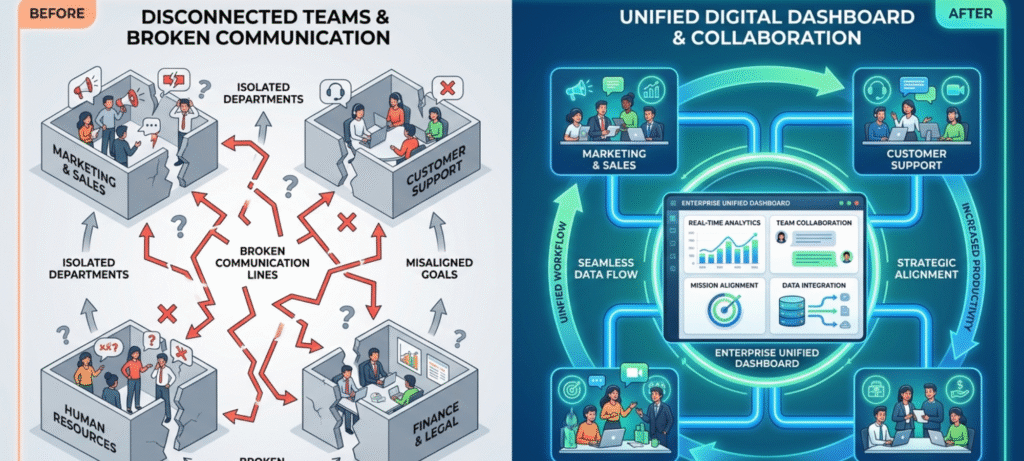
The biggest enemy of any growing business is the “silo.” This happens when the marketing team doesn’t know what the sales team is doing, or when a designer is working off an outdated version of a project brief. This fragmentation is a silent profit killer.
Companies use online collaborative productivity software to create a “Single Source of Truth.” When every file, conversation, and deadline is hosted in one place, the confusion disappears. Whether you are using Slack, Microsoft 365, or specialized project boards, the goal is total visibility. This concept of centralized data management is so effective that it has migrated into other sectors. For example, the use of Managed IT Services for Education has revolutionized how schools manage student data and teacher collaboration, proving that these “business” tools are actually universal “efficiency” tools.
Real-Time Synergy vs. Static Emails
Let’s be honest: email is where good ideas go to die. We’ve all been there—stuck in a 50-reply thread, trying to find that one attachment from three weeks ago. It’s exhausting and inefficient.
Collaborative software flips this script by offering:
- Live Co-Authoring: You can watch your colleague’s cursor move in real-time as you both edit a proposal. No more “Version 1,” “Version 2,” or “FINAL_FINAL” filenames.
- Instant Context: Instead of a long email, you can leave a comment directly on a specific line of code or a paragraph of text.
- Streamlined Communication: Channels and “Threads” keep conversations organized by topic, making it easy for new team members to catch up on a project’s history in minutes rather than hours.
The Global Talent Strategy: Hybrid Flexibility
We are living in an era where the best person for a job might live 5,000 miles away. In 2026, companies use collaborative software to dismantle geographic barriers. If you have the right digital infrastructure, a developer in Berlin can work seamlessly with a project manager in Orange County.
These tools allow teams to function as if they were sitting at the same desk. This flexibility is a major draw for modern employees. In fact, it is changing the way people buy homes. At HomeRocketRealty, we’ve seen a significant rise in buyers seeking properties with dedicated high-tech home offices. This is explored further in our guide on Modern Technology at HomeRocketRealty, which highlights how the right residential tech supports the software needed for a global career.
Transparency, Accountability, and the “Audit Trail”
Management is much easier when you don’t have to micromanage. Collaborative platforms provide an objective “Status Board” for every project.
- Clear Ownership: Every task has a name and a deadline attached to it. There is no ambiguity about who is responsible for what.
- Visible Progress: Automated dashboards show exactly how much of a project is finished.
- The Paper Trail: Every decision made is archived. If a project hits a snag, you can look back through the history to see where the logic shifted.
This creates a culture of “Radical Transparency.” When everyone knows that their contributions (or lack thereof) are visible to the team, accountability naturally increases.
Financial Logic: Slashing IT Overheads
From a CFO’s perspective, moving to collaborative software is a brilliant financial move. Maintaining physical servers, paying for individual software licenses, and hiring a massive in-house IT team to “fix the printer” is incredibly expensive.
By using a “Software as a Service” (SaaS) model, companies trade high capital expenditures for a predictable, scalable monthly subscription. This allows even small businesses to access the same high-level tools as a multi-billion dollar corporation. According to The World Bank, digital adoption is one of the fastest ways for businesses in emerging markets to scale. Furthermore, UNESCO highlights that these digital frameworks are essential for ensuring that educational and professional opportunities remain open to everyone, regardless of their local physical infrastructure.
Workflow Comparison: Traditional vs. Modern Digital
| Feature | The Old School Way | The Collaborative Software Way |
| Messaging | Slow, messy email chains. | Real-time, threaded chat. |
| Editing | Sending files back and forth. | Simultaneous, live co-editing. |
| Deadlines | Handwritten notes / Calendars. | Automated alerts & Kanban boards. |
| Access | Office-only (Server-bound). | Cloud-based (Work from anywhere). |
| Security | Vulnerable local hard drives. | Enterprise-grade cloud encryption. |
| Meetings | Mandatory in-person gatherings. | Instant video calls and screen sharing. |
Frequently Asked Questions (FAQs)
Will this software make my team feel “monitored”?
Not if it’s used correctly. The goal isn’t “surveillance”—it’s “support.” When tasks are clear, employees actually feel more autonomous because they don’t have to keep checking in with their boss to see what to do next.
Is it hard to switch from a traditional setup to a digital one?
There is a learning curve, usually about 2–4 weeks. However, the “lost time” during training is quickly made up for by the massive increase in speed once the team is comfortable with the tools.
What is the best software for a small business?
Most small businesses start with Google Workspace or Microsoft 365. They provide the “basics” (email, docs, sheets) while allowing for easy integration with more advanced tools like Slack or Trello later on.
Does it help with client relationships?
Absolutely. Many companies invite their clients into specific “guest channels” or project boards. This gives the client a front-row seat to the progress, building massive trust through transparency.
Final Thought: The Agile Advantage
Ultimately, companies use online collaborative productivity software because it makes them “Agile.” In 2026, the market moves too fast for slow communication. Businesses that can pivot instantly, hire globally, and document their processes digitally are the ones that survive. By removing the physical and technical friction of “doing work,” these tools allow teams to focus on what actually matters: innovation and results.