
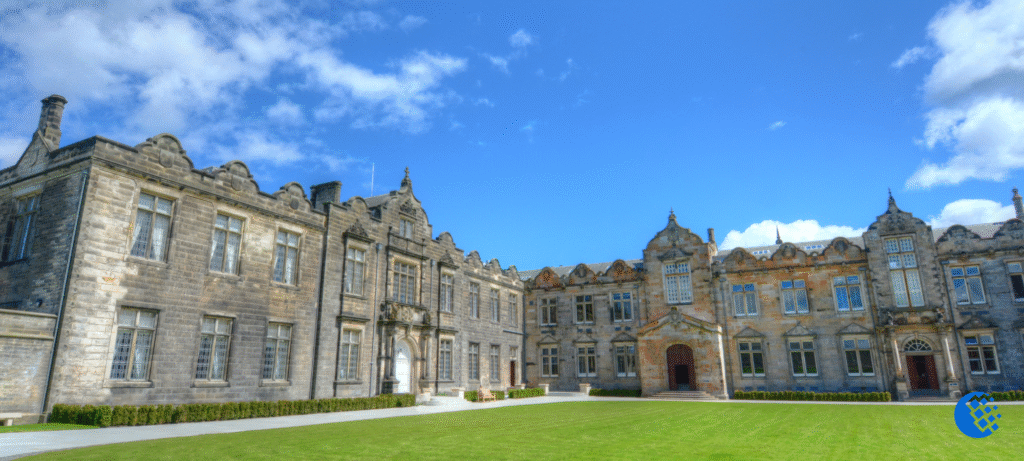
St Andrews is one of those universities that makes people go “wow” when you mention it. It’s the third oldest university in the English-speaking world, Prince William went there, and it’s got this reputation for being super selective. But what’s the actual acceptance rate and what does that mean for your chances of getting in?
The University of St Andrews acceptance rate sits around 8-10% overall, making it one of the most selective universities in the UK. But that number doesn’t tell the whole story because acceptance rates vary wildly depending on what program you’re applying to and where you’re applying from.
Breaking Down the Numbers
St Andrews receives roughly 20,000 applications each year for about 1,800-2,000 undergraduate spots. That’s where you get that 8-10% figure from. But here’s the thing, those numbers include international applicants, UK applicants, Scottish applicants, and they’re all judged slightly differently.
For Scottish and EU students the acceptance rate tends to be a bit higher, maybe 12-15% depending on the year and program. For students from the rest of the UK it drops to around 8-10%. And for international students, especially Americans, it can be even more competitive at around 5-8% for popular programs.
The acceptance rate also changes dramatically by subject. Getting into International Relations at St Andrews is brutally competitive with acceptance rates below 5% some years. Same goes for Economics, Management, and anything related to film studies. Meanwhile, some science programs or less popular humanities subjects might have acceptance rates closer to 15-20%.
You also gotta consider that St Andrews gets a lot of applications from highly qualified students. It’s not like they’re rejecting tons of unqualified people to keep the numbers low. Most applicants have strong grades and test scores, so getting in means standing out from an already impressive pool.
Why St Andrews Is So Selective
Part of what makes St Andrews so selective is its size. It’s a small university in a small town with limited housing and facilities. They physically can’t accept more students even if they wanted to. The entire student body is only about 10,000 students total, with roughly 8,000 undergrads.
Location also plays a role. St Andrews is this tiny town on the coast of Scotland with a population of like 18,000 people. There’s not unlimited housing or infrastructure to support massive student numbers. They’re constrained by physical reality.
The university’s reputation has exploded over the past 20 years too. It used to be well-regarded but not insanely competitive. Then Prince William enrolled in 2001 and suddenly everyone wanted to go there. Applications shot up and acceptance rates plummeted. The royal connection definitely boosted St Andrews’ profile internationally.
Rankings matter too. St Andrews consistently ranks as the top university in Scotland and usually in the top 3-5 in the UK overall in various league tables. High rankings attract more applicants which makes the school more selective which helps rankings. It’s a cycle that feeds itself.
What They’re Actually Looking For
St Andrews cares a lot about academics first and foremost. They want to see top grades, strong test scores, and evidence that you can handle rigorous university-level work. For UK students that means excellent A-level predictions or results. For Americans it’s high SAT/ACT scores plus AP exams or SAT Subject Tests.
Your personal statement matters more at St Andrews than at some other UK universities. They actually read them carefully and want to see genuine intellectual curiosity about your chosen subject. Generic statements about “always loving history” won’t cut it. They want specific examples of what you’ve read, researched, or explored in the field.
References from teachers are important too. St Andrews wants academic references that speak to your ability and potential in the subject you’re applying to study. A glowing reference from your history teacher won’t help much if you’re applying for Chemistry.
For some programs, especially in arts and humanities, they conduct interviews. These can be in-person or over video call. The interviews are academic focused, not about your extracurriculars or personality. They might give you a text to analyze or ask you to discuss a topic related to your intended major.
St Andrews also values the Scottish education system’s emphasis on breadth. Even though you apply to a specific program, they like seeing students with diverse academic interests and strong performance across multiple subjects, not just hyper-specialization in one area.
Requirements for UK Students
UK students applying to St Andrews typically need AAA or AAB at A-level for most competitive programs. Some subjects like Medicine or the most competitive arts programs want A star AA or even A star A star A. Requirements vary by program so you gotta check the specific course you’re interested in.
For Scottish students using Highers, most programs want AAAAB or AAAAA. Advanced Highers are also considered and can strengthen your application. St Andrews is a Scottish university so they’re very familiar with the Scottish qualifications system.
GCSE results matter too though they’re not usually listed as formal requirements. Having mostly 7s, 8s, and 9s (or A and A star in the old system) at GCSE shows consistent academic strength. Weaker GCSEs can hurt your chances even if your A-level predictions are strong.
The UCAS personal statement is critical for UK applicants. You’ve got 4,000 characters to explain why you want to study your chosen subject and demonstrate that you’ve engaged with it beyond classroom requirements. St Andrews reads these carefully and they can make or break borderline applications.
You’ll also need an academic reference from a teacher, ideally one who teaches a subject related to what you’re applying to study. Strong references that provide specific examples of your academic abilities and potential really help.
Requirements for International Students
American students need strong SAT or ACT scores. We’re talking 1400+ on the SAT or 30+ on the ACT for most programs, higher for the most competitive ones. St Andrews also strongly recommends or requires AP exam scores, usually wanting 4s or 5s on three or more relevant AP exams.
Some programs accept SAT Subject Tests instead of APs but AP exams are generally preferred. The AP exams should relate to your intended major. Applying for Economics? They’ll want to see AP Calc, AP Econ, AP Stats, something along those lines.
Your high school transcript matters too. St Andrews wants to see mostly As in challenging courses, preferably honors or AP classes. A transcript full of easy classes and B grades won’t be competitive even with good test scores.
The personal statement works the same way for international students as UK students. Focus on your academic interest in the subject and what you’ve done to explore it. Talking about extracurriculars or personal growth stories doesn’t fit the UK application style.
International students also need to demonstrate English language proficiency if English isn’t their first language. That usually means IELTS or TOEFL scores. Requirements vary by program but generally you need IELTS 7.0 or TOEFL 100+ for most courses.
The Most and Least Competitive Programs
International Relations at St Andrews is probably the single most competitive program. It’s world-renowned, tons of people apply, and acceptance rates are brutal. We’re talking maybe 3-5% acceptance in some years. Same deal with Economics and Management.
Film Studies is also insanely competitive because St Andrews has an excellent program and it’s a popular subject. English Literature, Art History, and Modern History are all quite selective too.
Sciences tend to be slightly less competitive overall though it varies by specific subject. Chemistry and Biology acceptance rates are usually higher than humanities programs. Physics and Mathematics are moderately competitive.
Some less mainstream subjects have better acceptance rates. Things like Geography, Geology, Classical Studies, or certain language programs might accept 15-20% of applicants. That doesn’t mean they’re easy to get into, just less brutally competitive than IR or Economics.
Medical school at St Andrews is its own beast with separate application processes and extremely low acceptance rates. Medicine is competitive everywhere in the UK and St Andrews is no exception.
How the Application Process Works
UK and EU students apply through UCAS like all UK universities. You submit one application that goes to up to five universities. St Andrews is just one of your choices. The deadline for most courses is January 15th, earlier for Medicine.
Your UCAS application includes your personal statement, academic reference, predicted grades, and all your personal information. St Andrews reviews everything holistically but academics carry the most weight.
After you apply, St Andrews will review your application. For some programs and some applicants, that’s it. They’ll make a decision based on your submitted materials. For others, especially competitive humanities programs, they might invite you for an interview.
Interviews at St Andrews are academic conversations, not casual chats. They might ask you to analyze a piece of text, discuss a historical event, solve a problem, or explain a concept. They’re testing how you think and engage with academic material.
Offers typically come between January and March. Most offers are conditional, meaning you need to achieve certain grades in your final exams. For UK students that’s usually specific A-level grades. For Americans it might be maintaining your GPA and achieving certain AP scores.
American Students Have a Different Path
American students don’t use UCAS. Instead, you apply directly to St Andrews through the Common Application. This is unusual because most UK universities require UCAS, but St Andrews accepts Common App to make it easier for Americans.
The application process is pretty straightforward. You fill out the Common App, write your personal statement focusing on your academic interests in your chosen subject, submit your transcript and test scores, and get a letter of recommendation from a teacher.
Application deadlines for Americans are also different. Instead of the January UCAS deadline, American students can apply as late as March 15th for most programs. There are also earlier deadlines if you want to apply early.
St Andrews is need-aware for American students, meaning they consider your ability to pay when making admissions decisions. UK universities don’t offer financial aid to international students the way American universities do, so they want to make sure you can afford to attend before accepting you.
This need-aware policy means St Andrews might be slightly more accessible for American students who can pay full tuition compared to those who need significant financial aid. It’s not fair but it’s the reality of the system.
Financial Considerations
Tuition at St Andrews for international students including Americans is around £28,000-32,000 per year depending on your program. That’s roughly $35,000-40,000. You also need money for housing, food, books, travel, and living expenses, probably another £10,000-15,000 per year.
So you’re looking at maybe £40,000 total per year, which is about $50,000. For a four-year degree that’s $200,000 total. That’s comparable to many private American universities but more expensive than most public universities for in-state students.
Scottish and EU students pay much less. Scottish students studying in Scotland get free tuition. Students from the rest of the UK pay around £9,250 per year. International students subsidize domestic students basically.
St Andrews offers some scholarships for international students but they’re limited and competitive. Most American students don’t receive significant financial aid. If cost is a major factor, you need to plan for paying close to full price.
Some American students find St Andrews affordable compared to elite American universities even without aid. If your alternative is paying $80,000 per year at a private American university, St Andrews at $50,000 per year looks like a deal.
Your Actual Chances
If you’re a strong student with great grades, test scores, and a compelling personal statement focused on academics, you’ve got a reasonable shot at St Andrews. Not a guaranteed shot, but reasonable.
For most programs, having the minimum requirements isn’t enough. You need to exceed them. Think A star grades at A-level, not just As. Think 1450+ on the SAT with multiple 5s on AP exams, not just meeting the minimum.
Your personal statement can really help or hurt you. A genuine, well-written statement that demonstrates intellectual curiosity and engagement with your subject can push a borderline application into the acceptance pile. A generic or poorly written statement can sink an otherwise strong application.
Being realistic about program competitiveness matters too. Applying to International Relations at St Andrews is a long shot for almost everyone. Applying to Geography or a science subject gives you better odds if your qualifications are strong.
If you’re an American student who can pay full tuition, your chances improve slightly compared to students who need financial aid. That sucks but it’s true. St Andrews gives preference to students who can afford to attend.
Comparing to Other Universities
St Andrews’ acceptance rate is similar to Ivy League universities in the US. Schools like Columbia, Penn, or Brown have acceptance rates around 5-10%. St Andrews is roughly as selective as those schools overall, maybe slightly less selective for less popular programs.
Among UK universities, St Andrews is more selective than most. Oxford and Cambridge obviously have lower acceptance rates around 15-17% overall, but they’re unique. After Oxbridge, St Andrews is probably the most selective university in the UK.
LSE, Imperial, and UCL in London have acceptance rates around 10-15% depending on the program. Durham and Edinburgh are similar. St Andrews is competitive with those schools, maybe slightly more selective for equivalent programs.
Compared to top American universities like Harvard, Stanford, or MIT with acceptance rates under 5%, St Andrews is less selective overall. But for specific programs like International Relations, St Andrews can be just as hard to get into as top American schools.
Life After Acceptance
Getting into St Andrews is just the first step. The university is academically rigorous and expects a lot from students. The workload is heavy, the standards are high, and you need to be genuinely interested in your subject to thrive.
St Andrews uses a different grading system than American universities. Instead of GPAs, you receive classifications like First Class Honours, Upper Second, Lower Second, etc. Getting a First is very difficult and requires consistently excellent work.
The town of St Andrews is tiny and quite isolated. It’s beautiful and historic but there’s not a lot happening. If you need a big city with tons of activities, St Andrews might feel limiting. But if you want a close-knit academic community focused on learning, it’s ideal.
Job prospects after St Andrews are generally quite good. The university has a strong reputation and employers in the UK and internationally recognize the degree. Many students also go on to top graduate programs.
The student experience at St Andrews is unique with lots of traditions, a strong sense of community, and an emphasis on academics. It’s not for everyone but students who fit the culture tend to love it.
Strategies to Improve Your Chances
Start preparing early. If you’re thinking about St Andrews, make sure you’re taking challenging courses, getting top grades, and building a strong academic profile throughout high school or sixth form.
For your personal statement, focus intensely on your academic interests. Read books and articles related to your intended major, form opinions, and discuss them in your statement. St Andrews wants to see intellectual engagement, not just enthusiasm.
Choose your program strategically. If you’re set on St Andrews and flexible about subject, applying to a less competitive program increases your chances. But don’t apply to something you have no interest in just to get in.
Nail your interview if you get one. Practice discussing academic topics articulately. Be prepared to think on your feet and engage with challenging questions. Show intellectual curiosity and the ability to analyze and argue.
Make sure your academic references are strong. Talk to your teachers about why you want to study your chosen subject and what makes you a strong candidate. Good references that provide specific examples can really help.
For American students, focus on achieving strong AP scores in relevant subjects. St Andrews cares more about AP scores than most UK universities. Getting 5s on three or four relevant APs significantly strengthens your application.
Common Mistakes to Avoid
Don’t write a personal statement about extracurriculars, community service, or personal growth. UK universities including St Andrews want to know about your academic interests, not your volunteer work. Save that stuff for American applications.
Don’t apply to a program just because it sounds prestigious. St Andrews wants students who are genuinely interested in their chosen subject. Applying to Economics because it sounds impressive when you actually prefer History won’t work out well.
Don’t ignore program-specific requirements. Each course at St Andrews has specific subject requirements for A-levels or AP exams. Make sure you’re taking the right classes to qualify for your intended program.
Don’t assume being American gives you an advantage. St Andrews gets tons of American applications and accepts a small percentage. American students face just as much competition as UK students, maybe more for popular programs.
Don’t submit a sloppy application. Typos, grammatical errors, or a poorly structured personal statement will hurt you. St Andrews is an academically rigorous university and they expect your application materials to reflect high standards.
Don’t forget about English language requirements if applicable. International students from non-English speaking countries need to prove English proficiency. Missing this requirement means automatic rejection.
Final Thoughts
The University of St Andrews acceptance rate of 8-10% makes it one of the most selective universities in the UK and comparable to Ivy League schools in the US. But that overall number hides significant variation by program and applicant type.
Getting into St Andrews requires excellent academics first and foremost. Top grades, strong test scores, and a compelling personal statement focused on your academic interests are essential. The bar is high and competition is fierce.
Your chances improve if you apply to less competitive programs, have qualifications that exceed the minimum requirements, and demonstrate genuine intellectual curiosity in your personal statement. American students who can afford full tuition also have a slight advantage.
Understanding what St Andrews actually looks for helps you present the strongest possible application. Focus on academics, show engagement with your subject beyond classroom requirements, and make sure every part of your application meets their expectations.
Whether St Andrews is worth the competitive admissions process depends on what you want. If you’re looking for a rigorous academic experience at a historic university with a strong reputation, it’s worth applying. But be realistic about your chances and have backup options. Similar to understanding elementary grading scales or knowing what age kids learn to write fluently, getting into selective universities is about understanding the real expectations and working systematically toward them.