
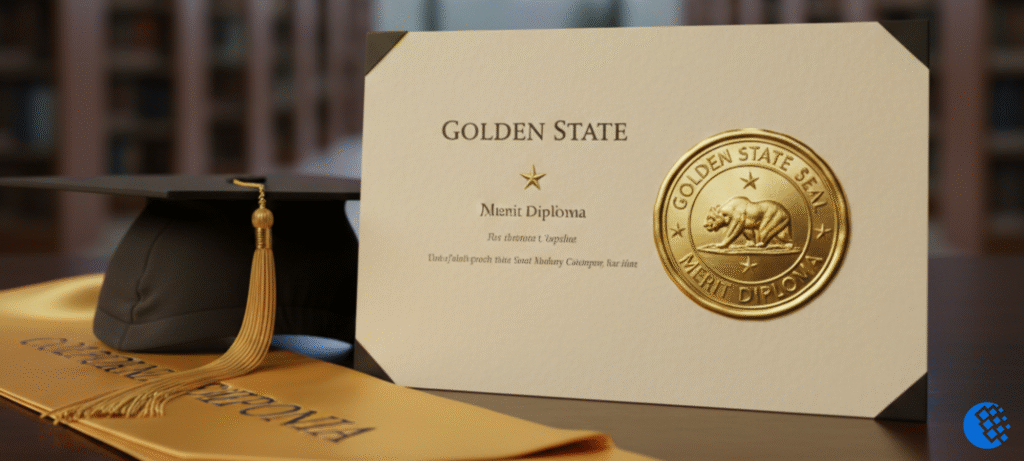
If you’re a high school student in California, or the parent of one, you’ve probably heard whispers about various “seals” and “insignias” that can be attached to a graduation diploma. Among the most prestigious is the golden state seal merit diploma (GSSMD).
Now, I know what you’re thinking—is this just another sticker? Not exactly. Think of the GSSMD as a “Super Diploma.” It’s a joint honor awarded by the California State Board of Education and the State Superintendent of Public Instruction. It tells colleges and employers that you didn’t just meet the bare minimum to graduate; you actually mastered the curriculum across multiple core subjects.
In this guide, we are going to break down exactly what this seal is, how you qualify for it in 2026, and why it actually matters for your future.
What is the Golden State Seal Merit Diploma?

This diploma is a good and well-respected indicator of educational quality. Unlike a charter school accreditation, which is awarded to schools for high-quality institutional standards, the Golden State Seal Merit Diploma is awarded to individual students for recognition of academic excellence.
It’s important to note that this isn’t a separate document. You don’t get a second diploma in the mail. Instead, your standard high school diploma gets a literal gold seal, and your official transcripts—the ones you send to universities—will have a special notation. It’s the academic equivalent of a “varsity letter” for your brain.
Why Should You Care? (The Benefits)
Is it worth the extra effort? For most students, the answer is a resounding yes. Here is why:
- College Applications: When admissions officers at UC or CSU schools see the GSSMD on your transcript, it serves as an immediate verification of your academic rigor.
- Resume Building: If you’re heading straight into the workforce, having a state-certified “Merit” status on your high school credentials can set you apart from other entry-level applicants.
- Recognition: You often get to wear a special medallion or sash at graduation, which, let’s be honest, looks great in photos.
- Academic Confidence: It’s a tangible reward for the late nights spent studying for those Smarter Balanced (SBAC) tests and keeping your grades up.
If you are a student trying to keep track of these various graduation honors, using a Teacher Toolbox approach to organizing your own records can be a lifesaver. Keep copies of your test scores and semester grades in one place so you can verify your own eligibility.
Eligibility Requirements: The “Six Subject” Rule
To earn the golden state seal merit diploma, you must meet two foundational criteria:
- You must be eligible to receive a high school diploma from a California public school.
- You must demonstrate “mastery” in six specific subject areas.
Four of these subjects are mandatory: English Language Arts (ELA), Mathematics, Science, and U.S. History. The other two are “elective” subjects that you get to choose.
1. English Language Arts (ELA)
You can prove mastery in ELA in one of two ways:
- Grades: Earn a grade of B+ or above (or the numerical equivalent) in a single course during each semester of grade 9, 10, or 11.
- Test Scores: Achieve a level of “Standard Met” or higher on the Grade 11 Smarter Balanced Summative Assessment (SBAC).
2. Mathematics
The math requirements are very similar to ELA:
- Grades: A grade of B+ or above in a single math course (each semester) in grades 9, 10, or 11.
- Test Scores: A score of “Standard Met” or higher on the Grade 11 SBAC for mathematics.
3. Science
Science allows for a bit more flexibility in terms of which test you use:
- Grades: A grade of B+ or above in a single science course (each semester) in grades 9, 10, or 11.
- Test Scores: Achieve “Standard Met” or higher on the California Science Test (CAST) taken in grade 10 or 11.
4. U.S. History
The bar for history is slightly different:
- Grades: You must earn a grade of B or above (not B+) upon completion of the required U.S. History course (both semesters).
- Test Scores: You can also use a qualifying score on a district-approved examination if one is available.
5. Two Additional Subjects
This is where you can customize your merit. You need two more subjects where you’ve shown mastery. This could be:
- Additional qualifying grades in ELA, Math, or Science that you haven’t used yet.
- A grade of B or above in other high school courses (like World History, Foreign Language, or Fine Arts).
- Qualifying scores on certain state or district-level exams.
Note: According to the California Department of Education, SAT and AP scores are generally not used directly for GSSMD eligibility unless the local district has a specific policy for converting those scores into “mastery” indicators.
How the Process Works (And a Common Mistake)
A lot of students think they have to “apply” for the golden state seal merit diploma. In reality, the responsibility falls on your Local Educational Agency (LEA)—usually your school district or charter school.
They are required by law to maintain records and identify students who qualify. However, schools are run by humans, and humans make mistakes. Sometimes a student’s transfer credits aren’t coded correctly, or a test score is missed.
My Advice: Around March of your senior year, check in with your guidance counselor. Ask them if you are on the list for the Golden State Seal. If you think you qualify based on your grades but they don’t have you listed, provide them with your transcripts. You might find that your path looks a bit like an AP English Literature and Composition Syllabus—rigorous and full of specific milestones that need to be checked off one by one.
Comparing the Different California Seals
The Golden State Seal isn’t the only honor available. California offers three “official” seals that can go on a diploma. Here is how they compare:
| Seal Name | Focus Area | Key Requirement |
| Golden State Seal Merit | General Academics | Mastery in 6 core subjects (Grades/SBAC) |
| State Seal of Biliteracy | Foreign Language | Proficiency in English + another language |
| State Seal of Civic Engagement | Civics & Service | Excellence in civics and community service |
Many high-achieving students aim to get all three! If you’re interested in policy and education standards, the California Department of Education (CDE) website has the most up-to-date data on how these seals are being awarded across the state.
People Also Ask (FAQs)
What is a Golden State Seal merit diploma?
It is a recognition for California high school graduates who have demonstrated superior performance in at least six subject areas. It consists of a gold insignia placed on the diploma and a notation on the student’s official transcript.
What is the GPA for a diploma with merit?
There isn’t a single “GPA” requirement. Instead, eligibility is based on individual course grades (usually B or B+ and above) or reaching the “Standard Met” level on state assessments like the SBAC or CAST.
How many people get the golden state seal merit diploma?
It varies by district, but typically about 25% to 35% of graduating seniors in high-performing California districts meet the criteria. It is meant to be a distinction for “superior” performance, so it isn’t something that every student receives automatically.
Does it help with college admissions?
Yes, especially for California state schools (CSU and UC). It provides an “official” stamp of approval on your academic record that goes beyond just having a high GPA. It proves you met specific state standards for mastery.
What is the seal on the diploma in California?
There are actually three: the Golden State Seal Merit Diploma, the State Seal of Biliteracy, and the State Seal of Civic Engagement. Each recognizes a different type of excellence.
Tips for Success
If you’re still in your freshman or sophomore year and want to ensure you get the golden state seal merit diploma, here is your game plan:
- Don’t Blow Off the SBAC: Those state tests in 11th grade really matter. If you score “Standard Met” or “Standard Exceeded,” you basically lock in your eligibility for Math and ELA right then and there.
- Aim for the B+: In your core classes (Math, English, Science), that extra few percentage points to move from a B to a B+ can make the difference for this award.
- Check Your U.S. History Grade: Remember, history only requires a B, but you have to maintain it for both semesters.
- Stay in Touch with your Counselor: As I mentioned earlier, districts are responsible for the paperwork. Make sure they know you’re aiming for this honor.
For those looking into the broader implications of these state honors, the California School Boards Association often publishes reports on how these programs impact student motivation and college readiness. It’s a fascinating look at how a simple “seal” can drive a lot of academic effort.
Wrapping It Up
The golden state seal merit diploma is more than just a piece of gold foil. it’s a testament to your hard work across four years of high school. It tells the story of a student who was consistent, capable, and ready for the challenges of higher education.
Whether you’re using it to boost your college application or just want the satisfaction of knowing you “mastered” the California curriculum, the GSSMD is an honor worth striving for.