

As your organization expands, the “hidden tax” of growth—the friction of communication, document fragmentation, and the difficulty of tracking decentralized data—can slow down even the most talented teams. Scaling successfully requires more than just hiring more people; it requires a synchronized environment where your tools handle the administrative burden so your leaders can focus on strategy.
To support sustainable growth, your software must transition from simple “to-do lists” to a unified project management tool. Here is how specific, integrated tools enable you to scale your project management without increasing your operational burn.
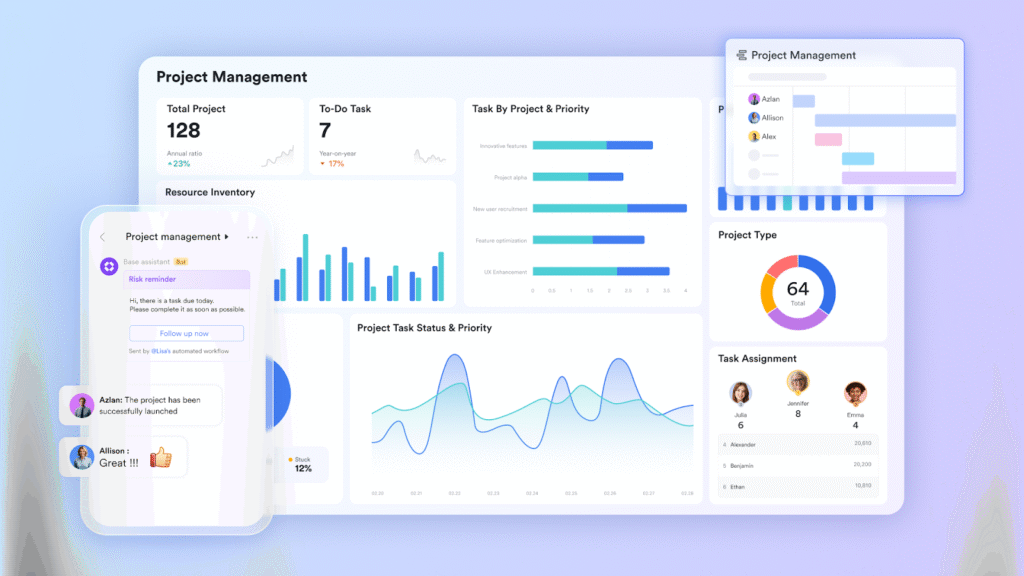
Scaling data architecture with Lark Base
In a small team, a flat spreadsheet might suffice for tracking tasks. However, as projects grow in complexity, you need the relational power of a database. Lark Base functions as a low-code database that allows you to link records across different departments—such as connecting a “Client Directory” to a “Project Tracker.” A key function is “Multi-Dimensional Views,” which allows managers to switch between Gantt charts for timelines, Kanban boards for workflows, and Gallery views for creative assets, all pulling from the same live data. Also, with a built-in, no-code workflow builder, it allows users to set up triggers, conditional branches, and actions to attain their goals. For example, a project lead can use the “Automated Trigger” function to notify a specific team in Messenger the moment a task status changes to “Urgent,” removing the need for manual status updates.
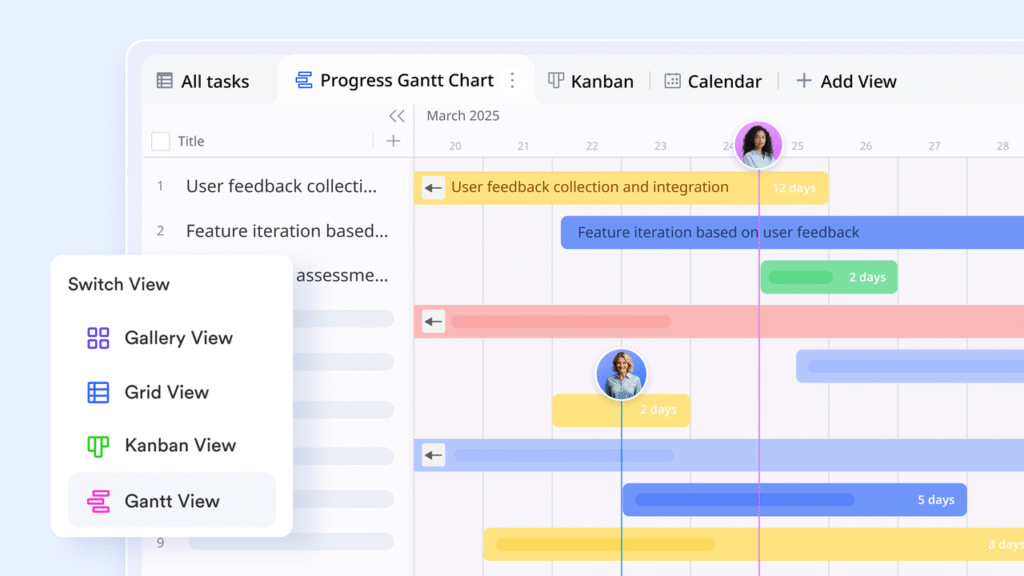
Preserving culture and context with Lark Wiki
One of the highest costs of growth is the “onboarding lag”—the time it takes for a new hire to become productive. Lark Wiki functions as a centralized, hierarchical knowledge hub that houses your company’s collective intelligence. A critical function detail is “Full-Text Universal Search,” which allows permitted members to search across company documents, chat histories, and project files from a single search bar. This empowers new employees to self-serve information regarding SOPs, brand guidelines, and past project post-mortems. As one of the most vital productivity tools, the Wiki acts as a digital brain, ensuring that “tribal knowledge” is documented and accessible, preventing the loss of information that often occurs during rapid headcount expansion.
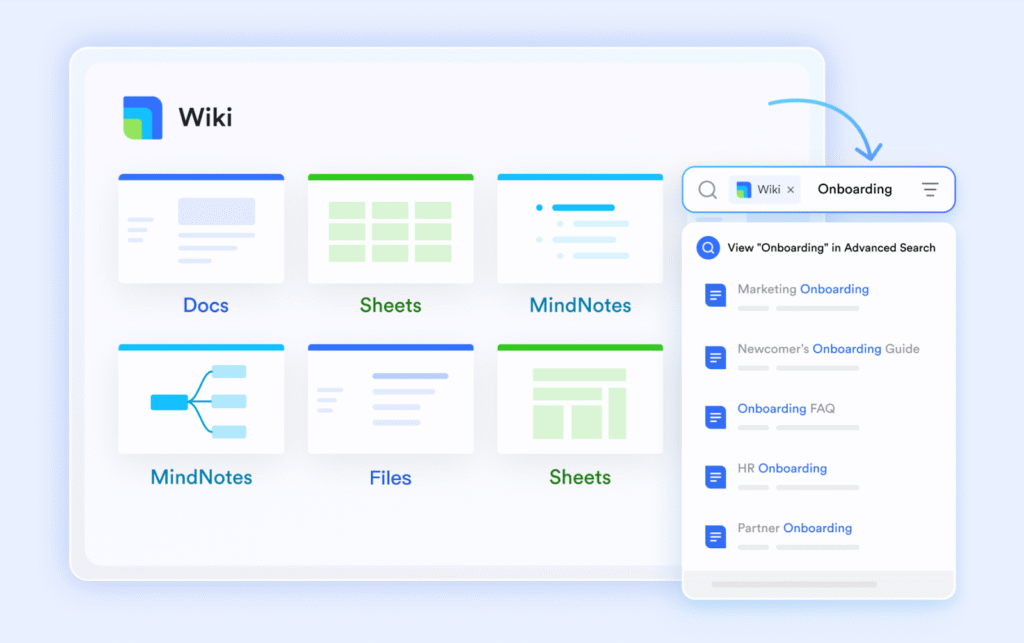
Coordinating global logistics with Lark Calendar
Scaling often involves moving into new regions and time zones, which can make meeting coordination a nightmare. Lark Calendar automates this “logistics overhead” through its “Group Scheduling” engine. A primary function detail is the “Find a Time” feature, which overlays the availability of up to 50 participants instantly, highlighting the exact windows where everyone is free regardless of their geographical location. It also supports “Meeting Rooms” integration, allowing you to book physical and digital spaces simultaneously. For enterprise-level scheduling, having a calendar that is natively tied to your chat and documentation hub saves hours of administrative work per week.
Streamlining high-volume communication with Lark Messenger
As a team grows, traditional group chats often become “noise” that kills focus. Lark Messenger solves this through its “Threaded Conversation” function, which allows users to reply to specific messages and keep sub-discussions organized without cluttering the main channel. Another essential function is the “Pin to Top” feature, which creates a “digital bulletin board” for every project group, housing the latest brief, timeline, and wiki links. This ensures that any new team member added to the project can scroll to the top and find all the necessary context in seconds, rather than digging through weeks of chat history. By utilising native connectors for project management tools like ProProfs Project, automated alerts from your database flow directly into these threads, keeping everyone aligned in real-time.
Enhancing accountability with Lark OKR
Growth is meaningless if the team is moving in the wrong direction. Lark OKR (Objectives and Key Results) ensures that every project is linked to the company’s “North Star.” A powerful function detail is the “Alignment View,” which provides a visual map showing how individual project tasks roll up into departmental goals and, eventually, the company’s quarterly objectives. This transparency ensures that as the organization becomes more decentralized, every employee understands the “why” behind their work. For example, a developer can see exactly how their specific bug fix contributes to the broader goal of “Increasing User Retention by 20%,” fostering a culture of shared ownership and high performance.
Removing administrative bottlenecks with Lark Approval
As a team scales, the “Approval Trap” often slows down momentum, waiting for a manager to sign off on a budget or a final design via email. Lark Approval moves these hurdles into an automated, mobile-first workflow. A critical function detail is “Parallel Approval Nodes,” which allows you to send a request to multiple stakeholders simultaneously (e.g., Legal and Finance) rather than waiting for one to finish before the other begins. Because these approvals are processed directly within the Messenger environment, stakeholders can sign off with a single tap from their phone while on the move. This prevents the administrative gridlock that often stalls hyper-growth companies, ensuring that the “speed of execution” stays high regardless of headcount.
Bonus: The real cost of “Growth friction” in your tech stack
When a business starts to expand, the first instinct is often to check google workspace pricing to see how much it costs to add more seats for basic email and storage. It seems like a simple, per-user expense, but the real “drain” on your budget starts when those basic tools can’t handle complex project tracking. To fill the gaps, companies often layer on extra costs: $8 a user for Slack, $10 a user for Asana, and another $15 for Zoom.
Before you know it, you are paying $40 or $50 per month for every single employee just to give them the basics. This is where growth becomes expensive. You aren’t just paying for the software; you are paying for “Information Decay”—the time your team wastes trying to remember which app holds the latest version of a project brief. When a deadline is in one app but the discussion about it is in another, your staff spends more time “managing the tools” than doing the work you hired them for.
Lark changes the math by putting your team’s chat, task database, and video calls in one single home. Instead of juggling a dozen different bills and windows, you have one clear view of your entire operation. This doesn’t just lower your monthly bills; it clears out the digital clutter so your team can finally move at full speed without being held back by a messy, expensive app stack.
Conclusion
Scaling a business is a test of your infrastructure as much as your talent. When a team grows, the “administrative friction” of fragmented tools—lost passwords, siloed data, and endless status meetings, acts like a hidden tax on your productivity. You cannot expect to reach new heights using the same disconnected systems that served you as a startup.
True sustainable growth is found in a synchronized environment. By moving into a unified digital workspace and a modern set of productivity tools, you remove the barriers between communication, data, and strategy. You aren’t just giving your team better tools; you are building a resilient, automated foundation that allows your organization to move faster, stay aligned, and achieve long-term business growth without the extra weight of administrative overhead.