
Semester ending, grades trickling in one by one, and you’re already doing that thing where you multiply units by grades in your head and lose count halfway through. If that’s you right now, a GWA calculator saves you the headache – punch in your units and grades, and it hands you the number your registrar would take a full afternoon to confirm.
Instantly Calculate Your General Weighted Average
Use the tool above to get your GWA in seconds. Below, we’ll walk through the formula behind it, how different Philippine schools apply it, and the small details (rounding, INC grades, elective units) that trip up even senior students.
What Is a GWA, and Why Does It Matter This Much?
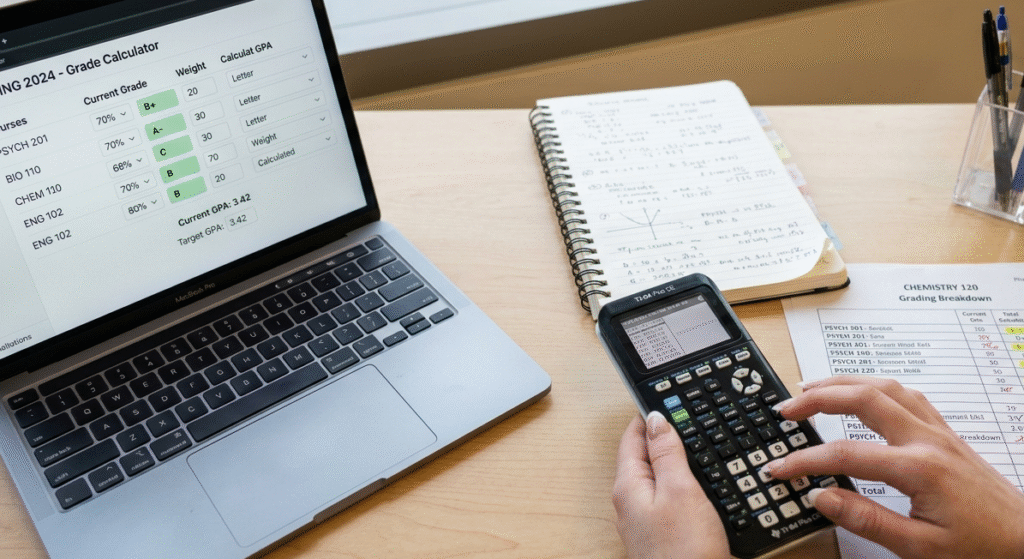
GWA stands for General Weighted Average — the unit-weighted average of every grade you’ve earned across a semester, or your whole college life if you’re computing a cumulative GWA. It’s not a simple average. A 3-unit subject pulls more weight than a 1-unit PE class, which is exactly why so many students get their manual math wrong and end up two decimal points off from what actually shows up on their transcript.
That gap matters more than it looks. Scholarship renewals, Latin honors eligibility, and even some job applications in the Philippines ask for GWA specifically, not GPA. Our 6-point grading scale breakdown covers how letter and percentage systems convert into the numbers you’ll actually plug into a calculator like this one — worth a quick read if your school still uses letter grades.
How to Calculate GWA (Step-by-Step)
Here’s how to calculate your GWA by hand, which is also exactly what the calculator is doing behind the scenes:
- List every subject with its unit value. A 3-unit major and a 1-unit PE class don’t count equally, so this step can’t be skipped.
- Multiply each grade by its corresponding units. This gives you “grade points” per subject.
- Add up all the grade points.
- Add up all the units.
- Divide total grade points by total units.
So if you had a 1.50 in a 3-unit subject and a 2.00 in a 2-unit subject, you’d compute (1.50 × 3) + (2.00 × 2) = 4.5 + 4.0 = 8.5, then divide by 5 total units, landing at 1.70. Do that six or seven times a semester and it’s easy to see why students just skip the manual version.
One thing that catches people off guard: on the Philippine 1.0–5.0 scale, lower is better — 1.0 is the top grade, and 5.0 is a failing mark. If you’re used to the American GPA scale where 4.0 is the ceiling, this system runs in reverse, and it’s a common source of confused first-year students Googling why their “high” number looks bad.
GWA Calculator Philippines: Formula and Grading Scale
Most Philippine colleges and universities anchor their computation to the framework set by the Commission on Higher Education, even though individual schools are free to adjust the finer details. You can check the official CHED site for the national policies your school’s registrar is ultimately answering to.
Here’s roughly how the standard scale breaks down:
| Grade | Description | Approx. Percentage |
|---|---|---|
| 1.00 – 1.25 | Excellent | 97–100% |
| 1.50 – 1.75 | Very Good | 90–96% |
| 2.00 – 2.25 | Good | 84–89% |
| 2.50 – 2.75 | Satisfactory | 78–83% |
| 3.00 | Passing | 75% |
| 4.00 | Conditional Failure | 70–74% |
| 5.00 | Failure | Below 70% |
Not every school follows this exactly. DLSU reports percentage scores directly. Ateneo uses letter grades. UP has its own finer 1.0–5.0 increments. If your school’s grading sheet looks different from the table above, that’s normal — it’s why a flexible GWA calculator philippines students can adjust to their own scale is more useful than a static formula sheet.
GWA Calculator College Students Actually Need
A generic average won’t cut it once you’re past your first semester, because a real GWA calculator college students rely on needs to handle a few messy realities:
- Multiple subjects with different unit loads — thesis units, lab units, and lecture units all carry different weights.
- INC (incomplete) grades — these usually shouldn’t be averaged in until they’re resolved, so leave them out of the calculation until your registrar updates your record.
- Semester-by-semester tracking — your cumulative GWA isn’t just this semester’s number; it’s a running weighted average across every term.
This is basically why we built the calculator the way we did — add or remove subject rows freely, adjust units per subject, and let it handle the weighting instead of doing it on a calculator app between classes.
BU GWA Calculator and School-Specific Variations
If you searched something like bu gwa calculator, you’re probably trying to match your specific university’s grading conventions rather than a generic national average. Bicol University, like most state universities, follows the standard CHED-aligned 1.0–5.0 scale, but always double-check your college’s specific student handbook — some departments round differently, and Latin honors cutoffs can vary by campus. The same logic applies whether you’re at BU, PUP, NU, or any other school with its own internal grading memo: the math stays the same, only the cutoffs and rounding rules shift slightly.
If Latin honors is the reason you’re tracking your GWA this closely, it’s worth knowing CHED requires zero failing grades anywhere on your transcript for the top honors tier, along with a minimum residency requirement at your school. The CHED guidelines on Latin honors lay out exactly what disqualifies a candidate, which is worth a read before you start counting decimal points too obsessively.
A Quick Story on Why Manual Computation Fails
A friend of mine spent an entire evening before enrollment recomputing her GWA by hand because she needed to hit a scholarship cutoff. She got 1.78. The registrar’s copy said 1.81. Three-hundredths of a point doesn’t sound like much until it’s the difference between renewing a scholarship and not — and it turned out she’d forgotten to weight a 1-unit NSTP subject correctly. That’s the kind of error a calculator simply doesn’t make, because it never “forgets” a row.
Frequently Asked Questions
How to calculate GWA?
Multiply each subject’s grade by its number of units, add up all those totals, then divide by the total number of units across all subjects. That gives you a unit-weighted average rather than a simple average of grades.
How to calculate for GWA if I have INC grades?
Leave incomplete subjects out of the calculation until they’re resolved and a final grade is posted. Including an INC as a zero or placeholder will distort your actual average.
How do you calculate GWA for a cumulative record across multiple semesters?
Combine every subject and unit from every semester into one list, then apply the same formula — total grade points divided by total units. It’s the same math as a single semester, just with more rows.
How to calculate your GWA if your school uses letter grades instead of numbers?
Convert each letter grade to its numerical equivalent using your school’s official conversion table first, then run the standard weighted average formula on the converted numbers.
How is GWA calculated differently from GPA?
GWA weights every grade by its subject’s units, while a simple GPA average sometimes doesn’t. On the Philippine 1.0–5.0 scale, GWA also runs in reverse compared to a 4.0 GPA scale, since a lower number means a better grade.
Final Thoughts
Whether you’re chasing a scholarship, tracking Latin honors eligibility, or just want to know where you stand before finals week, a reliable GWA calculator turns a process that’s easy to mess up into something that takes fifteen seconds. Understanding what actually goes into that number — and how your specific school might tweak it — matters just as much as trusting the tool for the arithmetic itself. If you’re weighing your academic standing against broader goals, our piece on what student success really looks like is a good next read once your GWA is sorted.
Calculate your grade now => Easygrader