

For the modern educator, the school calendar is less of a schedule and more of a tactical map. While the casual observer might think the answer to “how many weeks are in a school year” is a simple matter of math, those in the trenches know better. It is a balancing act of state mandates, student burnout thresholds, and administrative logistics.
In 2026, as we see a radical shift toward four-day school weeks and “balanced” year-round calendars, the traditional 36-week model is being stress-tested. Whether you are an administrator calculating instructional minutes or a student mastering how to write an argumentative essay, the cadence of the academic year dictates every deadline and milestone.
Table of Contents
- The 180-Day Myth: Why 36 Weeks is Never Just 36 Weeks
- The “Instructional Hour” Paradigm Shift
- A Global Perspective: UK, USA, and the Southern Hemisphere
- 2026 Trends: The Rise of the Four-Day School Week
- Higher Ed vs. K-12: The Semester Shrinkage
- The Logistics of Liability: Insurance and the “Assignment of Benefits”
- At-a-Glance: Global School Year Comparison (2026)
- Frequently Asked Questions (FAQs)
- Final Thought: Efficiency Over Endurance
The 180-Day Myth: Why 36 Weeks is Never Just 36 Weeks
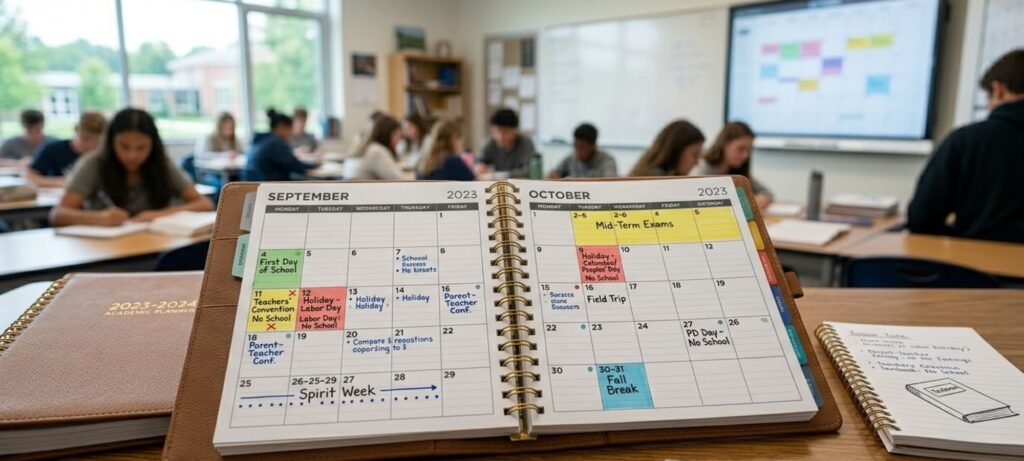
In the United States, the National Center for Education Statistics (NCES) generally points to 180 days as the legislative baseline for K-12 education. On paper, this is exactly 36 weeks. But ask any teacher about “calendar creep,” and they’ll tell you that the actual school year feels much longer.
Between the first professional development day in August and the final grade submission in June, a typical “36-week” year actually spans roughly 40 to 42 calendar weeks. Why the discrepancy? It’s the “administrative overhead”:
- Buffer Days: Building in time for snow days or hurricane evacuations.
- Intermissions: Federal holidays, winter breaks, and the much-needed spring hiatus.
- In-Service Days: Those days where the students stay home, but the faculty is grinding through data analysis and grading protocols.
The “Instructional Hour” Paradigm Shift
By 2026, the conversation has moved away from “days” and toward instructional hours. States like Colorado and Oregon have pioneered a shift where the quality of time spent matters more than the number of calendar boxes checked.
For example, a high school might only be in session for 165 days, but by extending each day by 45 minutes, they exceed the state mandate for total minutes. This flexibility is a godsend for districts struggling with bus driver shortages or teacher burnout. For those tasked with managing these transitions, understanding the legal fine print is as essential as knowing what is assignment of benefits is to a property claim—missing one detail can stall the entire process.
A Global Perspective: UK, USA, and the Southern Hemisphere
The world does not agree on how long a child should be in a classroom. The variation tells a fascinating story about national priorities.
The United States (K-12)
The US remains fairly rigid at the 180-day mark. However, the start dates are a cultural battleground. Southern states often start in early August to finish the first semester before the winter break, while Northern states often hold out until after Labor Day.
The United Kingdom
The UK pushes the envelope with a 39-week (190-day) schedule. It’s a “marathon” approach compared to the US “sprint.” Divided into three distinct terms, the UK system relies on “half-terms”—short one-week breaks in the middle of each term—to keep students from hitting a wall.
Australia and New Zealand
The Southern Hemisphere plays by the calendar year. Running from late January to mid-December, the Australian school year is a disciplined 40-week block. By splitting the year into four 10-week terms, they provide a predictable, rhythmic flow that many North American educators envy.
2026 Trends: The Rise of the Four-Day School Week
The biggest disruptor in 2026 is the Four-Day School Week (4DSW). Over 30% of rural US districts have now ditched Fridays.
While critics worry about “learning loss,” districts report a massive spike in teacher retention and student attendance. In this model, the “weeks” remain at 36, but the “days” drop to 144. To make this work, the school day often runs from 7:30 AM to 4:30 PM. This model requires students to be more focused and disciplined, a trait often developed through rigorous writing assignments like learning how to write an argumentative essay.
Higher Ed vs. K-12: The Semester Shrinkage
If you’re moving from high school to college, prepare for a shock. The university calendar is significantly shorter, typically lasting only 30 to 32 weeks.
College semesters are usually 15 weeks of instruction followed by one week of finals. This shorter window is intentional. Higher education assumes a “1:3” ratio—for every hour you sit in a lecture, you should be spending three hours in the library or the lab. This condensed schedule is why mid-terms feel so much more aggressive in a college setting; you are covering 36 weeks of K-12 material in a 15-week burst.
The Logistics of Liability: Insurance and the “Assignment of Benefits”
You might wonder why an educational guide mentions what is assignment of benefits. In the world of school administration, “AOB” is a critical term for facilities management. When a school roof leaks or a gymnasium floor is damaged during that 36-week window, the school board often signs an AOB to allow contractors to bill the insurance company directly.
Just as a student “assigns” their focus to a specific thesis in an essay, the district “assigns” their claim rights to get repairs done quickly. If these repairs aren’t handled within the summer break, it can throw the entire 180-day instructional calendar into chaos. For more on this legal framework, see what is assignment of benefits.
At-a-Glance: Global School Year Comparison (2026)
| Country | Avg. Weeks | Avg. Days | Break Structure |
| USA | 36 | 180 | 10-week Summer, 2-week Winter |
| UK | 39 | 190 | 6-week Summer, 3 Half-terms |
| Australia | 40 | 200 | 2-week breaks between 4 Terms |
| Japan | 42 | 210 | 5-week Summer, 2-week Spring |
| South Korea | 44 | 220 | 2 main Semesters, High intensity |
Frequently Asked Questions (FAQs)
How many weeks are in a school year without holidays?
In a standard US public school, there are 36 weeks of actual teaching. When you add the five major holiday breaks, the “academic season” lasts about 40 weeks.
Does a private school have fewer weeks?
Often, yes. Private schools aren’t always bound by state mandates and may run for 32 to 34 weeks. They compensate for fewer weeks with a more rigorous daily pace and smaller class sizes.
What is a “Quarter” vs. a “Semester”?
Think of a Semester as a 18-week “book.” A Quarter is a 9-week “chapter.” Most schools use the quarter system to provide mid-term progress reports, while semesters are used for final transcript credits.
Final Thought: Efficiency Over Endurance
As we look at the educational data of 2026, the conclusion is clear: the number of weeks matters less than the efficiency of the grading and feedback loop. A 36-week year supported by streamlined tools like EasyGrader is far more effective than a 40-week year bogged down by administrative fatigue.
The goal for any student or teacher should be to maximize those 180 days, ensuring that every hour spent in the classroom is an hour spent moving the needle toward mastery.