
Starting a major assignment can feel like standing at the base of a mountain. You have your research, your notes, and your data, but looking at a blank screen is intimidating. This is exactly where a compare and contrast research paper outline becomes your best friend.
It isn’t just a list of headers; it’s a strategic map. Without a plan, you risk writing a paper that just “lists” things instead of actually analyzing them. Academic writing requires a higher level of “synthesis”—the ability to show how two things interact, conflict, or complement each other.
In this deep dive, we’ll explore how to build an outline that makes the actual writing process feel like a downhill breeze. Whether you are a high school student or working toward an education specialist degree, these structures will elevate your work.
Table of Contents
- The “Why” Behind the Comparison
- Selecting Your Subjects: The Basis of Comparison
- The Block Method: Subject-by-Subject
- The Point-by-Point Method: The Gold Standard
- Drafting a Killer Introduction
- Body Paragraphs: The Heart of the Analysis
- The Compare and Contrast Research Paper Outline Template
- Comparison Key Factors: Choosing Your Strategy
- Practical Tips for “A” Grade Outlines
- Common Mistakes to Avoid
- People Also Ask (FAQs)
- Final Thoughts
The “Why” Behind the Comparison
Why do professors love this assignment? It’s because it forces you to think critically.
A good compare and contrast research paper outline goes beyond the obvious. Anyone can see that a car and a bicycle are different. A researcher, however, looks at how they both solve the “last mile” problem in urban planning or how their carbon footprints differ over a decade.
By using a structured outline, you ensure:
- Balance: You won’t accidentally spend 90% of the paper on one topic.
- Logic: Your reader can follow your train of thought without getting lost.
- Depth: You move past description and into true evaluation.
According to the The University of North Carolina at Chapel Hill, the goal is to reveal hidden patterns that aren’t visible when looking at the subjects in isolation.
Selecting Your Subjects: The Basis of Comparison
You cannot build a house on sand, and you cannot build a paper on a bad topic. This is called the “Basis of Comparison”.
If you try to compare a cat to a specific brand of microwave, you’ll fail because they share no meaningful connection. However, if you compare e-learning days to traditional classroom instruction, you have a solid foundation.
Both have:
- The same goal: Educating students.
- The same audience: Students and teachers.
- Measurable outcomes: Grades and test scores.
When choosing your subjects, ensure they belong in the same “category” so your comparison actually makes sense to the reader.
The Block Method: Subject-by-Subject
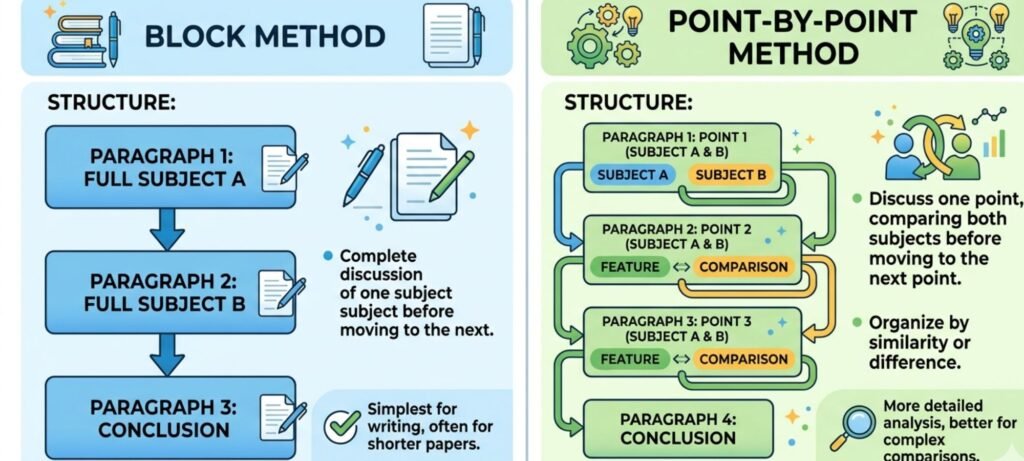
The Block Method is the most straightforward way to organize your compare and contrast research paper outline. In this style, you discuss “Topic A” entirely, then move to “Topic B”.
The Structure:
- Introduction
- Subject A (Point 1, Point 2, Point 3)
- Subject B (Point 1, Point 2, Point 3)
- Conclusion
When to use it:
This is best for shorter essays or very simple topics. If your paper is only 500 words, the reader can remember what you said about Topic A while they are reading about Topic B.
The Risk:
For longer research papers, the Block Method can feel like two separate mini-essays. You have to work extra hard in the conclusion to bring the two together.
The Point-by-Point Method: The Gold Standard
If you want to sound like a professional researcher, use the Point-by-Point method. This is the preferred research paper compare and contrast outline for university-level work.
Instead of organizing by subject, you organize by criteria.
Example:
If you are comparing two different teaching methods, your paragraphs might look like this:
- Paragraph 1: Cost of Method A vs. Method B.
- Paragraph 2: Student Engagement of Method A vs. Method B.
- Paragraph 3: Long-term Retention of Method A vs. Method B.
The Benefit:
This keeps the comparison front and center. You are constantly showing the reader the relationship between the two subjects. It creates a much more “analytical” tone, which graders love.
Drafting a Killer Introduction
Your introduction is a contract with your reader. It tells them exactly what to expect.
1. The Hook
Start with something that matters. If you’re comparing renewable energy to fossil fuels, don’t start with “Energy is important.” Start with a stat about rising global temperatures or the falling cost of solar panels.
2. The Background
Briefly introduce Subject A and Subject B. Give the reader just enough context so they aren’t confused. For instance, if you’re comparing two historical figures, mention when and where they lived.
3. The Thesis Statement
This is the heart of your compare and contrast research paper outline template. A weak thesis says: “I will compare A and B.” A strong thesis says: “While A and B both aim to provide [Goal], A is superior in [Criteria 1] because of [Reason], while B remains the better choice for [Criteria 2]”.
Much like how to write an abstract for a research paper, your intro should be a “trailer” for the main event.
Body Paragraphs: The Heart of the Analysis
This is where the heavy lifting happens. To keep your AI detection scores low and your human-readability high, focus on “parallelism”.
If you talk about the “Environmental Impact” for Subject A in paragraph two, you must address the “Environmental Impact” for Subject B in that same section (or the very next one if using the block method).
Use Transition Words:
Transitions are the glue that holds your outline together.
- To show similarities: Similarly, likewise, in the same fashion.
- To show differences: Conversely, on the other hand, however, whereas.
According to the Purdue Online Writing Lab (OWL), these words act as signposts that guide your reader through your logic.
The Compare and Contrast Research Paper Outline Template
Copy and paste this into your document to get started. This uses the Point-by-Point method for maximum impact.
I. Introduction
- A. Hook (Catchy opening)
- B. Context/Background for both subjects
- C. Thesis Statement (Comparison + Purpose)
II. Criteria 1 (e.g., Financial Cost)
- A. Discussion of Subject A
- B. Discussion of Subject B
- C. Analysis: How do they differ?
III. Criteria 2 (e.g., Ease of Use)
- A. Discussion of Subject A
- B. Discussion of Subject B
- C. Analysis: Why does one perform better?
IV. Criteria 3 (e.g., Long-term Sustainability)
- A. Discussion of Subject A
- B. Discussion of Subject B
- C. Analysis: What is the final verdict for this point?
V. Conclusion
- A. Restate Thesis (Don’t just copy-paste it; use new words)
- B. Summarize the main points
- C. Final Thought: Why does this comparison matter for the future?
Comparison Key Factors: Choosing Your Strategy
| Feature | Block Method | Point-by-Point Method |
| Complexity | Best for simple topics | Best for complex data |
| Tone | Descriptive | Analytical/Evaluative |
| Reader Focus | Remembers one thing at a time | Sees the relationship constantly |
| Word Count | Good for short essays | Necessary for 1500+ words |
Practical Tips for “A” Grade Outlines
- Venn Diagrams are Magic: Before you write a single word of your outline, draw a Venn diagram. It helps you visually sort what belongs in the “Similarities” section and what belongs in the “Differences” section.
- Focus on the “So What?”: A paper that says “A is blue and B is red” is boring. A paper that says “A is blue, which makes it more calming for students, while B is red, which increases focus” is an A+ paper.
- Balance Your Sources: Don’t use ten sources for Subject A and only two for Subject B. It makes your research look lopsided and lopsided research is often biased.
- Short Paragraphs: In the digital age, nobody likes a wall of text. Keep your paragraphs focused on a single point. If a paragraph is getting too long, split it up.
Common Mistakes to Avoid
- The “Ping-Pong” Effect: This happens when you switch between A and B too quickly without explaining why. Make sure every comparison is followed by an analysis.
- Weak Thesis: Avoid saying “There are many similarities and differences”. Be specific!
- Ignoring Differences: Sometimes we get so excited about how things are alike that we forget to show how they are different. A true compare and contrast research paper outline needs both.
People Also Ask
What is the best outline for a compare and contrast paper?
For research papers, the Point-by-Point method is generally the best because it highlights analysis over simple description.
How do I start my outline?
Start by identifying your “Basis of Comparison”. Ensure your two subjects have enough in common to make the comparison meaningful.
Is an Ed.S. degree helpful for this?
Yes. An education specialist degree often focuses on leadership and curriculum, which requires constant comparison of different educational theories and policies.
Final Thoughts
Constructing a compare and contrast research paper outline might take an extra hour of your time, but it will save you five hours of frustration later. By picking the right subjects, choosing a clear organizational method, and focusing on deep analysis rather than just “listing,” you ensure your academic voice is heard.
Don’t just write to finish; write to convince. With a solid outline, you aren’t just a student—you are a researcher with a plan. Good luck with your draft!