

Algebra often feels like a puzzle where someone has hidden half the pieces or turned them upside down. Honestly, if you’re currently grinding through your math curriculum and feeling stuck, you’re definitely not the only one. Looking for a lesson 3.4 solving complex 1-variable equations answer key isn’t just about finishing the homework—it’s about finally making sense of the “logic” that makes these equations actually work.
In this guide, we aren’t just giving you a list of numbers to copy. We’re going to walk through these intimidating problems together, breaking them down into tiny, manageable chunks. By the time you finish reading, those long lines of numbers and parentheses won’t look like a secret code; they’ll just look like a clear path to an answer.
Table of Contents
- What Exactly Makes an Equation “Complex”?
- The Rules You Can’t Afford to Ignore
- Simple vs. Complex Equations: A Comparison
- The “Zero-Stress” Method for Solving
- Lesson 3.4 Answer Key & Deep Dive Solutions
- Practice Problems: Test Your Skills
- Common Mistakes (The Stuff That Trips Everyone Up)
- Pro Tips for Crushing Math Exams
- FAQs
Complex 1-Variable Equations
When teachers talk about “complex” equations in Lesson 3.4, they don’t mean they’re impossible. It just means there are more “chores” to finish before you can find the value of $x$. Instead of a simple problem like $x + 2 = 5$, you’re going to see brackets, variables on both sides, and maybe some messy fractions.
Think of it as the bridge between basic math and real algebra. It’s all about staying organized. Whether you’re learning from home and trying to figure out What is an E-Learning Day or sitting in a noisy classroom, the strategy is exactly the same: simplify until it’s easy.
What Exactly Makes an Equation “Complex”?
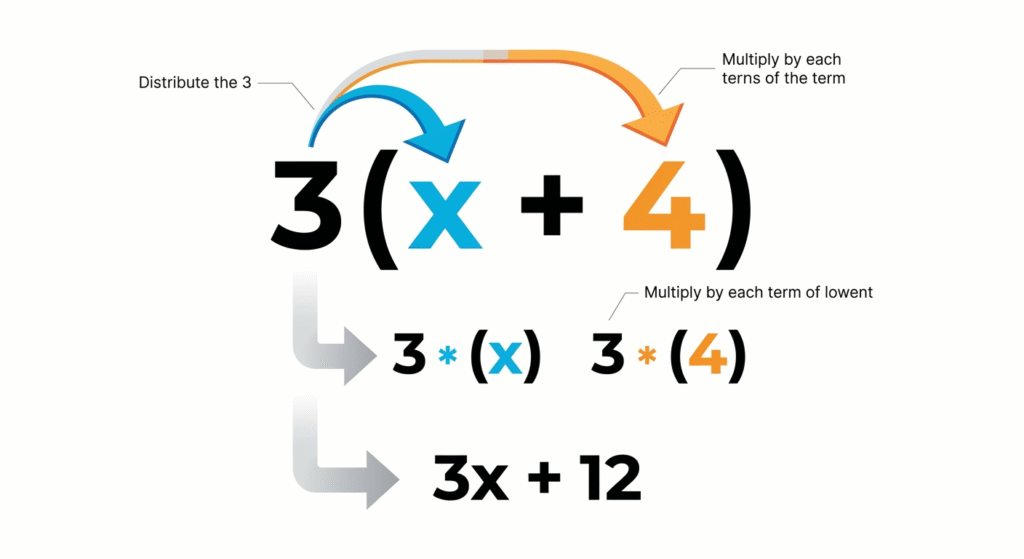
In this specific lesson, “complex” usually boils down to three annoying things that tend to clutter up your paper:
- Parentheses: You have to deal with numbers “hugging” the brackets.
- Variables Everywhere: You’ve got an $x$ on the left and an $x$ on the right, and they need to be reunited.
- Scattered Numbers: Constants are all over the place, and you have to clean them up before you can solve anything.
The Rules You Can’t Afford to Ignore
Before we jump into the answer key, make sure these four rules are locked in your head like second nature:
- The Balance Rule: Think of an equation like a playground seesaw. If you add 10 pounds to the left, you have to add 10 pounds to the right to keep it from tipping.
- The Distributive Property: $a(b + c) = ab + ac$. Make sure the number outside the bracket “visits” every single person inside.
- Like Terms: You can add $3x$ and $4x$ to get $7x$, but you can’t add $3x$ and 7. It’s like trying to add apples and rocks—it just doesn’t work.
- Opposites Solve Problems: If a number is being added, subtract it to move it. If it’s being multiplied, divide it.
Simple vs. Complex Equations: A Comparison
It’s helpful to see how much you’ve actually grown since the start of the year. Check out the differences below:
| Feature | Simple Equations (Level 1) | Complex Equations (Lesson 3.4) |
| Effort Needed | 1 or 2 quick steps | 4 or 5 careful steps |
| Parentheses | Almost never | Almost always |
| Variable Spot | Just one side | Usually both sides |
| Goal | Find $x$ instantly | Clean, move, and then solve |
My Go-To Method for Solving Anything
If you stick to this exact order, you’ll rarely get a problem wrong. I tell my students to memorize this sequence:
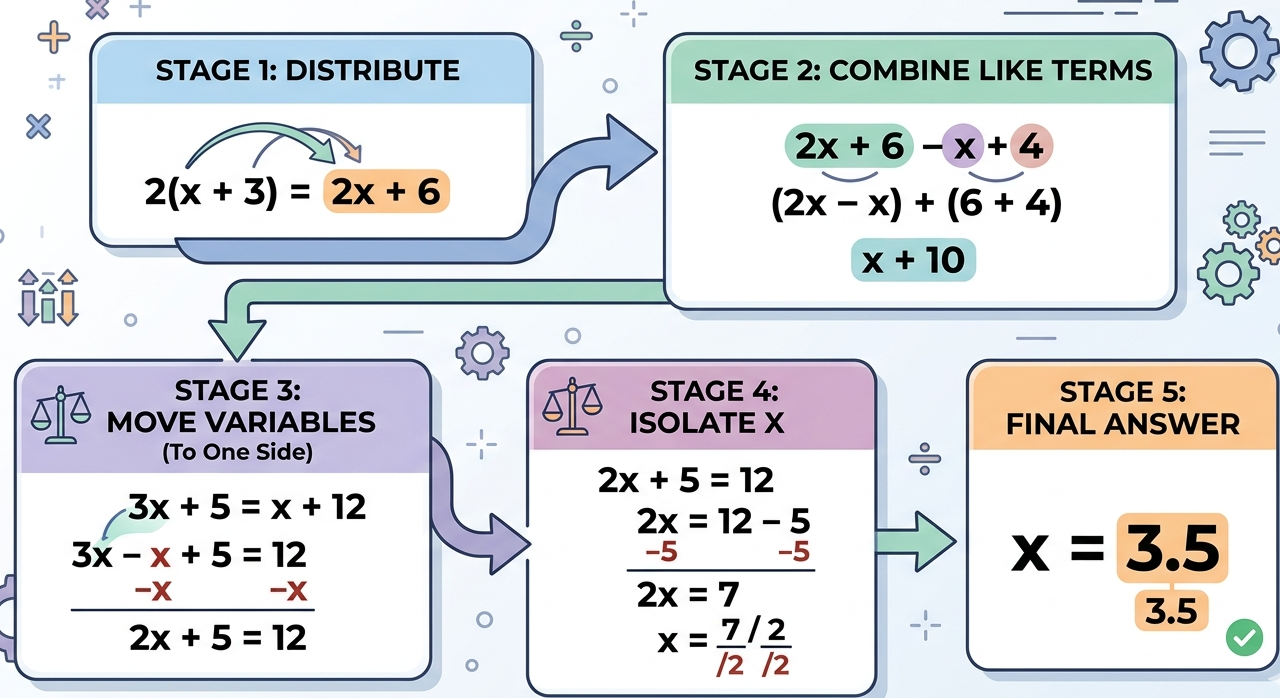
- Trash the Brackets: Use that distributive property to get rid of parentheses first.
- Side Clean-up: Look at just the left side and combine any numbers you can. Then do the same for the right.
- The X Migration: Use addition or subtraction to get all your $x$ terms onto one side of the equals sign.
- Number Shift: Move all your “plain” numbers to the opposite side of the variable.
- The Final Cut: Divide by whatever is left in front of $x$.
Lesson 3.4 Answer Key & Deep Dive Solutions
Let’s look at the actual problems. Don’t just look at the bold answer; look at the “how” behind it.
Problem 1: $3(x + 4) = 2x + 15$
- Distribute: $3 \cdot x$ and $3 \cdot 4$ gives us $3x + 12 = 2x + 15$.
- Move the 2x: Subtract $2x$ from both sides. Now we have $x + 12 = 15$.
- Isolate: Subtract 12 from 15.
- Result: $x = 3$.
Problem 2: $5x – 4 = 2(x + 1) + 3$
- Clear the bracket: $5x – 4 = 2x + 2 + 3$.
- Combine like terms: On the right, $2 + 3$ is 5, so: $5x – 4 = 2x + 5$.
- Move the x: Subtract $2x$ from both sides. This gives us $3x – 4 = 5$.
- Move the constant: Add 4 to both sides. $3x = 9$.
- Divide: 9 divided by 3 is 3.
- Result: $x = 3$.
Problem 3: $-(x – 5) + 4 = 3x + 1$
- Distribute the negative: It changes the signs inside. $-x + 5 + 4 = 3x + 1$.
- Combine: $5 + 4$ is 9, so: $-x + 9 = 3x + 1$.
- Move the x: Let’s add $x$ to both sides to keep it positive. $9 = 4x + 1$.
- Move the 1: Subtract 1 from 9. $8 = 4x$.
- Divide: 8 divided by 4 is 2.
- Result: $x = 2$.
Common Mistakes (The Stuff That Trips Everyone Up)
Even the smartest people in the class make these mistakes when they’re rushing:
- The “One-Sided” Distribute: Multiplying the 3 by the $x$ but forgetting to multiply it by the 4. You’ve gotta share the love!
- Negative Confusion: Thinking that $- (x – 5)$ becomes $-x – 5$. Remember: a negative times a negative is a positive!
- Messy Signs: Forgetting that when you move a $+7$ to the other side of the equals sign, it must become a $-7$.
Pro Tips for Crushing Math Exams
As you figure out How to Study for a Math Exam, keep these little “cheats” in mind to save your grade:
- The Reverse Check: Take your final answer and put it back into the original equation where the $x$ was. If both sides end up equal, you’ve got a 100% guarantee that you’re right.
- Neatness Counts: If your handwriting is messy, you’ll lose a negative sign somewhere. Line up your equals signs like a column.
- Kill the Fractions: If you see a fraction, multiply the whole equation by the bottom number (denominator) to make it vanish instantly.
For more practice, I always recommend checking out high-authority sites like Khan Academy or using the Wolfram Alpha Solver for those really stubborn problems.
FAQs
Q: What if I get an answer like 5 = 5?
A: That means there are “Infinite Solutions.” Literally any number you pick for $x$ will work in that equation.
Q: What if I get something impossible like 5 = 10?
A: That is “No Solution.” In geometry terms, it means the lines are parallel and will never cross paths.
Q: Can $x$ be a decimal?
A: Absolutely. In Lesson 3.4, you’ll often see answers like $3.5$ or $2.25$. Don’t panic if it’s not a round number.
Final Thoughts
Mastering the lesson 3.4 solving complex 1-variable equations answer key isn’t about being a math genius. It’s about being a good “cleaner.” If you can follow the steps to clean up brackets and move numbers around, you can solve any equation in the world.
Stop looking at the whole problem and just focus on the very next step. Keep your head up, keep practicing, and don’t let the variables intimidate you!