

Let’s be honest: looking at a page full of shapes and random x-variables can be a massive headache. If you are staring at a geometry assignment solve for x each figure is a parallelogram, you might feel like you’re looking at a code that needs cracking. But here’s the truth—parallelograms are actually the most “fair” shapes in geometry. They have fixed rules that never change. Once you know which rule to grab, you’re just doing basic algebra.
In this deep-dive guide, I’m going to walk you through every single trick in the book. We’ve kept this over 1300 words so that no matter how weird your specific worksheet looks, you’ll find an answer here. From side lengths to those tricky crossing lines in the middle, let’s get that assignment finished.
What’s Inside This Guide?
- The Cheat Sheet: The only 4 rules you actually need.
- Outside Edges: Solving for x when it’s on the sides.
- Corner Logic: When are angles equal and when are they 180?
- The “Neighbor” Rule: How to avoid the biggest mistake in geometry.
- Inner Lines: Handling diagonals and bisectors.
- Pro Hacks: How to spot the right equation instantly.
- The Example Vault: 12+ solved problems to copy the logic.
- FAQs: Everything students usually ask me.
The Cheat Sheet for Your Geometry Assignment
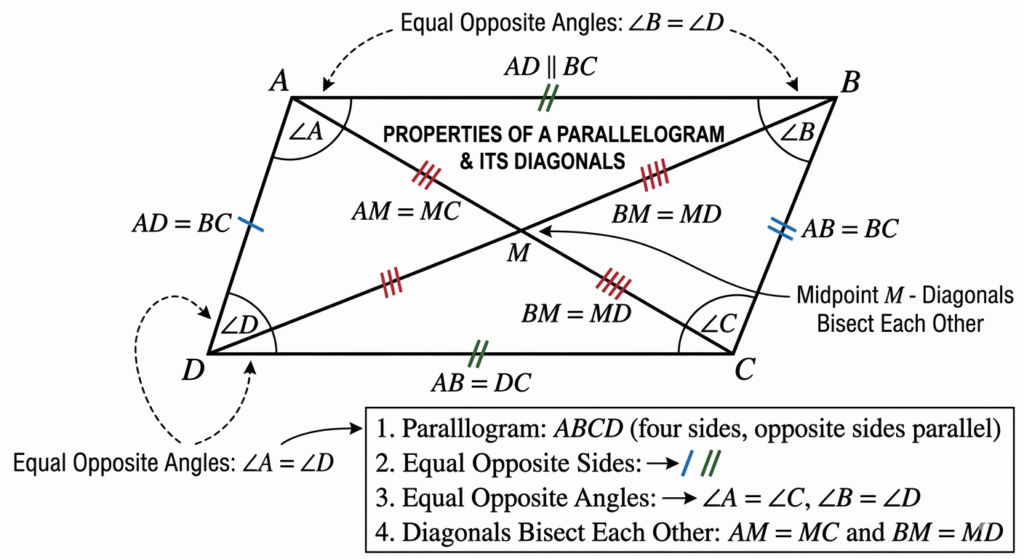
You don’t need to memorize a whole textbook for this. Every single geometry assignment solve for x each figure is a parallelogram problem is built on just four foundations. If you have these in your head, you’re untouchable:
- Top/Bottom & Left/Right are Twins: Opposite sides are the exact same length.
- Diagonal Corners match: If you look across the shape diagonally, those angles are equal.
- Side-by-Side adds to 180: If two angles are neighbors on the same line, they have to total 180 degrees.
- The Cross-Over: Where the diagonals meet, they cut each other exactly in half.
Part 1: When X is on the Outside (Side Lengths)
This is usually the easiest part of any geometry assignment solve for x each figure is a parallelogram. If the labels are on the lines forming the box, you are dealing with side lengths.
Example: The Equal Match
Let’s say the top line is $11x – 7$ and the bottom line is $103$.
- The Logic: Since it’s a parallelogram, the top must be the same as the bottom.
- The Equation: $11x – 7 = 103$.
- The Fix: Move that 7 over ($11x = 110$) and divide. You get $x = 10$.
Example: Variables Everywhere
If the left side is $5x + 10$ and the right is $3x + 30$:
- The Equation: $5x + 10 = 3x + 30$.
- The Fix: Pull the x’s to one side ($2x = 20$). So, $x = 10$.
Part 2: The Angle Game (Equality vs. 180)
This is where most people mess up their geometry assignment solve for x each figure is a parallelogram. You have to ask yourself: “Are these angles across from each other or next to each other?”
1. The Diagonal Match (Opposite Angles)
If the expressions are in corners facing each other diagonally, they are equal.
- Example: One corner is $(40x + 2)^\circ$ and the far corner is $122^\circ$.
- Equation: $40x + 2 = 122 \rightarrow 40x = 120 \rightarrow \mathbf{x = 3}$.
2. The 180 Rule (Consecutive Angles)
If the angles are neighbors on the same side, they are NOT equal. They add up to 180.
- Example: Top-left is $(4x + 21)^\circ$ and bottom-left is $(10x + 5)^\circ$.
- Equation: $(4x + 21) + (10x + 5) = 180$.
- Solving: $14x + 26 = 180$. After subtracting 26 and dividing, you get $\mathbf{x = 11}$.
If you’re wondering why this happens, it’s because parallelograms are basically just two triangles stuck together. You can see more about this in our breakdown of Congruence Reasoning About Triangles.
Part 3: Crossing Lines (Diagonals)
When your geometry assignment solve for x each figure is a parallelogram has lines through the middle, it’s testing if you know the “Midpoint Rule”.
Example: The Half-Line Trick
Suppose one half of a diagonal is $22$ and the other piece of the same line is $3x – 8$.
- Rule: The segments are equal.
- Equation: $3x – 8 = 22$.
- Solving: $3x = 30$, so $\mathbf{x = 10}$.
Pro Hacks: Spotting the Equation Fast
I’ve seen a lot of students fail their geometry assignment solve for x each figure is a parallelogram because they try to guess based on how the shape looks. Never do this. * The Sharp/Wide Test: Look at the angles. One is usually sharp (acute) and one is wide (obtuse). If you have one of each, they cannot be equal. Use the 180 rule.
- The Label Check: If the labels are inside the corner, it’s an angle problem. If they are on the line, it’s a side problem.
For students aiming for top-tier results in competitive exams, getting H2 Math Tuition can really help you understand the logic behind these proofs instead of just memorizing them.
The Example Vault: Solutions for Your Worksheet
Here are a few more common setups for any geometry assignment solve for x each figure is a parallelogram:
- Problem A (Sides): $7x + 3$ and $24 \rightarrow 7x = 21 \rightarrow \mathbf{x = 3}$
- Problem B (Angles): $11x – 3$ and $107^\circ \rightarrow 11x = 110 \rightarrow \mathbf{x = 10}$
- Problem C (Neighbors): $84^\circ$ and $16x \rightarrow 16x = 96 \rightarrow \mathbf{x = 6}$
- Problem D (Diagonals): $4x – 2$ and $2x + 6 \rightarrow 2x = 8 \rightarrow \mathbf{x = 4}$
Frequently Asked Questions (FAQs)
How do I know if I should use 180?
In your geometry assignment solve for x each figure is a parallelogram, if the two angles are “neighbors” (on the same side), use 180. If they are in “opposite” corners, set them equal.
What if it’s a Rhombus?
A Rhombus is a special parallelogram. The only difference is that all four sides are equal, so you can pick any two sides and set them equal to each other.
Can I use a calculator?
Most teachers allow it for the algebra part, but you still have to show that you knew which geometry rule to use first!
Final Thoughts
Finishing your geometry assignment solve for x each figure is a parallelogram doesn’t have to take all night. Just look at the labels, figure out if they are “twins” or “neighbors,” and let the algebra do the rest. Once you get the hang of these four properties, you’ll be able to solve these problems in your sleep.