

Academic Decathlon competition levels consist of four primary stages: local (scrimmage), regional, state, and finally, the national championship. Teams move through these rounds by racking up points across ten different academic subjects.
Getting a handle on the USAD (United States Academic Decathlon) hierarchy is the first step toward building a squad that actually stands a chance at winning. Whether you’re a student trying to boost your college applications or a coach dreaming of a state title, navigating these “rounds” takes a mix of smart strategy and serious academic range.
Overview of Academic Decathlon Competition Levels
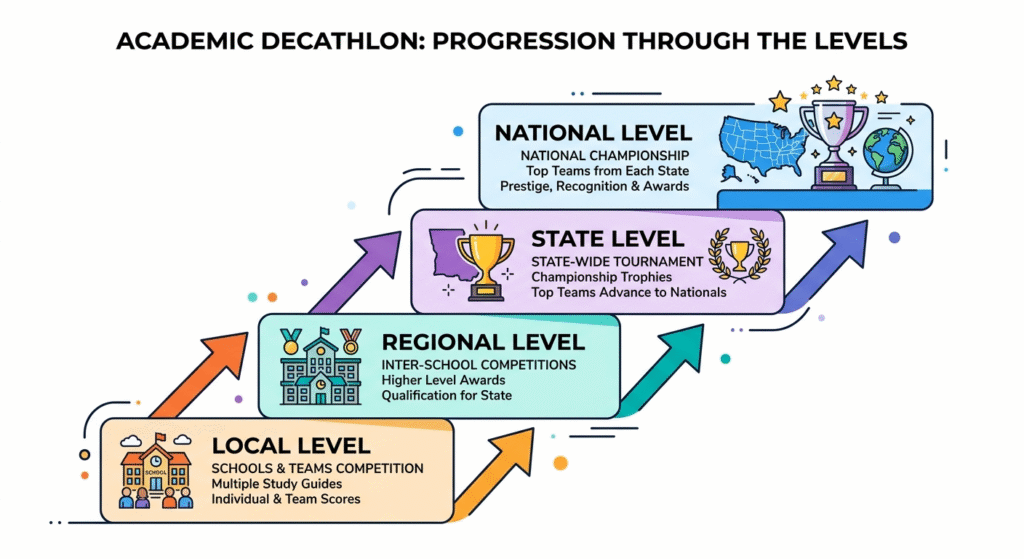
Think of this whole thing like a massive tournament. Schools start out in their own local areas and, if they have the scores to back it up, they move on to compete against the best academic minds in the state—and potentially the entire country.
1. Local / Scrimmage Level (Round 1)

The local level is often just called a scrimmage. You can think of this as the “pre-season” for academic nerds. These events are usually put together by a specific school district or county.
- Practice Under Pressure: Scrimmages are great because they let teams feel the heat of the ten subject areas without the fear of being kicked out of the competition.
- Real Feedback: Judges give out scores for the “subjective” events, like Speech and Interview. This is the perfect time for students to fix their eye contact or tweak their stories.
- Seeding: While many scrimmages are just for practice, some districts use these results to decide which teams go into which “seeds” for the regional rounds.
2. Regional Level (Round 2)
The regional round is where the gloves come off and the stakes get real. This is the first official qualifying round you have to pass to get to the state championship. Depending on where you live, this might be a county-wide contest or a specific “region” mapped out by the state director.
In states with huge programs, like Texas or California, regional contests are notoriously tough. Teams usually have to finish at the very top of their division or hit a specific “at-large” score to earn a spot at state.
3. State Level (Round 3)
If you win your regional title, you’re off to the state competition. This is usually a multi-day event where the vibe shifts from a high school gym to a college campus or a big-city convention center.
- Elite Competition: You’re only going up against the top-performing teams from every other region.
- Strict Rules: Things get serious here, especially with GPA verification. Every team must have their “3-3-3” roster locked in: three Honor students, three Scholastic, and three Varsity.
- The Ticket to Nationals: Usually, only the overall state champion (the team with the highest total points) gets the honor of representing their state at the national level.
4. National Level (Round 4)
The USAD National Finals is the absolute peak of high school academics. The location changes every year, bringing together state champs from all over the U.S. and sometimes even international teams from places like the UK or China.
At the national level, schools are split into Divisions (I, II, III, and IV) based on how big the school is. This keeps things fair so a small rural school isn’t forced to go head-to-head with a massive charter school that has thousands of students to choose from.
Academic Decathlon GPA Divisions
One of the coolest things about Decathlon is that it isn’t just for the “straight-A” crowd. To win, a team must have a mix of students with different academic backgrounds. Students compete in three divisions based on their unweighted GPA:
| Division | GPA Range | Description |
| Honors | 3.80 – 4.00 | The high achievers with the top grades. |
| Scholastic | 3.20 – 3.79 | The “B” students who usually form the heart of the team. |
| Varsity | 0.00 – 3.19 | The “C” students who bring a lot of raw talent to the table. |
Coach’s Tip: A winning strategy often involves finding a “Varsity” student who is incredibly smart but maybe just doesn’t love traditional homework. A high-scoring Varsity student is almost always the “secret weapon” that wins a state championship.
How Teams Advance Through Levels
Advancing is really just a numbers game. Each of the nine team members can score up to 1,000 points per event (10,000 total). While all nine students compete, only the top two scores from each category (Honor, Scholastic, Varsity) are added together for the team score. This makes the highest possible team score 60,000 points.
- The Qualifying Score: Most states have a “cut-off.” Even if you don’t win your specific region, you can still move on as an “at-large” team if your total points are high enough compared to the rest of the state.
- Keep Your Roster: Per the official USAD rules, the same nine-person team that won state has to be the one that goes to Nationals. No “trading up” for better students!
Why These Competition Levels Matter
The way Academic Decathlon is tiered teaches students more than just history or science—it teaches stamina. It’s easy to study in November for a scrimmage, but keeping that fire alive until the National Finals in April takes real discipline.
I
If you’re a student trying to stay focused during long study sessions, setting up a clean and distraction-free workspace can make a huge difference. Our guide on Workspace Design for Productivity shares simple ways to improve your setup. Coaches can also benefit from better organization—our tips on Digital Classroom Management help you keep study materials, practice tests, and schedules under control. And if you’re exploring structured learning paths, don’t miss our guide on B-BBEE Courses, which explains how specialized programs can support skill development and academic planning.
Frequently Asked Questions (FAQ)
How many levels are there in Academic Decathlon?
There are four official levels: Local (scrimmage), Regional, State, and National.
How do you qualify for the state level?
You either win your regional competition or score high enough to get an “at-large” bid based on your state’s rankings.
What are the GPA categories for Academic Decathlon?
They are divided into Honors (3.8–4.0), Scholastic (3.2–3.79), and Varsity (0.0–3.19).
Can a student compete in a lower GPA category?
No. You can “move up” (like a Varsity student competing in the Honors category), but you can never “move down” to a category with a lower GPA requirement.
Final Thoughts
Academic Decathlon is definitely a marathon, not a sprint. By understanding the different academic decathlon competition levels, teams can pace themselves and set smaller goals for each round. Whether you’re just trying to beat the rival high school next door or you’re aiming for a gold medal at Nationals, this journey is what builds the “decathlete” spirit and teamwork that lasts long after graduation.
Calculate your grade now => Easygrader