
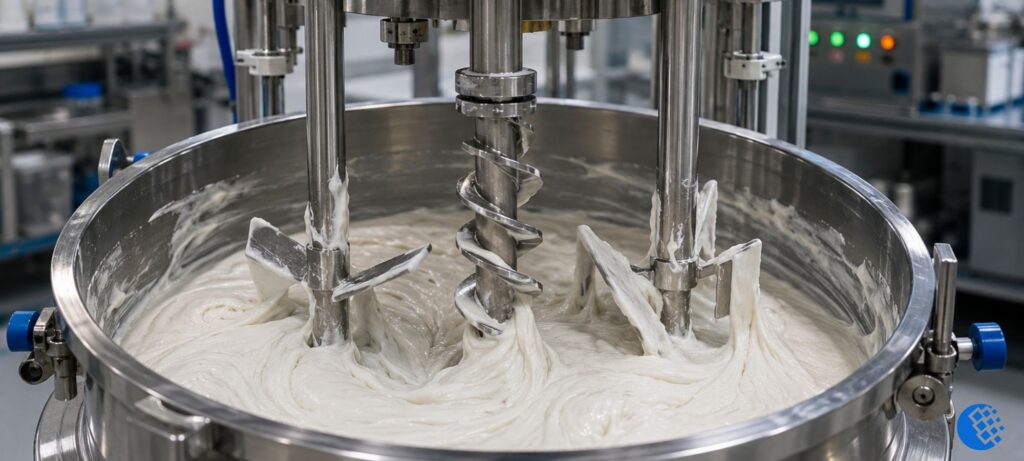
In research laboratories and product development environments, mixing is far more complex than simply blending ingredients together. The flow behavior of a material—known as its rheology plays a critical role in determining how effectively it can be processed, dispersed, and homogenized. Whether working with adhesives, coatings, inks, cosmetics, sealants, or specialty chemicals, understanding rheology is essential for selecting the right mixing technology.
As formulations become increasingly complex, especially those exhibiting non-Newtonian behavior, the design of mixing equipment must evolve to meet specific processing requirements. This is particularly true when working with highly viscous materials that demand specialized engineering and precise control. The relationship between rheology and mixer design is at the heart of modern laboratory-scale processing.
Understanding Rheology in Material Processing
Rheology is the science of how materials flow and deform under applied forces. Some materials flow easily like water, while others resist movement and require significant energy to mix. Many industrial formulations do not behave in a simple, predictable manner. Instead, their viscosity changes depending on factors such as shear rate, temperature, and processing conditions.
Materials can generally be classified as:
- Newtonian fluids, which maintain a constant viscosity regardless of applied force.
- Non-Newtonian fluids, whose viscosity changes under shear stress.
- Shear-thinning materials, which become less viscous when mixed.
- Shear-thickening materials, which become more resistant to flow under stress.
- Thixotropic materials, which decrease in viscosity over time when subjected to agitation.
These rheological characteristics directly influence the type of mixing equipment required for successful laboratory testing and scale-up.
Why High Viscosity Materials Require Specialized Mixing Equipment
High-viscosity formulations present unique challenges. Standard mixers often struggle to generate sufficient flow patterns, leading to poor ingredient distribution, dead zones, and inconsistent results.
When viscosity increases, several processing issues emerge:
- Reduced material movement
- Increased energy requirements
- Difficulty achieving uniform dispersion
- Greater heat generation
- Longer mixing cycles
- Potential air entrapment
To overcome these challenges, engineers design equipment specifically for demanding rheological conditions. A specialized high viscosity lab mixer provides the torque, blade geometry, and operational flexibility needed to process thick formulations efficiently while maintaining repeatable laboratory results.
The Influence of Rheology on Impeller and Blade Selection
One of the most important design decisions in laboratory mixing equipment involves selecting the appropriate impeller or blade configuration.
Different rheological properties require different flow patterns.
Axial Flow Impellers
Axial flow designs move material vertically through the vessel. They are commonly used for lower-viscosity fluids where circulation is relatively easy.
Radial Flow Impellers
Radial flow blades push material outward toward vessel walls. They generate higher shear forces and are useful when dispersion is a primary objective.
Helical and Anchor Mixers
For highly viscous materials, helical ribbons and anchor-style agitators are often preferred. These designs continuously sweep vessel walls, preventing stagnant regions while promoting efficient bulk movement.
The choice of blade geometry depends heavily on how the material responds to shear. Understanding rheological behavior enables engineers to optimize mixing efficiency while minimizing energy consumption.
Shear Forces and Mixing Performance
Shear is a critical factor in laboratory mixing operations. Some formulations require high shear to break apart agglomerates and achieve uniform particle distribution. Others may be sensitive to excessive shear and experience degradation if subjected to aggressive processing.
Rheological testing helps determine:
- Required shear levels
- Mixing duration
- Rotor speed ranges
- Energy input requirements
- Temperature management strategies
A properly designed mixing system balances these variables to achieve the desired product characteristics without compromising formulation integrity.
Vessel Geometry and Material Flow
Mixer performance is influenced not only by the agitator but also by vessel design.
The rheological properties of a formulation affect how material moves within the container. High-viscosity materials often exhibit poor circulation, making vessel geometry particularly important.
Design considerations include:
- Vessel diameter-to-height ratio
- Baffle placement
- Wall clearance
- Bottom configuration
- Material loading levels
Engineers use rheological data to optimize these parameters, ensuring effective mixing throughout the vessel volume.
The Role of Multiple Mixing Shafts
As viscosity increases, single-shaft systems may no longer provide adequate material movement. Multi-shaft configurations can significantly improve processing efficiency by combining different flow patterns within the same vessel.
For example:
- One shaft may generate bulk movement.
- Another may provide high-shear dispersion.
- A third may improve surface turnover.
This approach allows laboratories to process increasingly complex formulations while maintaining consistency and scalability.
An example of this design philosophy can be seen in manufacturers such as Hockmeyer Equipment Corporation, which develops laboratory mixing systems for high-viscosity and non-Newtonian materials. In these systems, factors such as blade design, shaft configuration, and operating conditions are selected based on the rheological characteristics of the formulation being processed, allowing researchers to evaluate material behavior under controlled laboratory conditions.
Scale-Up Considerations
One of the primary goals of laboratory mixing is generating data that can be successfully transferred to pilot and production environments.
Rheology plays a central role in scale-up because flow behavior often changes as batch size increases. Equipment that performs well at laboratory scale must reproduce similar shear conditions and mixing patterns at larger volumes.
Accurate rheological characterization helps engineers:
- Predict scale-up performance
- Reduce development risks
- Improve process consistency
- Minimize production delays
- Optimize equipment selection
Without a clear understanding of rheology, scaling a process can become costly and unpredictable.
Temperature Effects on Viscosity
Many materials exhibit significant viscosity changes with temperature. Even small temperature fluctuations can dramatically affect mixing performance.
For example:
- Resins often become easier to process when heated.
- Certain gels may thin under elevated temperatures.
- Some formulations can become unstable if overheated.
Modern laboratory mixers frequently incorporate temperature monitoring and control systems to maintain consistent processing conditions throughout testing and development.
Rheology Testing as a Design Tool
Before selecting laboratory mixing equipment, many organizations conduct rheological analysis using specialized instruments.
These tests provide valuable information regarding:
- Viscosity curves
- Yield stress
- Shear sensitivity
- Flow behavior index
- Time-dependent viscosity changes
The resulting data enables engineers to choose mixing technologies that align with the material’s unique characteristics.
Rather than relying on trial and error, rheological testing provides a scientific foundation for equipment selection and process optimization.
The Future of Rheology-Driven Mixing Design
As product formulations become more sophisticated, rheology will continue to play an increasingly important role in laboratory equipment design. Advances in automation, process monitoring, and computational modeling are enabling manufacturers to develop more precise mixing solutions tailored to specific material behaviors.
Future systems are expected to incorporate:
- Real-time viscosity monitoring
- Adaptive speed control
- Advanced process analytics
- Digital simulation tools
- Improved scale-up modeling
These innovations will help laboratories achieve greater efficiency, consistency, and product quality across a wide range of industries.
Conclusion
Rheology is far more than a theoretical concept—it is a practical engineering tool that directly influences how laboratory mixing equipment is designed and operated. From blade selection and shaft configuration to vessel geometry and shear management, understanding material flow behavior is essential for achieving reliable processing results.
For high-viscosity and non-Newtonian formulations, specialized mixing technologies are often necessary to overcome the challenges associated with thick, complex materials. By integrating rheological insights into equipment design, laboratories can improve product development, enhance process understanding, and create a stronger foundation for successful scale-up and manufacturing operations.