

When you start looking into graduate school options, it is incredibly easy to get lost in a massive bowl of alphabet soup. Between all the acronyms and titles, things get confusing fast. One of the most common questions people ask when sizing up their options is a simple one: is an MBA a master of arts or science?
The short answer is actually neither. An MBA, which stands for Master of Business Administration, is its own separate thing entirely. It is a standalone professional graduate degree and a distinct postgraduate education track. It doesn’t sit on the traditional Master of Arts (MA) or Master of Science (MS) academic tracks. Instead, it holds its own unique spot in higher education, built from the ground up to give you practical leadership skills and real-world business smarts.
Knowing how these tracks actually differ can save you a lot of headaches and help you pick the right path for your career goals.
Quick Answer: An MBA (Master of Business Administration) is neither a Master of Arts (MA) nor a Master of Science (MS). It is a professional master’s degree and a distinct graduate business degree classification focused on business management, organizational leadership, finance, strategy, and strategic decision-making.
What Is an MBA?

To see why the MBA gets its own special category, you have to look at what you actually learn in the program. A Master of Business Administration is what people call a professional qualification or a terminal professional degree.
Most traditional university programs want you to dive deep into theoretical research, history, or a single hyper-focused academic specialization. An MBA degree classification doesn’t do that. It is an interdisciplinary curriculum that gives you a broad, high-level look at how every single part of a business runs.
When you walk into a standard graduate studies business classroom, your core management education coursework will cover a bit of everything:
- Corporate finance and day-to-day managerial accounting
- Strategic management and organizational leadership
- Marketing strategies and understanding consumer habits
- Business operations, logistics, and supply chains
At the end of the day, the goal of this postgraduate business degree isn’t to turn you into a university researcher or an academic. It is to get you ready for high-level management, executive leadership, or starting your own company. Because of that, you will spend your time working through real case studies, handling group projects, and building a professional network.
Is an MBA a Master of Arts or Science?
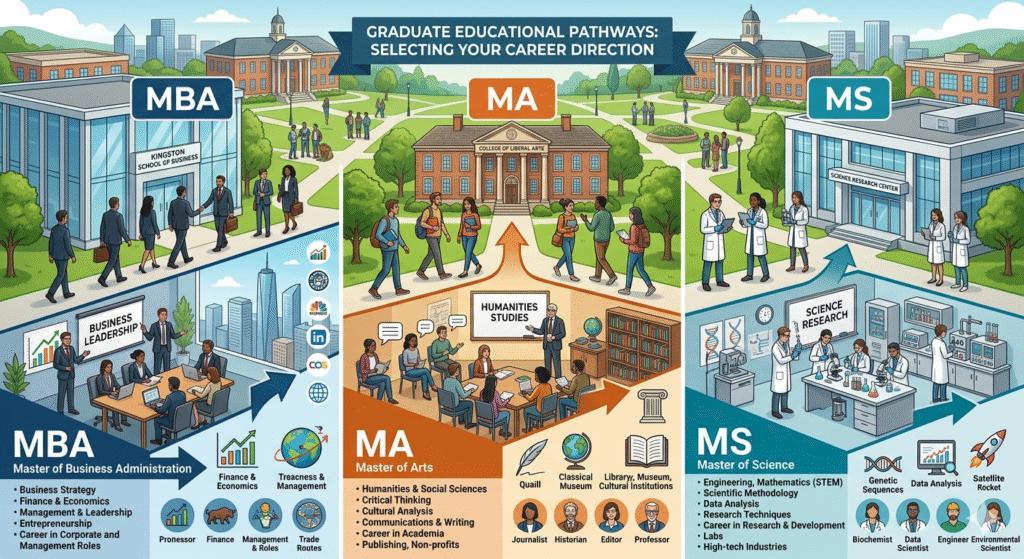
If you are trying to figure out is mba master of arts or science, it helps to understand how universities break down their degrees.
Once upon a time, graduate degrees were split right down the middle. If you studied the humanities or social fields, you got an arts degree. If you studied technical, data-heavy, or empirical fields, you got a science degree. But as the modern corporate world grew, it needed something else.
Business leadership takes a mix of qualitative people skills and quantitative math skills. Because it didn’t fit cleanly into either box, the academic world created a dedicated professional master’s degree category.
Here is a quick breakdown of how a Master of Business Administration compares to standard MA and MS tracks across most universities:
| Feature | MBA (Master of Business Administration) | MA (Master of Arts) | MS (Master of Science) |
| Main Focus | Broad business management & corporate leadership | Humanities, social sciences, communication | Technical subjects, hard sciences, data analytics |
| How You Learn | Case studies, team projects, practical strategy | Qualitative research, long essays, theory | Quantitative research, lab work, raw data |
| Who It Is For | Aspiring managers, executives, entrepreneurs | Teachers, creatives, policy analysts | Technical experts, data analysts, scientists |
| Thesis Needed? | Very rarely (you usually do a capstone project) | Pretty common (academic research paper) | Very common (data or lab-based thesis) |
Thanks to these structural differences, an academic institution won’t hand you an MBA as a sub-type of an MA or an MS. Many accredited MBA programs are recognized by organizations such as AACSB, one of the most respected accrediting bodies for business education worldwide. It stands completely on its own feet as an independent academic credential.
Is an MBA Considered a Science Degree?
Even though it has its own distinct category, people look at the heavy numbers, spreadsheets, and financial models in business school and wonder: is mba a master of science or arts deep down?
To be fair, the lines have gotten a little blurry lately because of big data. Lots of modern business schools offer specialized tracks in things like business analytics, supply chain statistics, or quantitative finance. Some schools have even changed their classes around so their programs get an official STEM designation from the government.
But even if your specific program spends all its time on data science, your actual diploma is still going to say Master of Business Administration. Adding some heavy math or data tools doesn’t change what the degree is at its core, which is a program built around running organizations and executive management.
Can an MBA Be Equivalent to an MA or MS?
If you talk to a hiring manager, they usually look at graduate degrees based on what you can actually do for the company, not just the exact letters on your resume. If a job posting says they want a “master’s degree in a related field,” employers often treat an MBA, an MA, or an MS similarly depending on the role.
For example, if you want a job in corporate strategy, a company will probably want an MBA over an MS because they need someone who understands the big picture. On the flip side, if you want to be a pure data scientist or a research economist, a specialized Master of Science is way more valuable because it proves you have deep, specific technical skills.
In the end, when comparing an MBA vs MS or an MBA vs MA, they aren’t completely interchangeable because they do different jobs. An MA or an MS makes you a specialized expert in one topic, while an MBA makes you an expert at managing people, budgets, and systems.
Professional vs. Academic Master’s Degrees
When you are figuring out your next steps in higher education, you want to pick a degree structure that matches how you actually like to learn and work. Some people love highly technical, structured tracks, while others prefer big-picture, communication-heavy learning.
For instance, if you love focusing on how people talk, human development, or language learning, you might find a better fit in humanities programs, like the style found in Language Lessons for a Living Education, which focus heavily on practical communication skills. Other people might want to skip the office world entirely and look at specialized Online Physical Education Courses to build real-world teaching credentials outside of a corporate desk job.
The biggest takeaway is that you shouldn’t pick a program just because the title sounds prestigious on paper. Take a close look at the actual classes, find out if it is more math or communication based, and see where people who graduate actually get hired.
Key Takeaways
- An MBA is not a Master of Arts (MA).
- An MBA is not a Master of Science (MS).
- MBA stands for Master of Business Administration.
- It is officially classified as a professional master’s degree rather than an academic one.
- MBA programs focus heavily on strategic decision-making, organizational leadership, finance, and business operations.
Frequently Asked Questions
Is an MBA a master’s of science or arts?
Neither one. It is a professional master’s degree that sits completely outside the traditional Master of Science (MS) and Master of Arts (MA) academic tracks.
Is an MBA considered a higher qualification than an MA or MS?
No, they are on the exact same academic tier (Level 7 postgraduate education qualifications). An MBA is a professional track meant for general business leadership, while an MA or MS is an academic track meant for deep study into a specific topic.
Can you get a Master of Science in Business Administration?
Yes, you can. Some schools offer a Master of Science in Business Administration (MSBA) or an MS in a specific area like finance or digital marketing. These programs focus almost entirely on technical data and research, whereas a standard MBA is all about general management.
What type of degree classification is an MBA?
It is officially classified as a professional graduate degree. The focus is on giving you practical tools you can use in the corporate world, rather than setting you up for academic research or a PhD track.
Do I need a science or arts background to get an MBA?
Not at all. One of the best things about an MBA is that classrooms are full of people from every background imaginable. It doesn’t matter if your bachelor’s degree is in engineering, fine arts, history, or biology—as long as you meet the regular admission and professional requirements, you can get in.
Is an MBA considered a professional degree?
Yes, an MBA is classified as a professional degree. This means its primary goal is to teach practical, real-world skills for professional career advancement, rather than focusing purely on theoretical academic research.
Is an MBA equivalent to a master’s degree?
Yes, an MBA is a full master’s level degree. While it has a different structure and focus than a traditional Master of Arts or Master of Science, it carries the same academic weight as any other master’s program.
Conclusion
To summarize, is an MBA a master of arts or science? It is neither. An MBA is a professional graduate degree designed to develop leadership, management, and strategic business skills. While MBA programs may include both qualitative and quantitative coursework, universities classify them separately from traditional MA and MS degrees. Choosing between an MBA, MA, or MS depends on your career goals, learning style, and desired level of specialization.