

For years, high school followed the same script. Late nights studying for standardized tests. Keeping your GPA as high as you could manage. Squeezing your extracurriculars into a few bullet points on a generic application form. That’s not really how it works anymore.
Today’s top universities are looking past the transcript. They want to see how you actually think, what you can build, and how you handle problems when things don’t go as planned.
That’s exactly why knowing how to create a portfolio for college admissions matters so much right now. It’s one of the few parts of your application where you’re fully in control of the story. Whether you’re applying to a computer science program or a fine arts school, a well-put-together college application portfolio can genuinely change how a committee sees your file.
I’ve seen this play out with students who had solid but unremarkable grades. Once they put together a real portfolio — one that actually showed their thinking, not just their output — reviewers started remembering their names. It’s a small thing that ends up mattering a lot. If you’re also thinking about how the rest of your student life feeds into this, it helps to look at what a student success definition actually looks like beyond grades — a portfolio is really just one piece of that bigger picture.
Here’s a mistake a lot of students make: they assume portfolios are only for art majors. That’s not true anymore. Admissions offices across the board — even for engineering, research, and business programs — want to see proof of what you’ve actually done, not just what you’re capable of on paper.
What Is a College Admissions Portfolio?

Think of it as your academic story, told through actual work instead of a list of accomplishments. A college admissions portfolio is a carefully chosen collection of your strongest projects — whatever form those take. Sketches, code, research papers, essays, design mockups, it doesn’t matter. What matters is that it shows how you’ve grown.
A lot of students treat this like a second resume, and that’s where things go wrong. A resume tells someone what you did. A portfolio shows them how well you did it. It gives an admissions officer a real look at how your mind works, not just a summary of your involvement.
Simple way to remember it: your resume lists your achievements. Your portfolio proves them.
Who Needs a College Admissions Portfolio?
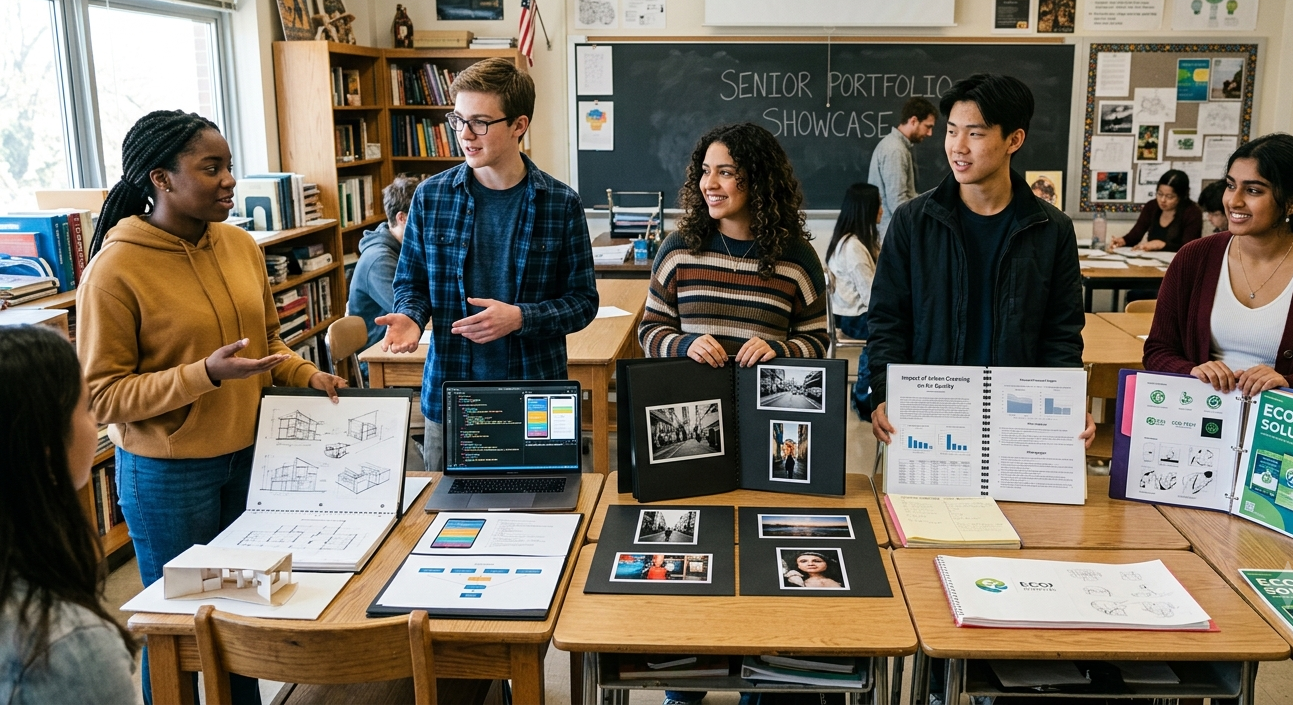
Not every applicant needs one, but for certain programs, it’s not optional — it’s expected. If you’re applying to any of these, your submission carries serious weight in the final decision:
Fine Arts & Studio Design — Illustration, graphic design, textiles, animation. Reviewers are checking your technical foundation and whether you have a voice that’s actually your own.
Architecture & Industrial Design — These programs care about spatial thinking, drafting skills, prototyping, and how you approach a problem that doesn’t have one clean answer.
STEM & Computer Science — Schools like MIT genuinely welcome maker portfolios, breakdowns of mechanical builds, or an active GitHub repository full of real projects.
Media Arts & Filmmaking — Screenwriting, film production, broadcast journalism. They want a portfolio that flows well and shows you understand pacing and editing, not just raw footage.
Humanities & Research — Honors programs often want writing samples: independent research, long-form articles, or scientific abstracts that show you can think critically on your own.
How to Create a Portfolio for College Admissions
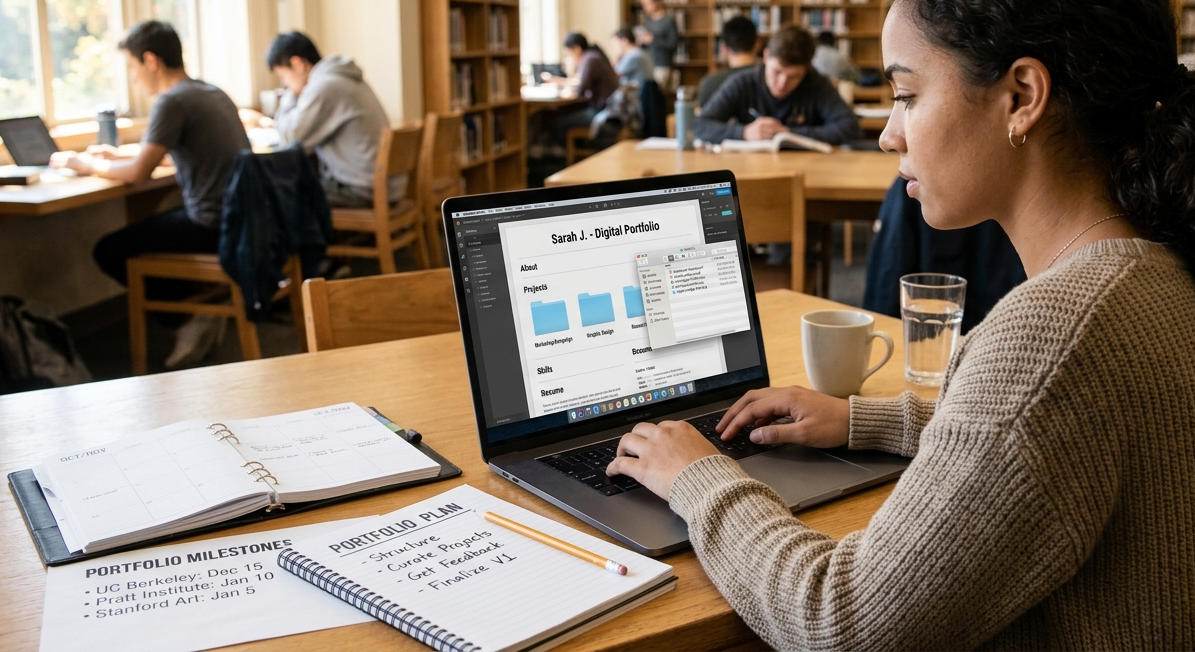
Building a portfolio from scratch can feel like a lot at first. I get why — you’re staring at years of random projects with no idea where to start. But it gets a lot more manageable once you break it into steps. Here’s how to put together something that actually sticks with the person reading it.
Step 1: Check Each School’s Requirements First
Before you organize a single file, look up the exact submission rules for every school on your list. This part matters more than people think — requirements vary a lot from one college to the next.
Some schools want everything uploaded through the Common App, which you can review directly on the Common App website, while others use dedicated portals like SlideRoom. It helps to keep a simple spreadsheet tracking file formats, resolution requirements, and deadlines for each one. Missing a small detail here can get your work overlooked before anyone even opens it.
Step 2: Be Ruthless About What You Include
Quality beats quantity, every time. An admissions committee might go through dozens of files in one sitting — they’ll remember three or four genuinely strong pieces far longer than a folder crammed with average ones.
Aim for somewhere around 8 to 15 pieces that show real range. One student I know of, applying for architecture, cut her portfolio down from twenty-two projects to nine. She was nervous about it at first, thought she was leaving too much out. But those nine pieces, each with sketches and revisions included, told a far stronger story than the full twenty-two ever could.
If you’re submitting art, don’t fill the folder with a dozen charcoal portraits. Mix in some color work, digital design, or a 3D piece so it’s clear you’re not a one-trick artist.
Step 3: Give It a Logical Flow
The way your portfolio is organized matters almost as much as what’s in it. You can go chronological, to show growth over time, or group things by theme or medium. Either way, treat it like walking someone through a gallery — each piece should lead into the next without feeling random.
Step 4: Write Short, Clear Descriptions for Each Project
A great piece of work loses a lot of its impact if the reviewer doesn’t understand what they’re looking at. Don’t make them guess.
For each project, write a few sentences covering:
- What problem or prompt you were working with
- The tools or languages you used (Python, Figma, Photoshop, whatever applies)
- Your specific role, especially if it was a group project
- The biggest obstacle you ran into, and how you got past it
Step 5: Show Your Process, Not Just the Final Product
Colleges aren’t only interested in the polished result. They want to see the messy middle — early sketches, failed attempts, rough drafts, or code that went through five versions before it worked. That’s what proves you can push through a hard problem, which is exactly the kind of thing college-level work demands.
Building good habits around this kind of steady, documented work often comes down to routine more than talent. If you’re trying to figure out how to actually fit portfolio work into a packed school schedule, it’s worth reading through this breakdown of a daily routine of a student — a lot of the same time-blocking ideas apply directly to portfolio building.
Step 6: Pull In Your Other Credentials
Your portfolio shouldn’t exist in isolation. Give it a section for your resume, a short list of awards or certifications, and a quick rundown of your extracurriculars or leadership roles. This ties everything together into one full picture.
Step 7: Build a Clean, Simple Online Home for It
Presentation matters here almost as much as the work itself. If someone has to dig through messy folders or wait forever for a page to load, you’ve already lost them. Most students today build their online portfolio for college admissions using simple website builders. Keep the design minimal — plain fonts, neutral backgrounds — and let the actual work stand out.
Step 8: Get a Second Opinion Before You Submit
Don’t send it off the second you finish. Step away from it for a day, then come back with fresh eyes — you’ll usually notice something you missed. Better yet, share the link with a teacher, counselor, or mentor you trust. Test every link in a private browser tab to make sure permissions actually work, check that images load properly on a phone, and read through everything one more time for typos.
How to Create a Photography Portfolio for College Admission
If you’re aiming for a photography or photojournalism track, building your portfolio takes a slightly different mindset. Reviewers here aren’t looking for a stack of nice vacation photos. They want a clear point of view.
Build around one idea, not twenty random ones. Instead of scattering unrelated shots, group your work around a theme — a documentary series about your neighborhood, a study of light and shadow in local architecture, whatever genuinely interests you. A focused theme shows you can develop an idea over time, not just snap a good photo once.
Show that you understand your camera. Reviewers want to see manual control over lighting, framing, and different shooting environments. A strong mix might include:
- Portraits with intentional, controlled lighting
- Candid street or documentary-style shots
- Architectural or texture-focused close-ups
- Editing that enhances the image without overdoing it
Keep your editing honest. Every photo you submit should be sharp and well-balanced. Skip the heavy filters and over-saturated edits — let your composition and connection to the subject do the work.
Best Portfolio Platforms for Students
Where you build your portfolio depends on your major and how comfortable you are with tech. Here’s a quick breakdown of the most reliable options:
| Platform | Best For | Format | Why Use It |
|---|---|---|---|
| SlideRoom | Direct college submissions | Fixed upload fields | Connects directly with Common App |
| GitHub | Coding, CS, data | Repositories & Readmes | The standard for software reviews |
| Behance | Visual arts, branding, design | Grid-style project blocks | Clean layout, strong visibility |
| Wix / Squarespace | Personal websites | Drag-and-drop | Full control over your own branding |
| Adobe Portfolio | Photography, media | Minimalist image grids | Free with an Adobe subscription |
| Canva | Quick presentations | Slide decks or PDFs | Easy templates for a college portfolio |
| Google Drive | Research papers, academic files | Shared folders | Simple, though not very visual |
What to Include in a College Portfolio: Quick Checklist
- A short, professional bio covering your goals and inspiration
- 8 to 15 well-chosen projects, leading with your strongest piece
- Some process documentation — sketches, notes, early drafts
- A short summary explaining the tools, purpose, and lesson behind each project
- Links to your resume, honors, and extracurricular summary
- A layout that works cleanly on laptop, tablet, and phone
Common Mistakes That Hurt a Student Portfolio
Including everything you’ve ever made. Extra filler work drags down your strongest pieces. Be selective.
Skipping the explanation. A wall of code or a row of unlabeled images forces the reviewer to guess. Always give context.
Using low-quality images. Blurry photos of drawings or grainy screenshots look unprofessional. Take the extra ten minutes to get a clean, well-lit scan.
Locking your files. A password-protected link or a private Google Drive folder can quietly kill your chances — busy reviewers won’t chase down access.
Ignoring the format they asked for. If a program wants a horizontal PDF, don’t send a website link instead. Small detail, but it matters.
Quick Answer
How do you create a portfolio for college admissions? Start by checking each school’s specific requirements, then choose your strongest 8–15 projects, organize them in a clear flow, write short descriptions explaining your process, and host everything on a clean, simple platform or PDF.
Frequently Asked Questions
What is the best portfolio website for students? For design or photography, Wix and Squarespace give you the cleanest, most customizable layouts. For computer science or engineering, a well-organized GitHub profile is what most reviewers expect to see.
How many projects should I include in a college portfolio? Somewhere between 8 and 15 strong, distinct pieces. That’s enough to show range without overwhelming the person reviewing it.
Is a website better than a PDF portfolio? Usually, yes — websites let you include interactive elements, video, and live links. That said, always check the specific school’s rules first. Some traditional programs still ask for a single PDF.
Can I use Canva to build my portfolio? Yes. Canva works well for polished slides or a clean PDF export, especially if you start from a portfolio template. Just make sure you export at a high resolution.
Do all colleges require a portfolio? No. Most general undergraduate applications rely on transcripts, essays, and test scores. But a growing number of schools let you submit an optional portfolio if you want to highlight a specific skill in art, music, or research.
What should I leave out of my portfolio? Old middle school work, unfinished sketches, repetitive pieces that show the same skill twice, and fan art. Also skip group projects where you can’t clearly point to your own contribution.
How early should I start building my portfolio? Ideally, sometime during junior year, so you have real time to collect strong work and refine it — rather than scrambling to put something together the month before deadlines hit.
Should I include unfinished work? A little bit is fine, especially if it shows your process. But most of your portfolio should still be finished, polished pieces.
Can I use the same portfolio for multiple colleges? Generally yes, though you may need to adjust the format depending on each school’s submission platform.
Final Thoughts
Putting together a real portfolio takes patience, and yes, some honest editing of your own work. But it’s also one of the only parts of your application where you get to decide exactly how your story gets told.
If you want a sense of how selective admissions offices actually think about this kind of proof-of-work, it’s worth skimming through how a school like MIT Admissions talks about maker portfolios and self-directed projects — it’s a good reality check on what “impressive” actually means to a reviewer.
Choose your strongest pieces, show how you think through a problem, and shape the layout around what each program actually values. When you put genuine effort into how it’s presented, admissions committees notice — and that’s exactly why mastering how to create a portfolio for college admissions is completely worth the time it takes.