
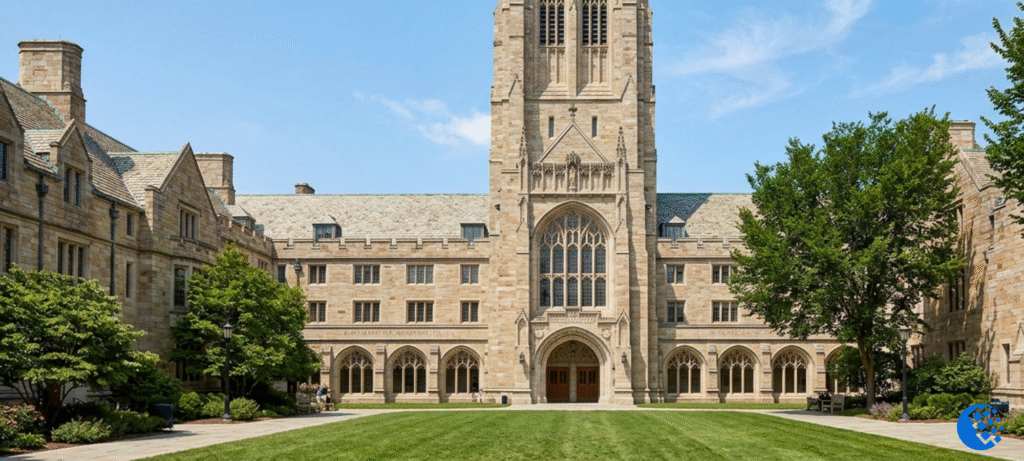
Early morning on York Street, and there’s almost always someone stopped under that stone tower taking a photo. Most of them will tell you it’s the Hall of Graduate Studies. Technically, they’re a few years out of date — Yale quietly renamed the building back in 2021 — but honestly, nobody’s going to correct them on the sidewalk.
That’s the whole story in miniature, really. Same Gothic building at 320 York Street in New Haven. Same stone carvings, same arched windows. Different name now — Humanities Quadrangle — and a genuinely different building once you step past the front door.
If you searched “hall of graduate studies” hoping for a quick answer, here it is: opened in 1932, historic Yale landmark, renovated in 2021, now officially called the Humanities Quadrangle. Same place. New purpose. Keep reading if you want the full picture, because there’s more going on here than a simple rename.
What Is the Hall of Graduate Studies, Exactly?
When it opened in 1932, Yale finally had a building designed specifically around graduate life, instead of squeezing doctoral students and faculty into whatever space happened to be free elsewhere on campus. Offices, classrooms, actual dormitory rooms, shared common areas — all of it under one Gothic roof, which wasn’t especially common at the time.
For most of the twentieth century, that’s exactly what it was. The place doctoral students lived and worked. Faculty offices lined its halls. Its central tower became one of those buildings you’d point to and say “that’s Yale” without even needing to explain further.
Not anymore, not quite. After a renovation wrapped up in 2021, the building picked up a new name — Humanities Quadrangle — and a new job: housing roughly fifteen humanities departments instead of functioning as the graduate school’s general headquarters. Old habits die hard, though. Plenty of alumni, a fair number of faculty, and even some current students still call it HGS without thinking twice.
The Building’s Backstory
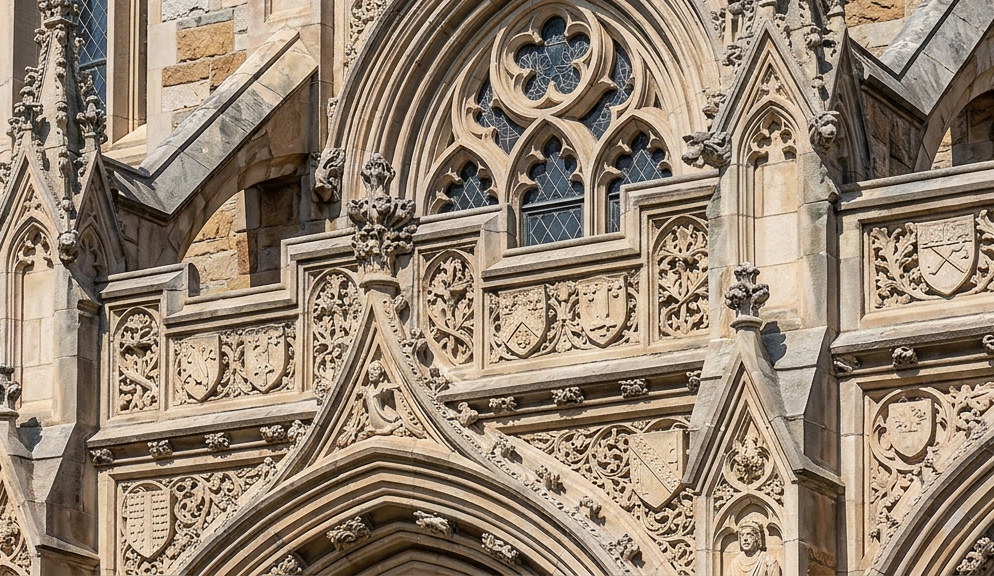
Construction ran 1930 to 1932. James Gamble Rogers designed it — the same architect responsible for a huge chunk of Yale’s Collegiate Gothic look more broadly, so if the building feels like it belongs, that’s why. This wasn’t a minor project either. Yale wanted its graduate school to have a real physical identity, something separate from the undergraduate residential colleges scattered around campus.
And for decades, it worked exactly as intended. Generations of doctoral students came through those doors. One thing that surprises people who don’t know the building well: it originally mixed academic space with actual dorm rooms, which is part of why the interior layout still feels a little unusual compared to a standard classroom building, even after everything got reworked.
Why Renovate a Nearly Century-Old Building?
By the 2010s, the wear was showing. Old infrastructure. Accessibility problems that any building from 1932 was bound to have eventually. And a layout that just didn’t encourage humanities faculty from different departments to bump into each other, which Yale increasingly wanted to fix.
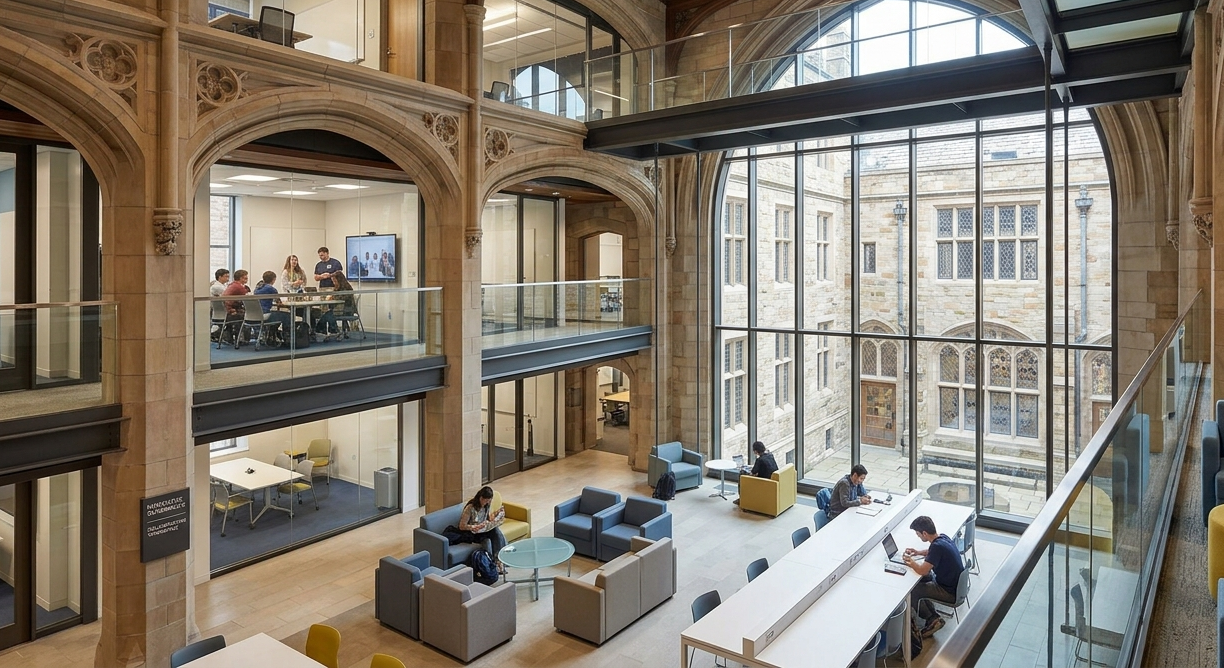
Tearing it down apparently was never really on the table — the building’s too much a part of Yale’s identity for that. So the university went with a full gut renovation instead, keeping the historic shell intact while rebuilding practically everything behind it. New underground space. A lecture hall. Film screening rooms. Wider hallways, specifically so people from different departments would actually run into each other during the day — that kind of informal collaboration is a lot harder to manufacture than it sounds on paper. Energy efficiency upgrades came along for the ride too, since nobody was building green in 1932.
One thing many visitors don’t expect: how different the inside feels now. From the street, it’s still every bit the 1930s Gothic landmark. Step through the entrance, though, and the contrast hits you almost immediately — open study spaces, modern classrooms, none of the cramped, dim corridors you’d brace yourself for in a building this old.
So Is It Hall of Graduate Studies or Humanities Quadrangle?
Here’s where the confusion usually starts. Alumni say “Hall of Graduate Studies.” Yale’s own website mostly says “Humanities Quadrangle.” Both are talking about the exact same building — same address, same stone tower, same footprint.
Why did Yale rename it? After the 2021 renovation, Yale renamed the historic Hall of Graduate Studies to reflect what the building actually does now: house multiple humanities departments and shared research space, rather than serve as the graduate school’s general hub the way it did for most of the last century.
So if an old syllabus, a professor, or a campus map still says HGS, don’t second-guess yourself. That’s the Humanities Quadrangle they mean.
What the Architecture Is Actually Doing
Collegiate Gothic, through and through — stone construction, that central tower, arched doorways, decorative carvings tying it to the rest of Yale’s older buildings. Rogers built several of Yale’s most recognizable structures, and this one shares a lot of the same architectural DNA.
What changed is everything behind that stone face. The renovation kept the exterior and the overall silhouette essentially untouched while reworking how people actually move through the interior. Interestingly, the extra square footage came from digging down rather than building out or up — which meant more usable space without touching the historic exterior at all. Smart move, honestly, given how much the building’s outward appearance matters to people on campus.
Who’s Actually Working Inside Now
Today, wander through the Humanities Quadrangle and you’ll pass faculty offices, graduate study rooms, seminar spaces, and departments ranging from History and English to Film & Media Studies and Comparative Literature. Roughly fifteen departments call it home at this point, though the exact count shifts a bit as Yale reorganizes programs over time — nothing in a university stays perfectly static for long.
Bringing that many departments under one roof was really the whole point of the renovation. Before 2021, humanities faculty were scattered across several separate buildings, which made the kind of casual, cross-department conversation Yale wanted to encourage genuinely difficult to pull off. You can’t really engineer a hallway run-in between two professors who work in different buildings entirely.
Don’t Confuse This With the McDougal Center
Quick but important distinction, because it trips people up constantly. The historic building got rebranded as the Humanities Quadrangle — but day-to-day graduate student life, events, and support services didn’t move in there with it. That’s all handled separately, at the McDougal Graduate Student Center.
So if you’re actually looking for graduate student resources rather than the historic building itself, you want McDougal Center. Not the Quadrangle.
Getting There From Chapel Street
The building sits at 320 York Street, right in the middle of Yale’s central New Haven campus — an easy walk from most of the university’s core buildings. Coming from somewhere like 1275 Chapel Street? You’re looking at just a few minutes on foot through the heart of campus. Exact timing shifts a bit depending on which entrance you’re aiming for and how you cut through the block, but it’s not a trek by any stretch.
If You’re Planning to Visit
Don’t expect this one to work like a museum. Classes, seminars, faculty meetings — they’re running throughout the day, so public access inside is naturally limited to people with actual business there. The exterior’s a different story. It’s easy to appreciate right from York Street, and honestly, it’s one of the more photographed Gothic buildings on Yale’s whole campus. If you’re doing any kind of campus architecture walk, it’s worth putting on the route.
Frequently Asked Questions
Is Hall of Graduate Studies still open? Very much so — it’s just operating under a new name, Humanities Quadrangle, with a different focus centered on humanities departments rather than general graduate school functions.
Why is it called Humanities Quadrangle now? Yale renamed the historic building after wrapping up a major renovation in 2021, reorganizing it around humanities departments rather than the graduate school broadly.
Who designed Hall of Graduate Studies? James Gamble Rogers, the architect behind much of Yale’s Collegiate Gothic campus, designed it. Construction ran from 1930 to 1932.
Where is Hall of Graduate Studies at Yale University? 320 York Street, New Haven, Connecticut — right in the heart of Yale’s central campus.
Can visitors go inside? Access is generally limited since it’s an active academic building full of ongoing classes and meetings, but the exterior and courtyard are easy to see from the street.
What departments are located there now? Around fifteen humanities departments and programs, including History, English, Film and Media Studies, Comparative Literature, and several language and religious studies programs.
How far is it from 1275 Chapel Street to Hall of Graduate Studies? Both sit within Yale’s central campus, and it’s a short walk — a few minutes, give or take, depending on your exact route.
Final Thoughts
The Hall of Graduate Studies didn’t disappear. The name mostly did. What actually changed is what happens behind that Gothic stone face — instead of running as Yale’s general graduate school hub, the building now anchors the humanities departments as the Humanities Quadrangle, with an interior that manages to feel genuinely current without stripping away the character that made people stop and take photos of it in the first place. Next time you hear either name on a campus tour, or spot it in an old course catalog, you’ll know they’re both pointing at the same stone tower on York Street.
If you’re comparing Yale’s buildings against other notable academic addresses, our piece on 64 University Place New York covers a similarly historic building worth knowing about. And if Yale is one of several schools on your list, our breakdown of the University of St Andrews Acceptance Rate is a useful comparison point for admissions research.
For the most current details, Yale’s official Humanities Quadrangle page is the best primary source, and Yale News’ coverage of the renovation gives a solid firsthand account straight from the university.