
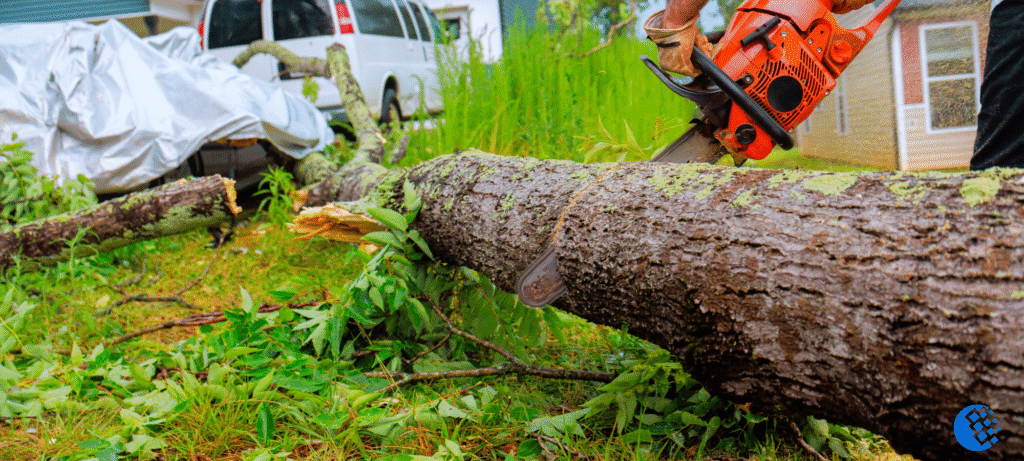
A strip center owner on the west side of Conway called about a water oak that had gone bare over the four parking spaces outside her nail salon. One crew quoted her $1,800. Another said $600, cash, that weekend. Neither number was invented, and that is the trouble with comparing them: the bids described different jobs, and only one priced the crane time and the lane closure. Access and risk set the price of a commercial removal, not trunk diameter, so any tree service conway ar property owners hire for a parking-lot job quotes the obstacles first. Here is the arithmetic behind that number, and where a low bid hides what it left out.
What Goes Into A Commercial Removal Quote
Start with the hazard, because the hazard prices everything after it. A dead tree over a parking lot can fail without warning, onto a windshield or onto a person, so cordon the drop zone off with cones and have a professional crew take it down promptly. That is not a sales line. Tree Care Industry Magazine reports that about half of all fatal tree-work incidents involve a person being struck by the tree itself, which is what a property owner risks with a rented saw.
Past that, a commercial quote is mostly a question of access. Can a bucket truck or a crane reach the trunk without crossing soft ground or a sidewalk slab? How much of the lot closes, and for how long? Each answer moves labor hours, and labor hours are the invoice. Plywood and steel mats to spread a crane’s load cost money too, far less though than repaving asphalt that cracked under an outrigger.
A Dead Parking-Lot Tree Priced Out
The case we see most often on small retail lots is a tree that died two summers back and has been shedding limbs ever since. Bark sloughing off in sheets, woodpecker holes near the union of two leaders. By the time the owner calls, the wood is brittle, which rules out a climber on that trunk and puts a crane into the quote. Ten years ago the same job took a full day, with half the lot roped off until the last brush run. Today a small crane picks the top out in three lifts, the ground crew feeds the chipper, and the lot reopens before lunch. The day rate looks worse on paper. The total usually comes in lower, because you are buying four hours of six people instead of nine hours of four.
Run the strip center oak as a scenario. Say the crane and operator come in at $850 on a four-hour minimum, the climber and two ground men bill $1,050 for five hours, hauling six tons of wood off the lot runs $270, and grinding the stump twelve inches below grade adds $170. That comes to $2,340 all in, on a lot that never closed for longer than one morning. Substitute your own crane rate and your own tonnage and the shape of it holds. The equipment and the people are the bill; the stump is the smallest line and the one owners argue about most.
The tree is already dead, but why it died should change how you treat its neighbors. In February 2026 the Texas A&M Forest Service put additional money behind slowing oak wilt, one of the most destructive tree diseases in the country, and its guidance on timing is specific: the high-risk period for spreading the fungus through fresh wounds runs February 1 through June 30. Wounds cut in that window should be painted immediately. The agency credits the disease with killing millions of trees in Central Texas. That calendar is Texas guidance, but the mechanism travels, so a tree service Conway AR property managers keep on file should schedule oak pruning around that window rather than the landscaping invoice. Ask your arborist which months he avoids.
A dead tree over pavement is a demolition job, not a landscaping chore. Price it that way and the number stops feeling like a surprise.
Why The Cheapest Bid Costs More Later
That $600 bid usually means no certificate of insurance, or a crew that drops the trunk in one piece and hopes the lot is empty. Ask for the certificate and the workers compensation declaration page before anybody starts an engine. Then ask plainly who pays if a limb lands on a customer’s hood. The Insurance Information Institute reports that bodily-injury liability claims average $37,174, and that roughly one in 1,150 homeowner policies files a liability claim in a year. Commercial coverage is not homeowner coverage and rules vary by state, so who pays is whatever the two policies actually say.
Cheap bids have a way of turning up again at the insurance renewal. Collect two or three quotes that describe the same scope, crane and mats and stump included, and compare on that basis instead of the bottom line. For a small Conway lot, an honest range for one dead hardwood over pavement lands in the low thousands. The tree comes down on a Tuesday morning with the salon open, the asphalt intact, and nothing left to sort out at renewal.