“Agent” has been applied to so many products that it has nearly stopped meaning anything. Some of those products are chatbots with a new label. Some are genuinely different systems. Telling them apart matters, because the two solve different problems and cost different amounts to run.
The distinction is not about the model. The same underlying model can power either. It is about what surrounds the model.
Four capabilities that separate them
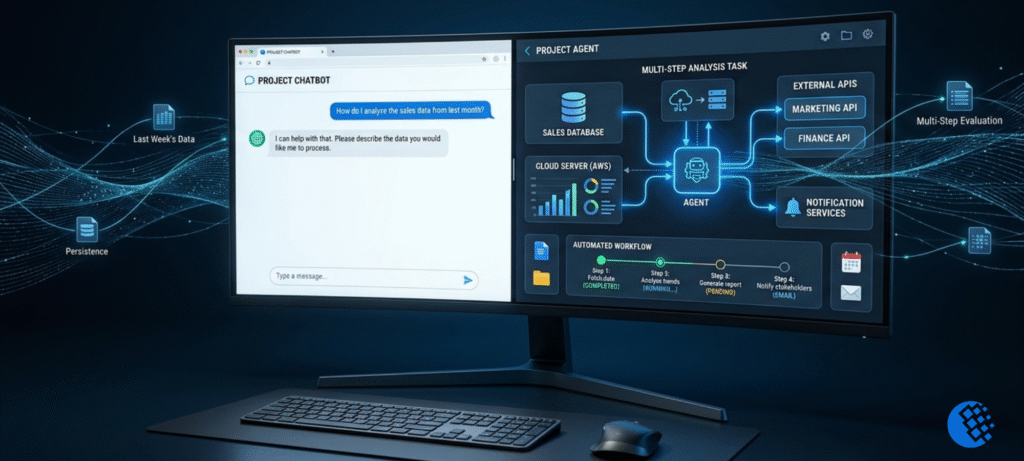
A chatbot is a stateless question-answering interface. An agent adds four things. Not all products marketed as agents have all four, and the ones missing two or three are usually chatbots.
1. Persistence
A chatbot starts each conversation empty. An agent carries state — what it has been told, what it has done, what it learned last week.
This is more consequential than it sounds. Persistence is what allows an agent to accumulate context about your business instead of being re-briefed every time. Without it, every interaction begins from zero and the total useful work is capped by how much you can type in one sitting.
2. Tool use
A chatbot generates text. An agent can do things: search the web, read a file, query a database, send a message, update a record.
Tool use converts an assistant from an advisor into a participant. It is also where reliability gets hard, because an incorrect suggestion is recoverable and an incorrect action may not be.
3. Multi-step execution
A chatbot answers, then stops. An agent can decompose a goal, execute several steps, evaluate intermediate results, and adjust.
This is the capability with the widest quality variation between products. Reliable multi-step execution is genuinely difficult — errors compound, and a wrong turn at step two produces confident nonsense at step six. Test it on real tasks before trusting it.
4. Triggered operation
A chatbot waits to be opened. An agent can run on a schedule or in response to an event — a message arriving, a form submitted, a threshold crossed.
Triggered operation is what removes the human from the loop, and it is the difference between a tool that saves you effort and one that saves you time.
The honest capability ladder
Most real products sit somewhere on a spectrum, and knowing where saves you from buying the wrong thing.
| Level | What it does | Typical label |
|---|---|---|
| 1 | Answers questions, no memory | Chatbot |
| 2 | Answers with conversation history | Assistant |
| 3 | Remembers across sessions, custom instructions | Custom assistant |
| 4 | Uses tools, takes actions when asked | Agent |
| 5 | Runs multi-step tasks with limited supervision | Autonomous agent |
| 6 | Triggered, unsupervised, in a live channel | Deployed agent |
Levels 1–3 are widely available and largely solved. Levels 4–6 vary enormously in reliability between products, and the marketing language does not vary at all.
When evaluating anything called an agent, ask which level it actually reaches. A product at level 3 sold as an agent is not a fraud, but it will not remove work from your week.
Which one you actually need
Use the frequency-and-consequence test.
You need a chatbot when:
- The task is occasional and you are present anyway
- You want a draft, an answer, or a second opinion
- The output goes to you, not to a customer
- The value is in thinking faster, not in doing less
You need an agent when:
- The task repeats many times a week
- It happens when you are not there
- It requires acting on something, not just describing it
- The value is in removing a human loop entirely
Most people asking for an agent want a chatbot with better memory. That is a level 3 product, it is cheap and mature, and it is a perfectly good outcome.
What deploying a real agent involves
If you genuinely need levels 4–6, three things matter more than the model.
Channel. An agent that lives where your people already are gets used. One behind a separate login gets forgotten. This is the strongest single predictor of adoption, and it is a deployment decision rather than a technology one.
Managed agent platforms have made channel deployment straightforward. Services like OpenClaw put an agent into WhatsApp, Telegram, or Discord without servers or code — you pick the model, connect the channel, and it responds where the conversation already happens. The technical barrier that used to make this a project has mostly gone; what remains is the scoping work.
Instructions. Agent quality is dominated by instruction quality, not model choice. Scope, voice, escalation conditions, source documents, and explicit prohibitions. Write it like onboarding a new hire, because it is the same task.
Escalation. Every agent needs a defined boundary and a handoff. Agents without escalation rules do not stop when they should — they produce a confident answer to a question they had no basis to answer. Be generous with escalation early; you can tighten it once you have evidence.
Model choice matters second, not first
Instructions dominate, but the underlying model does affect agent behaviour in specific ways: instruction-following consistency, refusal patterns, cost per interaction, and long-context handling when the agent accumulates history.
The useful arrangement is one where model choice is reversible. Multi-model platforms such as Perspective AI let an agent run on models from different labs and switch between them without rebuilding, which matters because your first choice will likely be wrong and the cost of correcting it should be trivial.
Start with a strong general model. Optimise for cost once you know your real volume, not before.
The failure modes that separate levels
Level 3 failure:
It forgets something you told it. Annoying, immediately visible, easy to correct.
Level 4 failure:
It takes a wrong action. Recoverable if you chose low-stakes actions, expensive if you did not.
Level 5 failure:
It compounds an error across steps and produces a confidently wrong result. Hard to spot, because the output looks like a completed task.
Level 6 failure:
It does all of the above unsupervised, repeatedly, until someone notices.
This is the actual argument for the staged rollout everyone recommends and few people follow: shadow mode first, supervised second, autonomous third. The staging is not caution for its own sake. It is how you find the level-5 failures before they become level-6 incidents.
Frequently asked questions
Is an AI agent just a chatbot with tools?
Tools are one of four differences. Persistence, multi-step execution, and triggered operation matter as much, and a product with tools but no memory is closer to a chatbot than to an agent.
Do I need technical skills to deploy an AI agent?
Not for messaging-channel agents on managed platforms. The work is writing instructions and defining escalation, which is operations work. Deep integration with internal systems still requires engineering.
What is the difference between an agent and an automation?
A traditional automation follows fixed rules and breaks on unexpected input. An agent interprets, which makes it flexible and less predictable. Use automation where inputs are structured; use an agent where they are messy natural language.
How much does running an AI agent cost?
Managed platforms usually bundle agents into a subscription with a credit allowance — commonly from around $15/month for a single agent, rising with agent count and message volume. Model choice affects consumption significantly.
Should an agent run autonomously from day one?
No. Shadow mode for a week, supervised for a week, then narrow autonomy on the categories that performed cleanly. Skipping this is the most common cause of failed deployments.
The useful question
Instead of asking whether something is an agent, ask what it does when you are asleep.
If the answer is nothing, it is a chatbot, and that may be exactly right for what you need. If the answer is something specific and useful, you have an agent — and you should find out at which level, before you find out the expensive way.