

Most affiliates lose money on their first few native ad campaigns. Not because native ads don’t work — they absolutely do — but because people jump in without understanding how the funnel actually needs to be structured.
Native ads for affiliate marketing sit in a weird middle ground. They’re not as aggressive as banner ads. They’re not as personal as Facebook. They show up as ‘recommended articles’ on news sites, blogs, and content platforms, and when done right, they pull in cold traffic that converts surprisingly well.
This guide walks through the whole picture: what affiliate marketing native ads are, which networks to use, how to build a funnel that doesn’t lose money on day one, how to track properly, and how to scale what’s working. If you’ve never run native ads before, start at the top. If you’re already running campaigns, jump to the sections on tracking and GEO targeting — that’s where most of the money is left on the table.
What Are Native Ads in Affiliate Marketing?
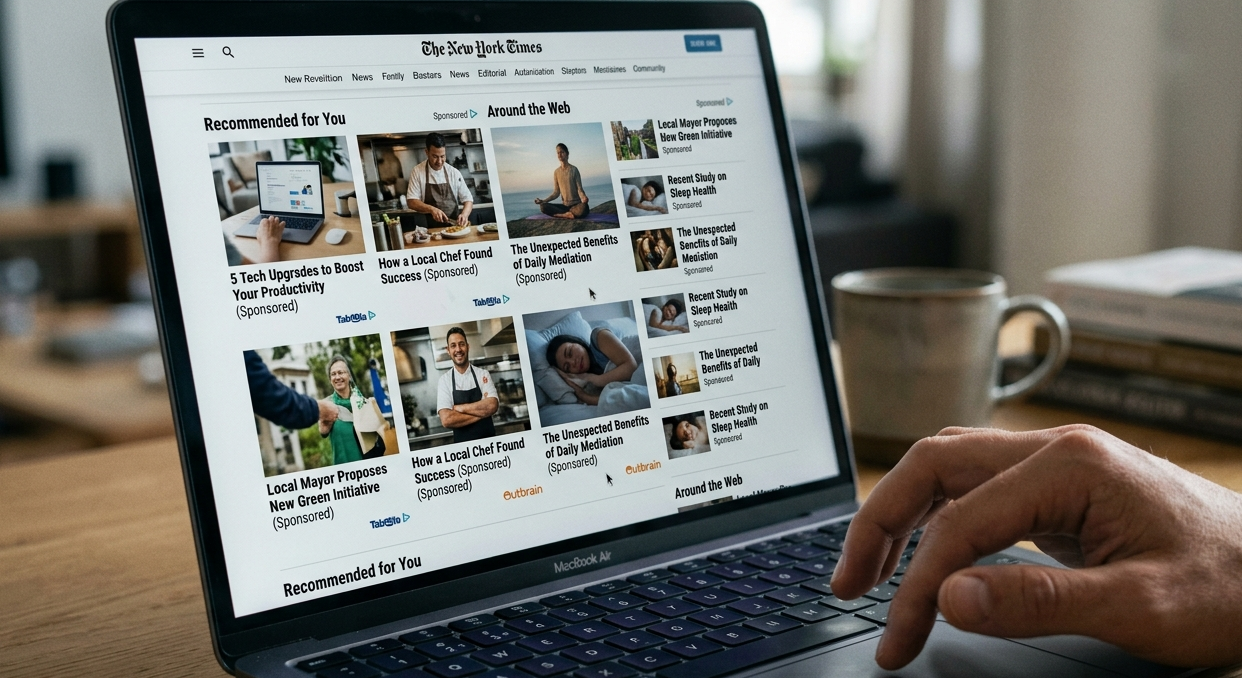
Native ads are paid placements that are designed to look like regular editorial content on whatever site they appear on. You’ve seen them at the bottom of news articles — those ‘you might also like’ widgets showing sponsored stories. That’s native advertising.
For affiliates, the appeal is obvious. People scrolling through a news site are in content-consumption mode. Their guard is down. A headline that reads like an interesting article gets clicked on at rates that banner ads can only dream about. The user lands on an advertorial page, reads something that feels like editorial content, and then moves through to the affiliate offer.
Compare that to banner ads, which most people blank out completely, or pop-ups, which create instant hostility. Native ads work because they fit the environment they appear in rather than fighting it.
The three biggest native ad platforms in this space are Taboola, Outbrain, and MGID. Between them they cover millions of publisher sites across news, entertainment, sports, and lifestyle content.
Why Native Ads Work So Well for Affiliate Campaigns
There are a few reasons why affiliates keep coming back to native traffic even when other channels get expensive or ban-happy.

People aren’t in ‘skip this ad’ mode
Social media has trained users to swipe past anything that looks promotional. Native ads sidestep that entirely. They look like content, so they get read like content. CTRs on a well-written native headline routinely sit between 0.3% and 1.5% — modest-sounding, but that’s cold traffic with zero brand recognition.
You can tell a story before the pitch
This is the big one. Native ads give you space to warm up cold traffic. Instead of sending someone straight from a widget click to a supplement sales page, you route them through an advertorial first. That advertorial builds context, tells a story, and makes the offer feel like a natural conclusion rather than a hard sell. Conversion rates on traffic that’s gone through a proper advertorial are usually two to four times higher than direct-linked traffic.
The compliance situation is more manageable
Facebook has banned more affiliate accounts than most people want to think about. Native platforms are stricter than they used to be, but they’re generally more willing to work with affiliates in verticals like health, finance, and survival that Facebook treats as radioactive. That doesn’t mean anything goes — but the rejection rates are lower and the bans are less sudden.
Scale is real
Once a campaign is profitable, native traffic can scale significantly. Taboola alone reaches over 500 million unique users per month. If your offer converts at a GEO that’s well-covered by major publishers, there’s genuine headroom to increase spend without your CPCs spiking immediately.
How Affiliate Marketing Native Ads Actually Work – Step by Step
Here’s the actual workflow, from picking an offer to scaling a profitable campaign.
Step 1: Pick an affiliate offer that suits native traffic
Not all offers work on native. The best verticals for native ad campaigns are health supplements, personal finance, insurance, weight loss, survival gear, beauty, and some software/SaaS niches. These work because they have strong emotional hooks, which makes writing curiosity-driven headlines much easier.
E-commerce offers with thin margins are harder to make work on native because the CPC costs eat into revenue quickly. Stick to CPA offers or high-ticket items where there’s room to absorb traffic costs during the testing phase.
Step 2: Build an advertorial (bridge) page – don’t skip this
Direct linking on native traffic is a reliable way to waste your testing budget. Cold traffic that clicks a native ad isn’t ready to buy. They clicked because a headline intrigued them, not because they were looking for a product.
An advertorial page sits between the ad and the offer. It reads like an article — ‘How This 52-Year-Old Teacher Paid Off $40,000 in Six Months’ — and it gradually moves the reader toward the offer through storytelling, social proof, and a soft call to action. The goal isn’t to sell. It’s to pre-sell. The offer page does the selling.
Good advertorials are 400 to 800 words, have a clear narrative structure, feel like something you’d actually read on a real editorial site, and end with a natural transition to the offer.
Step 3: Create your native ad creatives
Each native ad is made up of a headline and an image. That’s it. The image needs to look like it belongs in a content feed — not a product photo or a stock illustration. Think candid shots, real-looking people, before/after contexts.
The headline is everything. It needs to create enough curiosity that someone mid-scroll stops and clicks. More on headline writing in a later section, but the basic formula is: create a knowledge gap that the click will close.
Step 4: Set up tracking before you spend a single cent
This is where beginners most often skip a step and regret it. You need to know which headlines, images, placements, and landing page variants are driving conversions — not just clicks. Tracking software like Voluum, RedTrack, or Bemob sits between your native ad network and your affiliate offer. It captures the data your network’s dashboard won’t show you.
Step 5: Launch small, read the data, then optimize
Start with a modest daily budget — $30 to $50 is fine for initial testing. Run three to five different headline and image combinations. Let them gather at least 1,000 clicks before you make decisions. At that point, kill the creatives that aren’t performing and put budget behind the ones that are.
Step 6: Scale what’s working
Once you have a creative and advertorial combination that’s profitable, you increase the budget gradually — typically 20 to 30% every few days rather than doubling overnight. Jumping budget too fast tends to shift your traffic quality and break what was working.
Best Native Ad Networks for Affiliate Marketing
The network you pick matters, both in terms of traffic quality and how affiliate-friendly their policies are. Here’s a breakdown of the main options.
| Network | Best For | Min. Budget | Traffic Quality |
| MGID | Beginners & CPA offers | $100–$200 | Tier 1 + Tier 2 |
| Taboola | Scale & volume | $500+ | Premium publishers |
| Outbrain | High-quality US traffic | $500+ | Top-tier editorial |
| Revcontent | US health & finance | $100+ | Strong US focus |
| RichAds | CPA & push traffic | $50+ | Mixed, good for testing |
| Yahoo Gemini | US + mobile native | $300+ | Mid-to-high quality |
A few notes on choosing between these: MGID is genuinely the best starting point for beginners. The minimum budget is low, their support is responsive, and they allow most CPA verticals. Taboola and Outbrain deliver better traffic quality but require more upfront spend to get meaningful data. RichAds is worth testing for push notification traffic in addition to native.
Which Affiliate Offers Work Best on Native Traffic
Native ad traffic is cold. People weren’t looking for your offer — they were reading something else. That changes what converts.
Health and supplements
This is the dominant vertical on native. Weight loss, testosterone, joint pain, blood sugar, sleep — these all have strong emotional resonance and straightforward advertorial angles. The challenge is compliance (more on that below), but the volume available is huge.
Personal finance and debt
Debt relief, budgeting apps, credit repair, and retirement planning all perform well. The CPA payouts are often higher than health offers, which gives you more room to absorb testing costs. Headlines in this space tend to be fear-based or curiosity-based: ‘The Retirement Mistake Most Americans Make’ works because it implies you might be making it.
Insurance
Auto insurance, home insurance, Medicare — lead generation offers in this space pay well and convert from native traffic because the audience skews older (which matches well with Taboola and Outbrain’s publisher inventory).
Survival and preparedness
Solar generators, emergency food supplies, tactical gear. These convert well from news traffic because the audience that reads conservative news and weather coverage overlaps closely with the buyer profile.
Software and tools
VPNs, antivirus software, productivity tools. These tend to have good approval rates on all native platforms and work with curiosity-driven angles like ‘why your internet provider doesn’t want you using this.’
Native Ad Funnel Structure — How to Build One That Converts
The funnel is the single most important thing to get right. A bad funnel with a good offer loses money. A good funnel with a mediocre offer can still be profitable.
Layer 1: The native ad (headline + image)
Your only job here is to get the click. You’re not selling anything yet. The headline creates a curiosity gap. The image looks native to the feed. The combination makes someone think ‘what is that?’ and click to find out.
Layer 2: The advertorial page
This is the trust-building layer. The reader arrives expecting an article, and they get one. The best advertorials tell a real-feeling story — a person, a discovery, a result. They handle objections before the reader thinks of them. They end with a transition that makes clicking through to the offer feel like the logical next step rather than a sudden sales pitch.
The page needs to load fast (under two seconds), look clean, and have no navigation links that let people click away. The only exit is through to the offer.
Layer 3: The affiliate offer page
This is the network’s page, not yours in most cases. Your job was to get a warm, pre-sold visitor to this page. The offer page closes them. If the offer page converts poorly despite good advertorial traffic, that’s a signal to test a different offer — not necessarily a problem with your funnel.
Writing Native Ad Headlines That Actually Get Clicked
The headline is doing almost all the work in a native ad. The image stops the scroll; the headline earns the click. Here’s what separates high-CTR headlines from ones that get ignored.
Create a knowledge gap
The reader should feel like they’re missing information they probably need. ‘Doctors Are Shocked By This Morning Habit’ works because the implied information is: something you might be doing (or could do) is surprising medical professionals. The click answers the question.
Speak directly to the specific audience
‘The Retirement Mistake Most Americans Make’ targets people who are close to or thinking about retirement. It’s not for everyone, which is exactly why it works — the people it’s for feel like it was written for them.
Real headline examples by vertical
- Health: ‘Why Thousands Are Ditching Their Morning Coffee for This Instead’
- Finance: ‘The Credit Score Trick Banks Don’t Want You Knowing About’
- Survival: ‘Why Smart Families Are Quietly Stocking Up On This’
- Software: ‘Your Internet Provider Can See Everything — Unless You Do This’
- Weight loss: ‘She Lost 40 Pounds Without Changing What She Ate — Here’s Why’
Notice that none of these mention the product. The product is the answer to a question. The headline asks the question.
Tracking and Optimization – Where Most Affiliates Leave Money Behind
Running native ads without proper tracking is like driving without a speedometer. You have some sense of what’s happening, but you’re missing the data that actually tells you what to do next.
What you need to track
Your native network’s dashboard shows you clicks and spend. That’s not enough. You need to know: which placements (specific publisher sites) are sending converting traffic, which headline and image combinations produce the best CTR, what your cost per acquisition (CPA) is at the campaign and creative level, and what your earnings per click (EPC) looks like across different GEOs.
Tracking tools worth using
- Voluum — industry standard for serious affiliates, excellent real-time reporting and A/B testing features
- RedTrack — solid option with lower pricing, good for affiliates who are still scaling up
- Bemob — free tier available, good starting point for beginners before committing to a paid tracker
- ClickMagick — simpler interface, works well for single-offer campaigns without complex funnel routing
The metrics that actually matter
CTR (click-through rate) tells you whether your creatives are compelling. Anything above 0.4% is reasonable for native; above 0.8% is strong. CPC (cost per click) varies hugely by GEO and vertical — knowing your average helps you spot placements that are overpriced. ROI and CPA are the numbers your campaign lives or dies by. EPC (earnings per click) across different traffic sources tells you where to send more budget.
Blacklisting bad placements
This is one of the most underutilised optimizations in native campaigns. Every native network lets you see performance by publisher site (called placements). In most campaigns, 10 to 20% of placements drive 80% of conversions. The rest are spending your budget for little return. Pull a placement report after your first 2,000 clicks and blacklist anything with significant spend and zero conversions.
GEO Targeting in Native Affiliate Marketing
Where your traffic comes from affects almost everything: CPC costs, conversion rates, payout levels, and what compliance rules apply. Getting GEO strategy right is one of the fastest ways to improve ROI.
Tier 1 vs Tier 2 countries
Tier 1 GEOs — US, UK, Canada, Australia — have the highest CPCs and the highest payouts. The competition is also the strongest. For beginners testing a new offer, starting with Tier 2 countries (Germany, France, Italy, Spain, some of Eastern Europe) can get you conversion data at lower cost before committing to expensive US traffic.
The US market is expensive but worth it for the right offers
US traffic on Taboola or Outbrain can cost $0.15 to $0.60 per click depending on the niche. For a supplement offer paying $40 CPA, you need to convert roughly one in 80 to 100 clicks to break even at that CPC. That’s achievable with a good funnel, but there’s no margin for sloppy tracking or weak advertorials.
Localization matters more than most people think
Running an English advertorial to a German audience doesn’t work. Neither does using American cultural references in UK campaigns. If you’re testing non-English GEOs, translate properly — machine translation is obvious and tanks credibility. Also adapt the offer: some supplement brands have localized landing pages; some don’t. Check before building your funnel around one.
Device targeting
Mobile and desktop traffic behave differently on native. Mobile tends to have lower CPCs but also lower conversion rates for longer-form offers. Desktop converts better for finance and insurance. It’s worth splitting campaigns by device from the start so you can see which performs better for your specific offer rather than averaging the two together.
Native Ads vs Facebook Ads for Affiliate Marketing
Both channels work for affiliate marketing. They work differently, and which is better depends on your vertical, budget, and risk tolerance.
| Factor | Native Ads | Facebook Ads |
| Ad approval | Easier, faster | Strict, frequent bans |
| Traffic type | Cold, curiosity-driven | Cold + warm retargeting |
| Cost per click | Often lower ($0.05–$0.50) | Higher ($0.50–$2.00+) |
| Scalability | High with budget | Can hit audience cap fast |
| Compliance | More lenient overall | Very strict health/finance |
| Learning curve | Moderate | Moderate to high |
| Best vertical | Health, finance, survival | E-comm, SaaS, lead gen |
The short version: Facebook has better targeting but punishes affiliate marketers aggressively. Native has more lenient policies and more scalable volume, but requires a proper advertorial funnel to convert cold traffic. Most experienced affiliates run both and let the data decide where to put more budget.
If you’re thinking about combining AI tools with your affiliate ad strategy, see AI Ads for Affiliates — it covers how automation is changing creative production and campaign management for affiliate marketers.
Compliance and Policy Rules You Actually Need to Follow
Native ad compliance is less brutal than Facebook’s but it’s gotten tighter over the past two years. Platforms have improved their review processes, and some of the old tactics that used to slide through now get flagged immediately.
What gets ads rejected or accounts banned
- Fake news-style headlines that reference specific public figures without their endorsement
- Before/after images on health offers (specifically banned on most platforms)
- Exaggerated income claims (‘Make $500 per day doing this from home’)
- Countdown timers on advertorials that reset on page reload — seen as deceptive
- Fake testimonial quotes attributed to celebrities
FTC disclosure rules
If you’re running affiliate campaigns in the US, your advertorial page needs a disclosure. Something like ‘This post contains affiliate links. We may receive a commission if you purchase through them.’ It doesn’t have to be prominent to the point of killing conversions, but it needs to be present. The FTC has been increasingly active in going after undisclosed affiliate content, and the networks themselves are starting to require it as part of their review process.
Health claim restrictions
This is the biggest compliance minefield in native affiliate marketing. Claims like ‘cures diabetes’ or ‘clinically proven to regrow hair’ will get your ads rejected and potentially your account reviewed. The standard to aim for is: write your advertorial as if you’re telling a real person’s story, not making product claims. ‘John noticed his blood sugar readings had changed after three weeks’ is different from ‘this supplement reverses diabetes.’ One is a story; the other is a medical claim.
Common Mistakes That Burn Beginners’ Budgets
There’s a fairly predictable set of errors that most new native affiliates make. Worth going through them before you’ve made them yourself.
Direct linking to the offer
Sending native traffic straight to an affiliate sales page without a bridge page almost never works. The audience isn’t warm enough. They need context before they’ll consider buying. Build the advertorial.
Setting it up and walking away
Native campaigns need daily monitoring, especially in the first week. Placements shift. CPCs change. A placement that was converting on Monday can turn into a money pit by Thursday. Check your tracker every day and blacklist underperforming placements proactively.
Testing one creative and giving up
A single headline/image combination rarely wins first time. Launch three to five creatives per campaign. The one you thought was weakest will sometimes outperform everything else. Let the data decide, not your gut.
Scaling too fast
Doubling a $50/day campaign to $100/day overnight often doesn’t produce double the results — it tends to shift your traffic quality and increase CPC. Increase budgets gradually. 20 to 30% every few days is a reasonable pace once you’ve confirmed profitability.
Ignoring the advertorial entirely
Some affiliates put all their energy into the ad creative and use a thin, template-looking bridge page. The advertorial is doing most of the conversion work. A weak advertorial means a weak campaign, regardless of how good the ad is.
AI and Automation in Native Advertising
The native ad platforms have gotten considerably smarter over the past couple of years, and affiliates who ignore that are leaving optimizations on the table.
Automated bidding
Taboola and Outbrain both have automated bidding modes that adjust your CPC in real time based on conversion likelihood. These can work well once your campaign has enough conversion data (usually 30 to 50 conversions) for the algorithm to learn from. Before that, manual bidding gives you more control over early spend.
AI creative testing
Some affiliates are now using AI tools to generate headline variations at scale. Instead of writing five headline options, they generate 30, run them all at low spend, and let performance data narrow the field. The economics of this work better once you’re running campaigns at volume.
Audience segmentation tools
Several native platforms now offer interest-based and lookalike audience targeting, not just contextual placement. Building audience segments from your converting traffic and using them to guide targeting can meaningfully improve ROI on campaigns that are already profitable. Think of it as a step between basic topic targeting and the kind of audience layering you’d do on Facebook.
For a broader look at monetization approaches that complement native ad strategies, the Profitable App Ideas explores 50 ways to earn in 2026 — useful context if you’re thinking about diversifying beyond single-channel affiliate traffic.
Frequently Asked Questions
What are native ads in affiliate marketing?
Native ads are paid content placements designed to match the look and feel of editorial content on the sites where they appear. In affiliate marketing, they’re used to drive cold traffic to advertorial pages that pre-sell visitors before routing them to an affiliate offer.
Are native ads actually good for affiliate marketing?
Yes, for the right verticals. Health, finance, insurance, and survival niches have been profitable on native for years. The key is building a proper funnel rather than direct-linking. Without an advertorial in the middle, most native traffic won’t convert well enough to be profitable.
Which native ad network should a beginner start with?
MGID is usually the best first choice. Lower minimum budget, reasonable traffic quality, and more flexible policies around CPA offers than some of the bigger platforms. Once you have a profitable campaign, you can replicate it on Taboola or Outbrain for more volume.
How much money do you need to start with native ads?
Realistically, $300 to $500 to run a meaningful test. You need enough budget to gather 1,000 to 2,000 clicks across a few creative variations before you can make informed optimization decisions. Starting with $50 and expecting results in two days leads to bad conclusions.
Can complete beginners make money with native ads?
Yes, but there’s a learning curve and an initial testing cost. Beginners who study the funnel structure, set up tracking properly, and start with a beginner-friendly network like MGID have a reasonable path to profitability. Beginners who skip tracking and direct-link to offers tend to lose their test budget and quit.
What is an advertorial page?
An advertorial is a piece of content that looks like a regular article but is written specifically to pre-sell visitors on an affiliate offer. It tells a story, builds trust, handles objections, and ends with a call to action that leads to the offer page. It’s the most important part of a native affiliate funnel.
Are native ads profitable in 2026?
They are, though the easy money days of five years ago are gone. Competition has increased, compliance requirements have tightened, and you need a more polished funnel than you did in 2019. That said, affiliates who track properly, test systematically, and build strong advertorials are still finding profitable campaigns across health, finance, and insurance verticals.
For an in-depth look at how native and content-based advertising works at the platform level, Taboola’s advertiser resource hub covers creative best practices, bidding strategy, and vertical-specific guidance directly from the largest native ad network.
The Mobidea Academy native advertising guide is one of the most comprehensive free resources for affiliate-specific native ad strategy, including GEO targeting, offer selection, and funnel optimization for CPA campaigns.
Final Thoughts
Affiliate marketing native ads aren’t a shortcut and they’re not a lottery. The affiliates making consistent money from this channel are the ones who treat it like a real business: they track everything, they build proper funnels, they test methodically, and they optimize based on data rather than hunches.
The funnel is non-negotiable. Native ad, advertorial, offer — that three-layer structure is what makes cold traffic convert. Skip the advertorial and you’ll spend your testing budget proving that cold traffic doesn’t buy things without context.
Start on MGID with a budget you can afford to test with. Pick a CPA offer in a vertical with strong emotional resonance. Write three headline variations. Build a real advertorial — not a thin one. Set up a tracker before you spend anything. Then run, read the data, and optimize. That’s it. That’s the whole system.
The complexity comes later, when you’re scaling across GEOs, testing AI-assisted creative generation, and layering audience segments on top of placement targeting. But the fundamentals don’t change regardless of scale: follow the data, keep the funnel intact, and don’t skip the advertorial.