
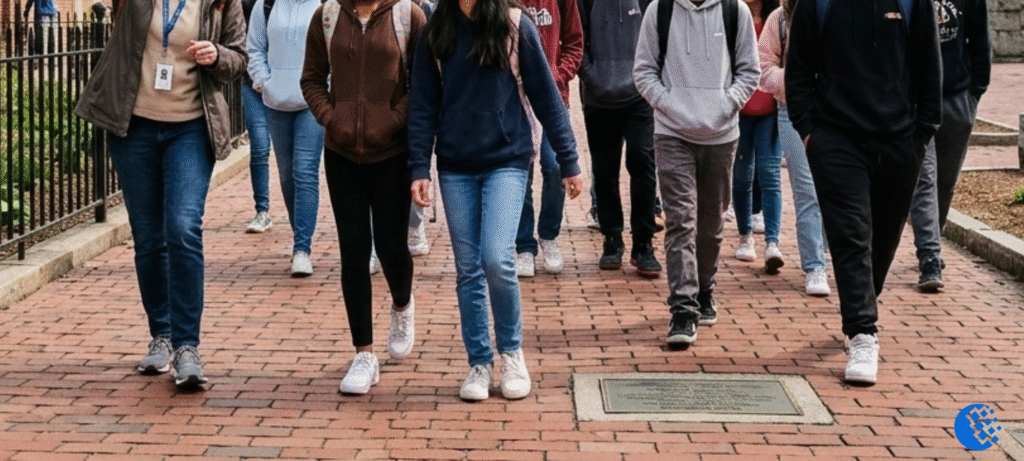
There is a specific kind of magic that happens when a student walks away from a textbook and onto the actual cobblestones of the Revolutionary War. Educational trips to Boston offer that “lightbulb moment” where history stops being a dry set of dates to memorize and starts feeling like a real story they are part of. Boston isn’t just a city; it’s a living, breathing classroom. Whether you’re exploring the roots of American democracy or the front lines of global robotics, this city provides a level of immersion that few places can match. For teachers and organizers planning a 2026 tour, here is your boots-on-the-ground guide to making it happen.
Why Schools Prioritize Educational Trips to Boston
There’s a reason travel giants like WorldStrides and EF Explore America keep Boston at the top of their lists year after year. The city is essentially designed for the student experience, blending historical gravity with modern accessibility.
The Walkability Factor
In many major U.S. cities, you spend half your day stuck in a charter bus, staring at taillights. Boston is different. Because the historic core is so compact, you can cover three centuries of history on foot. This isn’t just great for the budget; it keeps student engagement high. When students are moving, they are observing. They notice the narrow 17th-century alleys, the harbor breeze, and the way the glass skyscrapers sit right next to colonial brick meeting houses.
Deep Curriculum Alignment
The sites in Boston don’t just “look cool”—they directly support national standards for U.S. History, Civics, and STEM.
- History & Civics: The transition from British subjects to American citizens is mapped out geographically.
- Literature: You have the haunts of Alcott, Emerson, and Thoreau just a short drive away in Concord.
- STEM: Boston is currently a global biotech hub. Seeing the collaboration between MIT and private industry gives students a look at career paths they might not have known existed.
The Inspiration Factor
Walking through an Ivy League campus can fundamentally change a high schooler’s perspective. For many students, these institutions feel like fortresses. A guided tour breaks that barrier. It makes “the dream” feel like a tangible plan.
The “Must-See” Highlights for Educational Trips to Boston
The Freedom Trail: The Backbone of the Trip
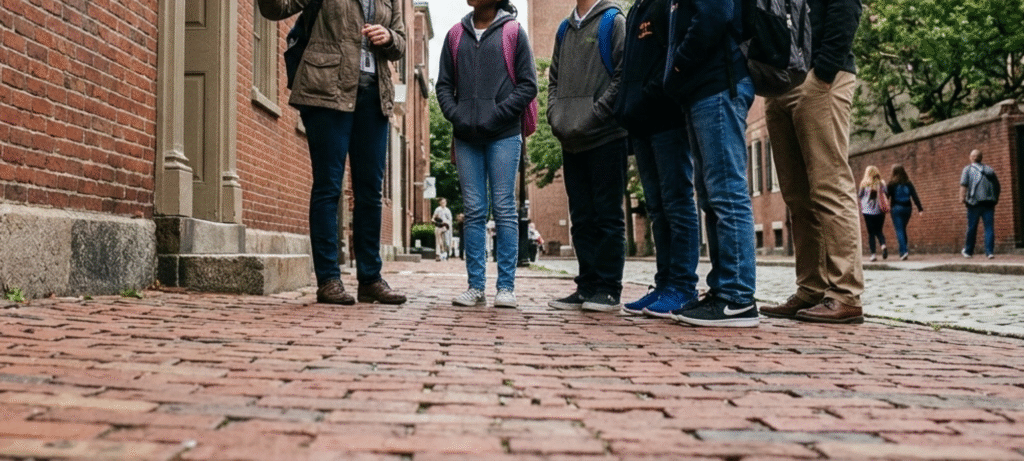
You cannot discuss educational trips to Boston without the Freedom Trail. It’s a 2.5-mile path marked in red brick that leads you to 16 significant sites. Seeing the Paul Revere House or standing in the Old North Church makes the 1700s feel incredibly real.
Boston Tea Party Ships & Museum: History as Theater
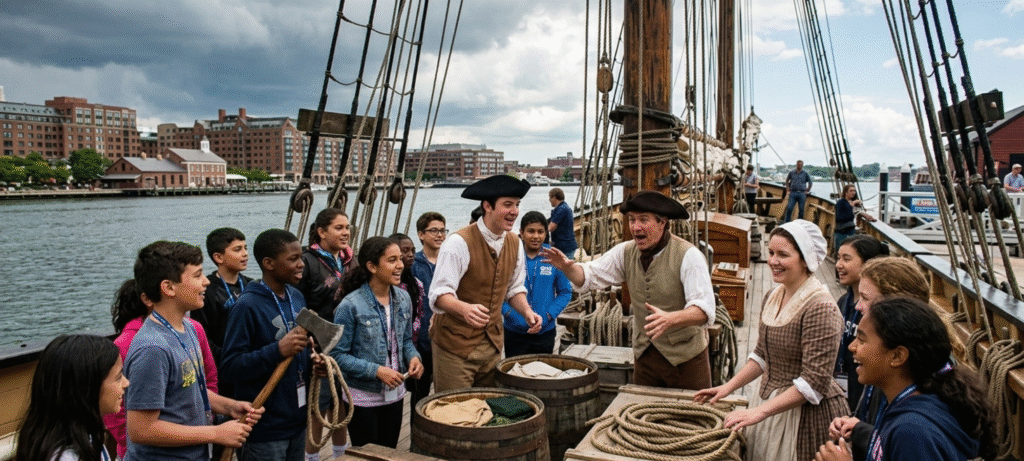
This is far from a boring museum visit. It’s an interactive experience where students actually get to throw “tea” overboard and engage with actors in period costume. It’s loud, it’s dramatic, and it’s always a crowd-favorite for middle schoolers. It teaches the economic and social tensions of the time better than any 50-minute lecture ever could.
Harvard & MIT: A Glimpse into the Future
Even if your trip is history-focused, you shouldn’t skip the “Brainpower Triangle.” Touring Harvard Yard or seeing the cutting-edge architecture at MIT helps students visualize their next steps in education. It shifts the focus from where we’ve been as a country to where these students can go as individuals.
Naval Heritage at the USS Constitution
Visiting “Old Ironsides” gives a fantastic look at early American naval strength and the War of 1812. If you have a half-day to spare, a quick bus ride to Salem offers a fascinating (and slightly spooky) lesson on colonial law, mass hysteria, and social psychology.
A Realistic 4-Day Itinerary for 2026
Planning a schedule that doesn’t exhaust the students is an art form. Here is a structure that balances heavy walking with seated education.
| Day | Theme | Key Activities |
| Day 1 | Arrival & Context | Check-in, a walk through the Seaport, and a group orientation dinner at Quincy Market. |
| Day 2 | The Revolution | A guided walk of the Freedom Trail, a visit to the Old State House, and the Tea Party Museum. |
| Day 3 | Innovation & STEM | Harvard and MIT campus tours in the morning; Museum of Science in the afternoon. |
| Day 4 | Maritime Legacy | Visit the USS Constitution, a final reflection session by the harbor, and departure. |
Understanding the Investment: Costs for 2026
Budgeting for a student group requires a clear view of the “all-in” price. In 2026, we are seeing a slight increase in hospitality costs, but Boston remains more affordable than New York or San Francisco.
- 3–4 Day Trip: $900 – $1,500 per person.
- 5–6 Day Trip: $1,500 – $2,500 per person.
Pro Tip: If your school is on a tight budget, consider visiting in late February or early March. While the weather is “authentic” (read: very cold), hotel rates are significantly lower than the peak spring months of April and May. Plus, the museums are much less crowded, giving your students better access to guides.
Academic Value: Beyond the Sightseeing
To ensure the school board approves the trip, you need to prove the educational ROI. Many teachers link the experience back to the classroom using creative, multi-layered assessments.
For Younger Groups
Assessment doesn’t have to be a grueling exam. Use simplified reflection rubrics. Even looking at a grading scale for Kindergarten can help you design a system that rewards participation and observation rather than just testing memorized facts. The goal for this age is to spark a lifelong interest in history.
For High Schoolers
Connect the trip to modern industry. Analyzing Boston’s tech hubs through a business technology assessment lens can help students understand how historical innovation in maritime trade paved the way for today’s biotech boom. Have them write a comparative essay on the “Federalist vs. Anti-Federalist” debates while sitting in the pews of a historic meeting house.
Planning Secrets for a Stress-Free Trip
After years of helping teachers organize these tours, a few “hacks” stand out:
- The 9-Month Rule: The best group-friendly hotels (those with interior corridors and breakfast included) fill up by September for the following spring.
- Chaperone Strategy: Aim for a 1:10 ratio to keep the group manageable during walking tours.
- Pack for Layers: Boston weather is famous for changing its mind every hour. A sunny morning can turn into a windy, rainy afternoon by 2:00 PM.
- Custom vs. Packaged: Pre-packaged tours from places like School Tours of America are easier, but custom planning lets you spend more time at the sites your students actually care about.
People Also Ask (FAQs)
How long should an educational trip to Boston be?
Most schools find that 3 to 4 days is the ideal duration to cover the major historical and academic sites without “museum fatigue.”
What grade level benefits most from a Boston trip?
While 8th graders (studying American History) are the most common visitors, high schoolers benefit immensely from the college-readiness and STEM aspects of the city.
Is Boston safe for student groups?
Yes, Boston is considered very safe and is one of the most walkable cities in the U.S. However, teachers should always use a “buddy system” for busy areas like Quincy Market.
Can we do a Boston trip on a tight budget?
Absolutely. Focusing on free sites along the Freedom Trail, using the “T” (subway) instead of private charters, and traveling during the off-season (winter) can cut costs significantly.
Does a Boston trip support STEM education?
Definitely. Between the MIT Museum, the Museum of Science, and the biotech hubs in Kendall Square, Boston is a top destination for tech-focused student groups.
Final Thought
Educational trips to Boston offer something a classroom simply can’t: a sense of place. When a student stands in the Old South Meeting House, the concept of free speech becomes more than a definition—it becomes a legacy they can feel. By planning with clear academic goals and a solid itinerary, you can provide an experience that shapes a student’s academic trajectory for years to come. Sometimes learning outside the classroom changes everything. And Boston just happens to be one of the best classrooms in the world.