
It’s one of those things that seems totally logical until you actually dig into it. Most people just assume that because sign language is visual, it has to be universal. I mean, a gesture for “eating” or “sleeping” feels like it should work anywhere, right? If you’ve ever watched a movie with a Deaf character and thought, “It’s so cool they can talk to anyone in the world,” you’re definitely not alone in that.
But the truth is actually the exact opposite. In fact, if an American traveler who is fluent in American Sign Language (ASL) walks into a cafe in London, they’d probably be just as confused as a hearing American trying to understand a thick local accent—or maybe even more so.
Is American Sign Language Universal? (The Quick Answer)
To get straight to the point: No, American Sign Language is not universal. ASL is a unique, natural language used mainly in the United States and the English-speaking parts of Canada.
Even though English speakers in the U.S. and the UK read the same books and watch the same shows, the Deaf communities in those countries speak completely different languages. Believe it or not, there are over 300 distinct sign languages used around the world today.
According to the National Institute on Deafness and Other Communication Disorders, there is no universal sign language, and different regions use distinct signed languages with their own grammar and structure.
Why Sign Language Isn’t the Same Everywhere
It helps to think about sign languages the same way we think about spoken ones. They weren’t “invented” by some committee in a boardroom; they grew naturally within specific communities. Because Deaf communities were historically separated by geography and borders, they developed their own slang, vocabularies, and grammar rules over time.
Linguistically, is american sign language universal? Definitely not, mostly because it didn’t actually grow out of English. It’s its own thing entirely. Just like Italian and Spanish share some roots but are different languages, ASL has its own history. Interestingly, ASL is actually much closer to French Sign Language (LSF) than it is to British Sign Language (BSL) because of how teachers moved between France and America in the 1800s.
ASL vs. BSL: A Surprising Divide
This is usually what shocks people the most. Since Americans and Brits both speak English, you’d think their sign languages would be similar. They aren’t. Honestly, they aren’t even close.
- The Alphabet: In ASL, you spell out letters with one hand (fingerspelling). In BSL, you use two.
- Understanding Each Other: An ASL user and a BSL user would probably only understand about 30% of what the other is saying—and that’s mostly through basic miming and facial expressions.
- The Vocabulary: Even basic signs for “mother,” “father,” or your “name” are totally different.
| Feature | American Sign Language (ASL) | British Sign Language (BSL) |
| Primary Region | USA & Canada | United Kingdom |
| Manual Alphabet | One-handed | Two-handed |
| Linguistic Root | Old French Sign Language | British Sign Roots |
| Usage | 500,000+ users | ~150,000 users |
What Is International Sign Language?
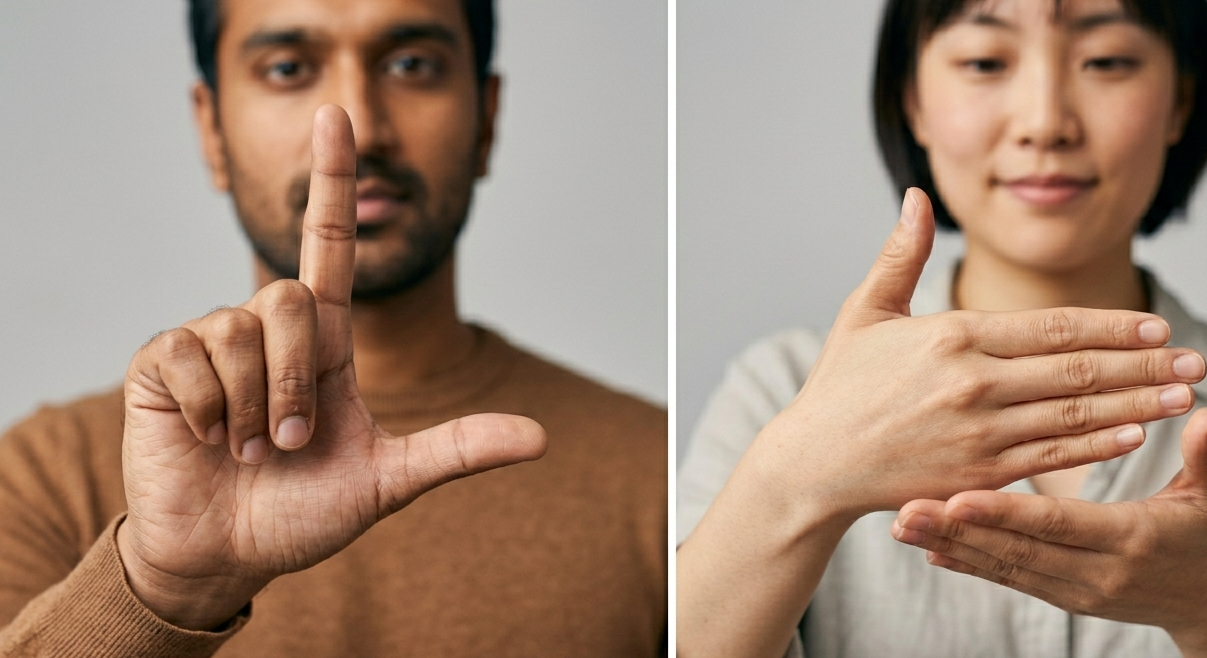
You might hear people mention “International Sign” (IS) and wonder if that’s the “universal” version everyone is looking for. It’s a bit of a tricky name. Is american sign language a universal language? No, and neither is International Sign.
Think of International Sign more like “Sign Language Esperanto.” It’s a simplified, very visual way of communicating used at big global events like the Deaflympics or meetings for the World Federation of the Deaf. It’s not a “native” language that anyone learns as their first tongue; it’s just a bridge used when two people from different countries need to find common ground.
Common Myths About ASL
Since many hearing people don’t interact with the Deaf community every day, there are a lot of myths out there. Let’s clear a few up:
Myth 1: ASL is just English with hand signs
This is a huge misconception. ASL has a completely different grammar structure. In English, we usually go Subject-Verb-Object. ASL often uses a Topic-Comment structure. It’s actually closer to Japanese or Navajo in how it’s built than it is to English.
Myth 2: Sign language is just “pictures in the air”
While some signs look like the object they represent, most are totally abstract. You couldn’t guess the sign for “philosophy” or “government” just by looking at someone’s hands. It takes years of study to master, just like any other foreign language.
Myth 3: If you know ASL, you can go anywhere
As we’ve seen, american sign language is universal only in North America. If you head to Mexico, you’ll find Lengua de Señas Mexicana (LSM). In Japan, it’s Nihon Shuwa (JSL).
How Many Sign Languages Exist?
Linguists think there are between 200 and 300 officially recognized sign languages. But there are likely hundreds more “home signs” used in smaller, remote villages.
- Auslan: Used in Australia.
- NZSL: Used in New Zealand.
- LSQ: Used in Quebec, Canada (it’s different from ASL!).
- Indo-Pakistani Sign Language: Used across South Asia.
It’s pretty amazing how wherever there are Deaf people, a unique and beautiful language naturally starts to form.
Is ASL Becoming a Global Standard?
Even though it’s not universal, ASL is very influential. Because of American media and top-tier schools like Gallaudet University, ASL has started to affect other sign languages. You’ll even find “dialects” in parts of Africa and Southeast Asia that have borrowed signs from ASL.
However, most countries are very proud of their own sign languages. Just like English hasn’t replaced French or Chinese, ASL isn’t going to replace local sign languages.
Why This Matters for Learners
If you’re thinking about learning to sign, the first question shouldn’t be “is it hard?” but “where am I going to use it?” If you’re in the U.S., go for ASL. If you’re moving to London or Sydney, you’ll need BSL or Auslan.
Learning ASL is an awesome way to see the world differently, but just remember you’re learning a specific culture’s language, not a global secret code.
FAQ
Is American Sign Language universal?
No. ASL is specific to North America. Other countries have their own unique languages that aren’t usually understood by ASL users.
Can an American Deaf person understand a British Deaf person?
Not easily. They might get the “gist” through gestures, but their actual languages (ASL and BSL) are as different as English and Dutch.
Which country has the most sign languages?
It’s hard to say, but countries with lots of regional diversity like India or many African nations often have several regional sign languages and dialects.
Is there a universal alphabet for sign language?
Nope. Even the alphabets vary. Some use one hand (like ASL), and some use two (like BSL or German Sign Language).
Final Thoughts
The idea that american sign language is a universal language is a bit of a romantic myth. We all want to believe there’s one “pure” way for humans to connect without words. But the reality—that our world is full of hundreds of rich, complex, and distinct visual languages—is actually way more interesting. It shows that the Deaf community isn’t just one group, but a global collection of diverse cultures, each with its own story.
You can find us here=> Easygarder