
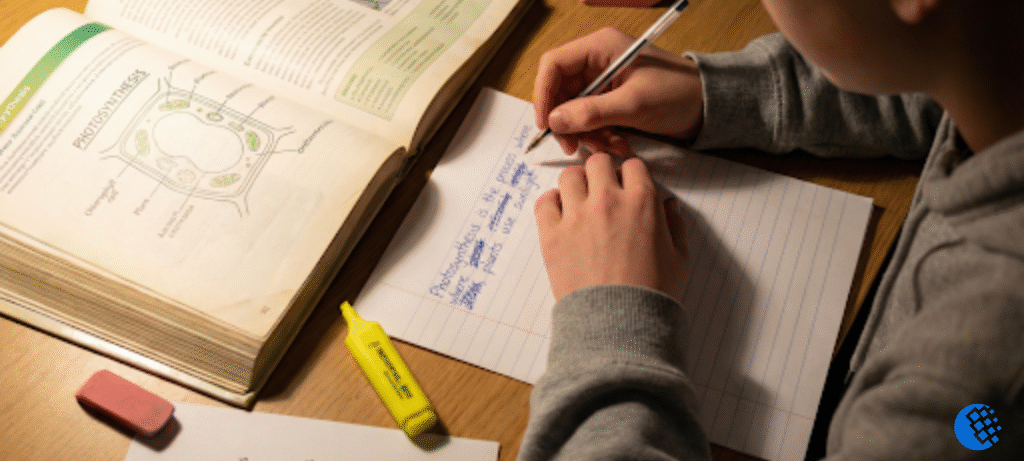
It’s 9 PM on a school night, and your Secondary 2 daughter sits at the dining table, staring at her science homework. She can explain photosynthesis perfectly when you ask her about it. She understands how plants make food, knows about chlorophyll, and can even tell you why leaves are green. But when faced with this exam question: “Explain why a plant kept in a dark cupboard for two weeks will die,” she writes two sentences and gets only 1 out of 4 marks.
Sound familiar?
This scenario plays out in thousands of Singapore households every week. Bright students who clearly understand science concepts struggle to translate that understanding into the structured, keyword-rich answers that exams demand. It’s frustrating for parents trying to help, and demoralizing for students who feel they “know it but can’t write it.”
The good news? Cognitive science research has identified exactly why this happens—and what we can do about it.
The Knowledge-Expression Gap: What Research Tells Us
Dr. John Sweller’s groundbreaking work on cognitive load theory at the University of New South Wales reveals a critical insight: understanding a concept and being able to express that understanding in writing are two entirely different cognitive tasks.
When your child explains photosynthesis verbally at the dinner table, they’re retrieving information from long-term memory in a low-pressure environment. They can use casual language, gestures, and take their time organizing thoughts. Their working memory—the mental workspace where active thinking happens—isn’t overloaded.
But during an exam, everything changes. Now they must:
- Retrieve the scientific concept from memory
- Analyze what the question is actually asking
- Select relevant information from everything they know
- Organize ideas in a logical sequence
- Use precise scientific terminology
- Write legibly while watching the clock
- Monitor their answer to ensure completeness
That’s at least seven simultaneous cognitive demands. Research shows our working memory can only handle 4-7 chunks of information at once. No wonder students freeze up or write incomplete answers—their cognitive resources are maxed out.
A 2019 study published in the Journal of Educational Psychology by researchers at Cambridge University found that even high-performing students showed a 35-40% drop in answer quality when required to write explanations versus verbal responses, specifically due to working memory constraints.
The “Curse of Knowledge” Problem
There’s another cognitive barrier at play: what Harvard psychologists call the curse of knowledge.
When students deeply understand a concept, their brain automatically fills in connections and steps that seem obvious to them. Ask a student who truly understands photosynthesis to explain it, and they might write: “The plant uses sunlight to make food.”
To them, this feels complete because their brain has automatically filled in details about chlorophyll, carbon dioxide, water, glucose, and oxygen. They know all this—it’s just not making it onto the paper.
Meanwhile, the marking scheme expects:
- Plants need light for photosynthesis
- Photosynthesis produces glucose/food for the plant
- Without light, photosynthesis cannot occur
- Without food, the plant cannot carry out life processes and will die
This isn’t about intelligence—it’s about metacognitive awareness: the ability to step outside your own understanding and recognize what needs to be explicitly stated.
Real-Life Example: The Melting Ice Investigation
Consider this typical Secondary 1 practical question that trips up even strong students:
“Students placed ice cubes in three beakers:
- Beaker A: Wrapped in aluminum foil
- Beaker B: Wrapped in newspaper
- Beaker C: Left unwrapped
After 30 minutes, the ice in Beaker C melted completely, while ice in Beakers A and B only partially melted.
Explain why the ice in Beaker C melted fastest.”
What students typically write: “Because Beaker C has no covering.”
What the marking scheme wants:
- Beaker C has no insulating material
- Heat from the surroundings can transfer to the ice easily/faster
- The ice gains heat energy and changes state from solid to liquid
- Therefore the ice melts fastest
Notice the difference? The student’s answer isn’t wrong—it’s incomplete. They’ve identified the key factor (no covering) but haven’t explained the mechanism (heat transfer) or used key scientific terminology (insulating material, heat energy, change of state).
This is the homework help dilemma in action. Your child understands that the covering matters. They might even understand it keeps things cold. But translating that understanding into exam-worthy explanation requires specific training.
Why Traditional Studying Doesn’t Fix This
Many parents assume more content revision will solve the problem. They buy assessment books, sign up for extra classes, make their child read the textbook repeatedly. And yet, the same struggles persist.
Here’s why: knowledge acquisition and knowledge expression are separate skills.
A 2021 meta-analysis in Science Education examining over 50 studies found that content knowledge explained only 60% of variance in science exam performance. The remaining 40% came from what researchers call “epistemic skills”—understanding how to structure scientific explanations, when to use technical vocabulary, and how to match answers to question requirements.
Think of it like cooking. You can memorize every recipe in a cookbook (content knowledge), but that doesn’t automatically make you skilled at plating dishes beautifully or adjusting flavors on the fly (expression skills). Both matter.
Singapore’s science exams specifically test both. The MOE syllabus isn’t just checking if students know facts—it’s assessing whether they can apply, analyze, and communicate scientific understanding. Open-ended questions are designed to evaluate these higher-order thinking skills.
The Four Missing Skills
Through working with over 5,000 students across Singapore, I’ve identified four specific skills that distinguish students who excel at open-ended questions from those who struggle:
1. Question Deconstruction
Strong students automatically break questions into parts:
- What scientific concept is being tested?
- What’s the context or scenario?
- What command words are used? (Explain vs. Describe vs. Compare)
- How many marks, therefore how many points needed?
Struggling students read the question once and start writing immediately, often answering a different question than what was asked.
2. Scientific Keyword Recognition
Every science topic has critical terminology that must appear in answers. For photosynthesis: chlorophyll, light energy, carbon dioxide, glucose, oxygen. For heat transfer: conduction, convection, radiation, insulator, conductor.
High-performing students have internalized which keywords matter for which topics. They’ve practiced enough to know that writing “heat moves” loses marks while “heat is transferred by conduction” earns them.
3. Causal Chain Thinking
Science is about causes and effects, processes and mechanisms. Quality answers show the logical chain:
Stimulus → Process → Mechanism → Result
Weak answer: “The plant dies because there’s no light.”
Strong answer: “Without light (stimulus), photosynthesis cannot occur (process). The plant cannot produce glucose (mechanism). Without glucose for respiration, the plant cannot carry out life processes (result) and will die.”
4. Answer Completeness Monitoring
This is metacognition in action. After writing an answer, effective students mentally check:
- Did I use key scientific terms?
- Did I explain the mechanism, not just state the result?
- Does my answer match the marks allocated?
- Have I answered all parts of the question?
These skills aren’t intuitive—they must be explicitly taught and practiced.
Evidence-Based Solutions: What Actually Works
Fortunately, research provides clear guidance on developing these expression skills:
Worked Examples and Modeling
A 2018 study in Learning and Instruction found that students improved answer quality by 48% after analyzing model answers with explicit annotation of: which parts earned marks, why certain phrases were essential, and how the answer was structured.
Parent Application: When helping with homework, don’t just tell your child their answer is incomplete. Show them a model answer, then work together to identify: What scientific keywords appear? How many separate points are made? What’s the logical flow?
Retrieval Practice With Feedback
Simply re-reading notes is among the least effective study methods. Professor Henry Roediger’s research at Washington University demonstrates that actively recalling information—then receiving immediate feedback—creates stronger learning.
Parent Application: Instead of “study chapter 3,” try: “Explain to me how water moves through a plant, and I’ll check your explanation against your notes.” The act of retrieving and articulating, plus immediate correction, builds both knowledge and expression skills.
Sentence Starters and Frameworks
Cognitive scaffolding research shows that providing structure reduces working memory load, allowing students to focus on content rather than organization.
Parent Application: For cause-effect questions, teach frameworks:
- “When [stimulus], [process] occurs…”
- “This causes [mechanism]…”
- “As a result, [outcome]…”
For comparison questions:
- “Both [X] and [Y] [similarity]…”
- “However, [X] [difference] while [Y] [difference]…”
These aren’t crutches—they’re training wheels that internalize proper structure.
Deliberate Practice on Question Types
Not all practice is equal. Anders Ericsson’s research on expert performance shows that improvement comes from focused practice on specific weaknesses with immediate feedback.
Parent Application: If your child struggles with “explain” questions, don’t just do more random questions. Focus specifically on explanation questions for one topic, review the marking scheme for each, and identify patterns in what examiners want.
When Home Support Isn’t Enough
Here’s an uncomfortable truth: even with these strategies, many parents hit a wall helping their Secondary 1-2 children with science.
Sometimes it’s knowledge gaps—you studied science decades ago using different terminology. Sometimes it’s time constraints—you’re balancing work, multiple children, and household responsibilities. Sometimes it’s the emotional dynamic—your child won’t accept help from you (a frustration familiar to many parents!).
This is where structured support during Secondary 1-2 becomes crucial. These two years form the foundation for upper secondary science and ultimately O-Level success. Students who develop strong answering techniques early consistently outperform peers who only focus on content memorization.
Programs that specialize in this transition period, such as Science Shifu’s secondary science tuition, focus specifically on building both content mastery and these critical expression skills. The approach combines simplified concept explanations with systematic training in answering techniques—exactly what cognitive science research recommends.
What makes this particularly effective is the combination of:
- Structured frameworks for different question types (reducing cognitive load)
- Model answer analysis so students internalize what quality looks like
- Immediate feedback on practice answers (essential for skill development)
- Scientific keyword emphasis across all topics
- Real-life connections that make abstract concepts concrete and memorable
The 24/7 homework support component addresses the immediate parent pain point—when your child is stuck at 9 PM, they can get unstuck rather than going to bed frustrated or submitting incomplete work.
The Parent’s Role: Learning Partner, Not Lecturer
Even with external support, parents remain critical to their child’s science success. But the role is different from what many expect.
Research on self-regulated learning shows that students benefit most when parents:
Ask metacognitive questions rather than provide answers:
- “What is this question really asking?”
- “What do you know about this topic that might help?”
- “How could you check if your answer is complete?”
Normalize struggle as part of learning:
- “These questions are designed to be challenging—let’s figure it out together.”
- “Making mistakes in homework is how you learn before the exam.”
Connect to daily life to make science relevant:
- “Remember when we talked about why the metal slide feels hotter than the wooden bench? That’s conduction—same concept as this question.”
- “The water cycle you’re studying is why we get rain. Let’s watch those clouds forming.”
Monitor workload and wellbeing:
- Is homework taking excessively long? That signals gaps that need addressing.
- Is your child anxious or defeated about science? Mindset matters as much as methods.
One of the most powerful things parents can do is help their child see that struggling with how to write answers doesn’t mean they’re “bad at science.” It means they’re developing a skill that requires practice, just like learning to play an instrument or speak a new language.
Looking Ahead: Building Scientific Thinking for Life
While our immediate concern might be helping with tonight’s homework or next month’s test, there’s a bigger picture.
The skills we’ve discussed—breaking down complex problems, identifying key information, constructing logical explanations, communicating findings clearly—these aren’t just exam skills. They’re fundamental scientific thinking skills that serve students throughout their education and careers.
A 2020 longitudinal study tracking 2,500 students from lower secondary through university found that students who developed strong scientific communication skills in Secondary 1-2 were:
- 3x more likely to pursue STEM subjects at A-Level
- 2x more likely to complete STEM university degrees
- Significantly more confident in problem-solving across all subjects
The student who learns to deconstruct a photosynthesis question in Secondary 2 is developing analytical skills they’ll use to understand COVID-19 vaccine mechanisms as a teenager, evaluate climate change claims as a young adult, and make informed medical decisions as a parent.
Taking Action: Next Steps
If you recognize your child in this article—understands concepts but struggles to express them—here’s what to do:
This week:
- Sit with your child during homework and ask them to explain their thinking process before writing answers
- Review one completed assignment together, comparing their answers to the marking scheme
- Identify one specific weakness (e.g., missing keywords, incomplete explanations, not answering the question asked)
This month:
- Focus practice on that specific weakness using targeted questions
- Create a keyword list for current topics and test recall regularly
- Implement retrieval practice instead of passive reading
- Have an honest conversation about whether additional support would help
This term:
- Evaluate whether current strategies are working—are exam results improving?
- Consider whether structured tuition could address gaps more systematically
- Ensure your child is building skills progressively, not just cramming before tests
Remember: the goal isn’t perfection. It’s progress. Each time your child writes a more complete answer, uses a scientific keyword correctly, or catches their own incomplete explanation, they’re strengthening neural pathways that make the next attempt easier.
The homework help dilemma is real, and it’s challenging. But it’s also solvable with the right combination of understanding why students struggle, applying evidence-based strategies, and seeking appropriate support when needed.
Your child’s 9 PM frustration with science homework doesn’t have to be permanent. With patience, proper techniques, and the right guidance, that same child can become confident in tackling even the toughest open-ended questions.
Because at the end of the day, they already have the understanding. They just need to learn how to show it.