

If you’ve been teaching for a few years, you might feel like you’ve hit a ceiling. You want more responsibility and a better paycheck, but you aren’t exactly thrilled about the idea of spending five years writing a massive dissertation for a PhD. This is where the Education Specialist (Ed.S.) degree comes in. It is one of the best-kept secrets in the academic world.
Think of the Ed.S. as the “bridge” between a Master’s and a Doctorate. It’s a post-master’s program that gives you the advanced “Specialist” status without the heavy research burden of a full Ed.D. or PhD. But the big question remains: what can you do with an education specialist degree once you have it? Let’s dive into the career paths that actually make this degree worth your time and money.
Table of Contents
- Defining the Ed.S.: More Than a Master’s, Less Than a PhD
- High-Level School Administration Roles
- Curriculum Development and Instructional Design
- Special Education Leadership and Advocacy
- The Financial Impact: Salary and Growth Potential
- Education Specialist vs. Educational Doctorate
- People Also Ask (FAQs)
- Final Thoughts
Defining the Ed.S.: More Than a Master’s, Less Than a PhD
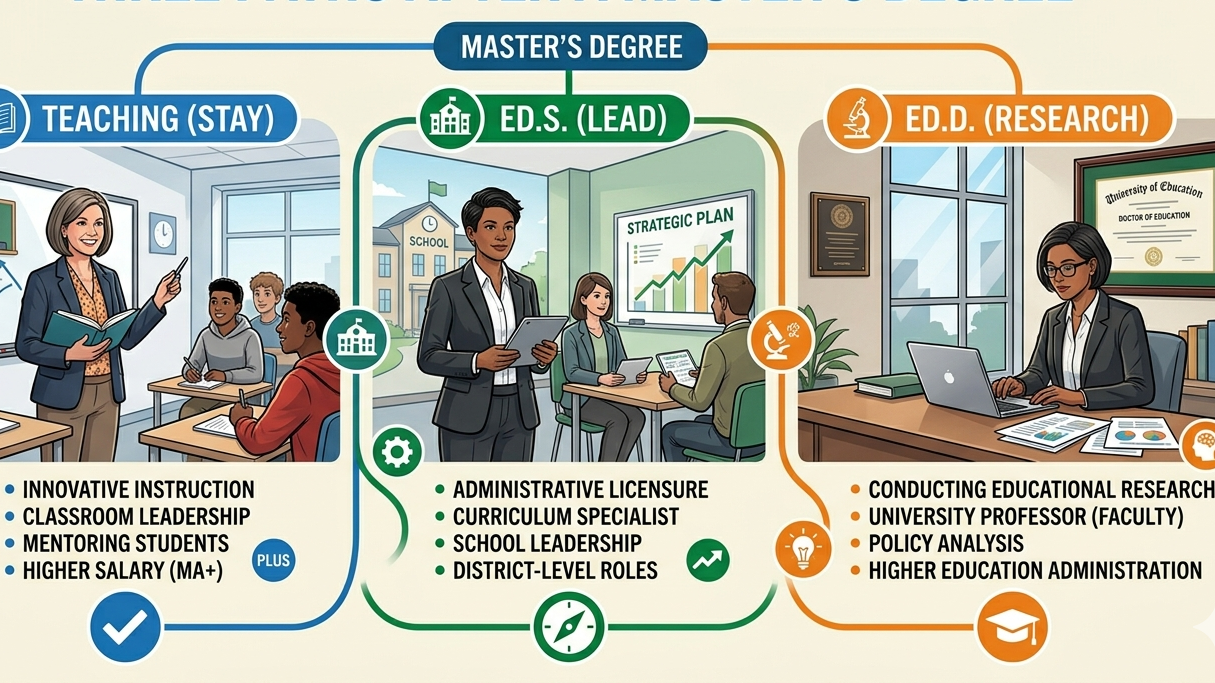
An Ed.S. is a terminal professional degree. This means it’s designed for practitioners—people who want to work in schools—rather than researchers who want to live in libraries. Most programs require about 30 to 60 credits beyond your Master’s.
Because it’s so specialized, it’s highly respected by school boards. While a Master’s degree helps you understand how to teach, an Ed.S. teaches you how to lead a department, a school, or even an entire district. It’s a tactical degree. You learn about school law, public policy, and advanced psychological assessments.
High-Level School Administration Roles
One of the primary answers to what can you do with an education specialist degree is moving into the “front office.” Many states actually require an Ed.S. or equivalent to be licensed for certain administrative roles.
- School Principal or Assistant Principal: You become the CEO of the building. You manage staff, handle budgets, and set the tone for the school’s culture.
- District Superintendent: This is the highest-level role in K-12 education. You work with the school board to manage multiple schools and thousands of students.
- Director of Student Services: You oversee non-academic needs like transportation, health services, and food programs to ensure the district runs like a well-oiled machine.
Moving into these roles requires the same level of precision and organization as how to write an abstract for a research paper—you have to summarize complex data into actionable plans.
Curriculum Development and Instructional Design
Not every leader wants to be a principal. If you love the “what” and “how” of teaching, the Ed.S. is perfect for becoming a Curriculum Specialist. In this role, you aren’t just following a textbook; you are the one choosing or creating the textbooks for the whole district.
Instructional designers often work behind the scenes to integrate technology into the classroom. They look at data to see where students are struggling and design new modules to bridge those gaps. According to Indeed, curriculum leaders are among the most in-demand roles for those holding this specific degree because they directly impact state test scores.
Special Education Leadership and Advocacy
If your passion lies in helping students with diverse needs, an Ed.S. in Special Education is a game-changer. You move beyond being a classroom teacher and become a Director of Special Education.
In this position, you ensure the school is compliant with federal laws like IDEA (Individuals with Disabilities Education Act). You help parents navigate IEPs and ensure every student has the resources they need to succeed. This isn’t just about teaching; it’s about legal advocacy and systemic change. This is a highly specialized field, much like knowing the intricacies of university of north texas diploma frame preservation—you are the expert that others turn to for the “hard” questions.
The Financial Impact: Salary and Growth Potential
Let’s talk numbers. Why do people really get this degree? In many districts, there is a “salary schedule.” When you move from the “Master’s” column to the “Specialist” column, you get an automatic, permanent pay raise.
According to the American College of Education, Ed.S. holders can see significantly higher lifetime earnings compared to those with just a Master’s. Because you qualify for “District-level” roles, your salary potential moves from the $60k-$70k range into the $100k+ range depending on your location and experience.
Education Specialist vs. Educational Doctorate (Ed.D.)
Choosing between these two can be tough. Here is a quick breakdown to help you decide.
| Feature | Education Specialist (Ed.S.) | Doctor of Education (Ed.D.) |
| Average Time | 1.5 to 2 Years | 3 to 5 Years |
| Final Project | Capstone or Field Experience | Full Research Dissertation |
| Focus | Practical Leadership Skills | Applied Research & Theory |
| Title | Specialist | Doctor |
| Goal | Immediate Career Advancement | Academic or Executive Leadership |
If you want the pay bump and the job title change now, the Ed.S. is usually the faster, more efficient path.
People Also Ask (FAQs)
Is an Ed.S. considered a doctorate?
Technically, no. It is a “Sixth-Year” degree that sits between a Master’s and a Doctorate. However, in the eyes of most school districts, it is treated as a terminal degree for salary purposes.
Can I teach at a college with an Ed.S.?
Yes, often at the community college level or as an adjunct instructor in a university’s department of education. However, for a tenured “Professor” title, a PhD or Ed.D. is usually required.
How do I become an education specialist?
You first need a Master’s degree in a related field. Then, you apply to a CAEP-accredited Ed.S. program. Many of these are now available online to accommodate working teachers.
What is the difference between a teacher and an education specialist?
A teacher focuses on daily classroom instruction. An education specialist focuses on the “big picture”—policy, psychology, curriculum design, or school-wide leadership.
Final Thoughts
At the end of the day, figuring out what can you do with an education specialist degree comes down to where you want to spend your time. If you love the school environment but feel ready to lead the charge from an office or a district boardroom, this degree is your ticket. It offers the perfect balance of prestige, a higher salary, and advanced knowledge without the grueling years of dissertation research. It’s an investment in your career that pays off both in your paycheck and in your ability to make a wider impact on the students you serve.