Speech vs language isn’t just two words that sound similar. They’re doing completely different jobs. Speech is the physical part, your mouth, tongue, lips and vocal cords turning air into sound that someone else can hear. Language is the system underneath all of that, the rules, the words, and the meaning you’re actually trying to get across.
Here’s the part that trips a lot of parents up. A child can know exactly what he wants to say, the idea is right there, fully formed, and still stumble over getting the sounds out cleanly. Or he can pronounce every word perfectly and still struggle to string a sentence together, or miss what you just told him to do. Which one’s actually going on matters, because it changes what kind of help is going to be useful.
Below, we’ll walk through speech vs language properly, with real examples, how delays differ, what the disorders look like, what a speech language pathologist does, and the questions people keep typing into Google about this.
Speech vs Language: The Difference at a Glance
Quick way to think about it: speech is the sound coming out, language is the meaning behind it.
| Speech | Language |
|---|---|
| Physical production of sounds | System for communicating meaning |
| Uses lips, tongue, jaw and voice | Uses words, grammar and symbols |
| Includes articulation | Includes vocabulary and grammar |
| Includes voice | Includes understanding (receptive skills) |
| Includes fluency | Includes social communication (pragmatics) |
| Can be spoken | Can be spoken, written, signed, or gestured |
What Is Speech?
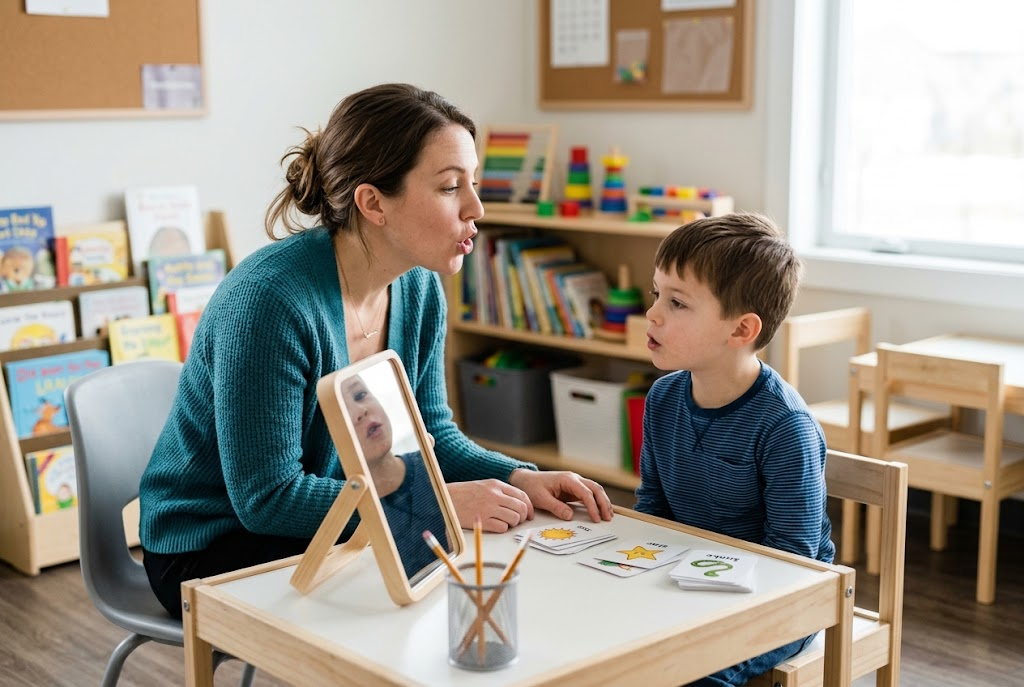
Speech is language once it’s been turned into sound. It takes real coordination, tongue, lips, jaw and vocal cords all moving together, and it breaks down into three main pieces.
Articulation
Articulation is how clearly someone makes individual sounds. A child who says “wed” instead of “red,” or who drops the ends off his words, is dealing with an articulation issue, not a language one.
Worth knowing: not every speech sound problem looks the same. Articulation is about a specific sound being wrong. Phonological difficulties are more about patterns, several sounds getting swapped or dropped in a predictable way across a whole word, not just one sound on its own. If a child is consistently dropping the last sound off his words, that’s actually a well known pattern worth reading up on separately, here’s a closer look at teaching final consonant deletion. Either way, that’s something an evaluation sorts out, not a checklist online.
Voice
Voice covers pitch, loudness and quality, whether it’s hoarse, breathy, too soft or strained.
Fluency (Including Stuttering and Cluttering)
Fluency is about rhythm, how smoothly the words come out. Repeating sounds, stretching them, or getting stuck mid word is what most people know as stuttering. There’s a lesser known fluency issue too, called cluttering, where speech comes out unusually fast or irregular and ends up harder to follow, almost like the words are tripping over each other.
What Is Language?
Language is the code underneath speech, the rules and symbols we use to understand and share ideas. It doesn’t even need to be spoken out loud. It can be written, signed, typed, whatever works. It covers word meaning, grammar and understanding, and reading and writing lean on the same skills too, so a child who struggles with spoken language may run into similar trouble once reading and writing enter the picture.
Receptive Language
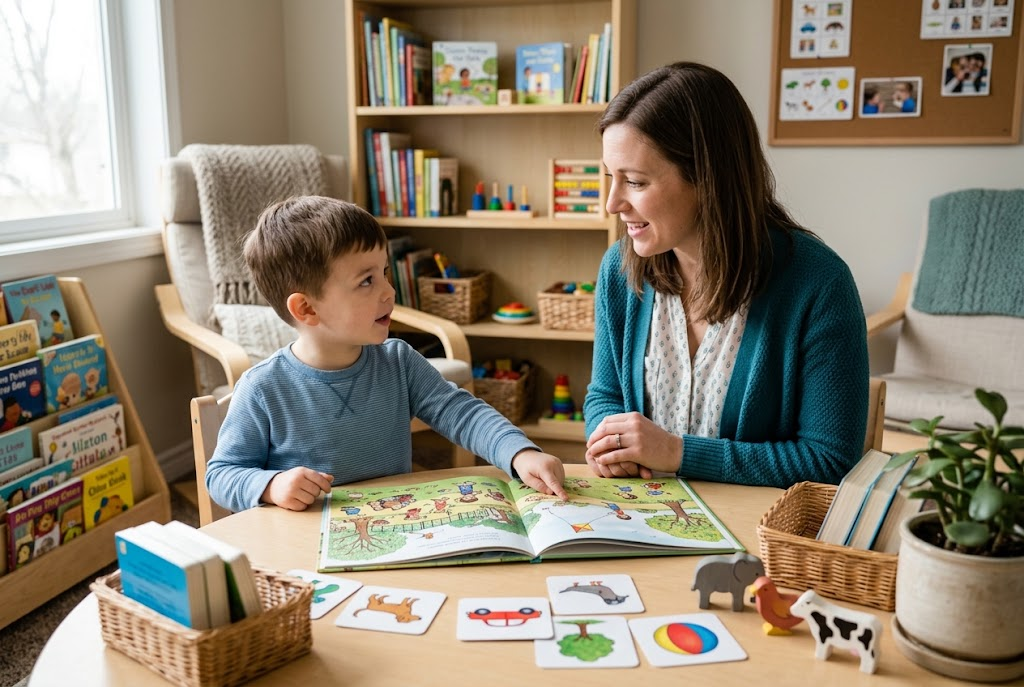
This is the understanding side, following directions, making sense of questions, catching what someone just said.
Expressive Language
This is using vocabulary, grammar and sentence structure to get your own thoughts across. A child might say every word clearly and still talk in short, choppy sentences, or struggle to explain what happened at school that day. That’s a language issue, not a speech sound one, and it’s worth remembering because the two get lumped together so often.
Pragmatic or Social Language
The unwritten rules of talking to people, taking turns, staying on topic, picking up on tone.
Speech vs Language Examples
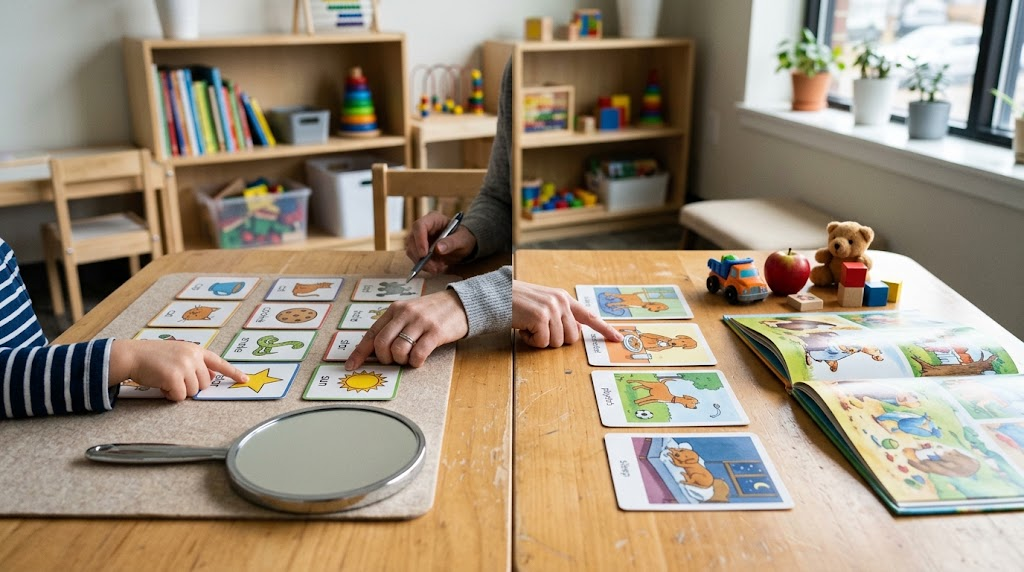
Definitions only go so far. Here’s what it actually looks like in real life.
| Situation | More closely related to |
|---|---|
| Says “tat” instead of “cat” | Speech |
| Trouble producing the /r/ sound | Speech |
| Stutters or gets stuck on sounds | Speech |
| Very limited vocabulary | Language |
| Struggles to understand directions | Language |
| Trouble forming sentences | Language |
| Trouble taking conversational turns | Language and social communication |
| Both pronunciation and sentence trouble | Speech and language |
A child who knows exactly what he wants to say but keeps saying “tat” instead of “cat,” that’s a speech sound thing. The word and the meaning underneath are both fine.
A child who pronounces words perfectly clearly but can’t quite follow “put the red cup under the chair,” that’s leaning toward a language comprehension issue instead.
And plenty of kids land somewhere in the middle, dealing with both at once. It happens more than people assume, which is really the whole argument for getting an actual evaluation instead of guessing off a list like this one.
Speech vs Language vs Communication
Communication is the umbrella term that speech and language both sit under, along with facial expressions, gestures, body language, writing and sign systems.
| Term | Simple meaning |
|---|---|
| Speech | Producing spoken sounds |
| Language | Understanding and expressing meaning |
| Communication | Sharing information through speech, language, writing, gestures, signs and more |
Speech and language are two tools in a bigger toolbox, not the whole thing. That’s why someone with very limited spoken language can still communicate just fine through writing, signing, pictures or an assistive device.
Speech Delay vs Language Delay
This is where a lot of parents get genuinely confused, and getting it right matters for how a child ends up being supported.
A speech delay is mostly about producing sounds. A child might struggle to pronounce certain sounds or hit speech milestones on time, even while understanding everything said to him and knowing exactly what he wants to say.
A language delay is about understanding or using words, sentences and concepts, even when the sounds themselves come out perfectly clean.
Speech delay, in practice: a child understands “give me the ball,” knows the word, uses it right, but says “ba” instead of “ball.”
Language delay, in practice: a child pronounces every word he knows clearly but can’t follow “put the ball under the chair,” or struggles to combine words into a full sentence.
Some kids deal with both at the same time, certain sounds are hard, and so is following directions or building sentences. It’s more common than people think, and it’s genuinely hard to sort out just by listening at home. That’s exactly what a formal evaluation is for.
Speech Disorder vs Language Disorder
These two are related but affect different parts of communication. A speech disorder is about how sounds, voice or fluency actually get produced. A language disorder is about how someone understands or uses words, sentences and meaning.
| Speech Disorder | Language Disorder |
|---|---|
| Affects how speech is produced | Affects how language is understood or used |
| May involve sounds, voice or fluency | May involve vocabulary, grammar, sentences, comprehension |
| Person may know what they want to say but struggle to produce it clearly | Person may pronounce words clearly but struggle to understand or express ideas |
| Examples: speech sound disorders, stuttering, some voice disorders | Examples: receptive or expressive language difficulties |
| Core issue is producing or delivering speech | Core issue is understanding or using the language system |
These aren’t labels to self diagnose from a blog post, they’re here so the terms make sense if a professional uses them with you. Someone can have one, the other, or both.
Speech Language Pathologist vs Speech Therapist
This comes up constantly, and the short answer is it’s usually the same person wearing two different name tags.
In the US, speech language pathologist (SLP) is the formal, credentialed title. “Speech therapist” is just the informal way people refer to the same job. An SLP typically works across speech sounds, language, fluency, voice, social communication, and depending on the setting, swallowing and feeding too.
Same logic covers speech language pathology vs speech therapy. Pathology is the field itself, assessment, diagnosis and treatment, while “speech therapy” is just the everyday term for the services an SLP actually provides.
Speech vs Language in Children
Parents usually notice something’s a little off before anyone else does. Roughly:
A speech concern looks like this: certain sounds are consistently hard, other people struggle to understand him, or words come out differently than expected for his age.
A language concern looks like this: trouble following directions, a noticeably small vocabulary, difficulty combining words into sentences, or trouble getting his point across.
Hearing is worth mentioning here too, it affects how speech and language develop, which is part of why hearing gets checked when a child has ongoing communication trouble. And plenty of kids show signs of both a speech and a language concern at once, which again, isn’t unusual.
Speech vs Language in Adults
This isn’t only a childhood thing. In adults, speech and language issues can show up after a stroke, a brain injury or a progressive neurological condition. Speech related changes affect clarity, fluency or voice. Language related changes affect word finding, understanding, reading or writing. Same as with kids, whether the root cause is speech based or language based changes what kind of support actually helps.
When Should You Talk to a Speech Language Pathologist?
If a communication issue sticks around, gets in the way of everyday interactions, causes frustration, or starts interfering with school, work or relationships, it’s worth bringing up with a professional. An evaluation is really the only reliable way to know whether the root cause is speech, language, hearing or something else entirely, and it beats guessing from an article like this one.
Frequently Asked Questions
What is the difference between speech and language?
Speech is the physical production of sounds and words. Language is the broader system used to understand and express meaning, spoken, written or signed.
What is the difference between language and speech?
Same idea, flipped around. Language is the underlying system of meaning and grammar, speech is how that system turns into physical sound.
What is the difference between a speech delay and a language delay?
A speech delay is about difficulty producing sounds clearly, even when the child understands and knows what he wants to say. A language delay is about difficulty understanding or using words and sentences, regardless of how clear the sounds are.
What is the difference between a speech disorder and a language disorder?
A speech disorder affects how sounds, voice or fluency get produced. A language disorder affects how someone understands or uses vocabulary, grammar or meaning. Someone can have one, the other, or both.
What is the difference between speech and language disorders?
Speech disorders are about production, sounds, voice, fluency. Language disorders are about understanding and using, vocabulary, grammar, comprehension. They get grouped together often, but they’re not the same thing.
Is speech part of language?
Speech is one way language gets expressed out loud, but language itself is bigger. It also covers understanding, writing, signing and social communication.
Can someone have both a speech and language disorder?
Yes, and it’s fairly common. That overlap is exactly why a full evaluation beats a quick checklist. This is really the core of speech vs language when both show up together.
What is an example of a speech problem versus a language problem?
A speech problem might look like saying “tat” instead of “cat,” even though the child knows the right word. A language problem might look like struggling to follow a multi step instruction even when pronunciation is completely clear.
What is the difference between speech, language and communication?
Communication is the broadest term, it covers every way people connect, including speech, language, gestures and writing. Speech and language are two of the main tools inside that bigger category.
Final Thoughts
Speech vs language get lumped together because they work as a team most of the time, but they’re doing genuinely different jobs. One’s about producing sound. The other’s about the meaning underneath it. Figuring out which one’s actually the issue, for a child or an adult, is the first real step toward getting the right kind of help. For background reading, the American Speech Language Hearing Association (ASHA) and the National Institute on Deafness and Other Communication Disorders (NIDCD) are both solid places to start.