

If you’re trying to figure out how to add study abroad to your resume, here’s the short version: you almost certainly don’t need to create a whole new section for it. A semester or academic program typically fits right into your Education section, sitting just under your main degree. But if your time overseas involved an internship, some research work, or a substantial volunteer commitment, it actually makes more sense under Experience.
That single decision matters a lot more than most people realize. Take a marketing internship in Madrid — file it under Education, and it gets lost next to your GPA, reading like just another class you happened to take. List that exact same internship under Experience, with an actual title and a few real responsibilities attached, and suddenly it reads like what it genuinely was: a job.
This guide walks through where study abroad actually belongs, how to write about it without sounding like a travel journal entry, how the approach shifts depending on where you currently stand in your career, and how to adjust the specifics based on your major and whatever job you happen to be applying for.
How to Add Study Abroad to Resume: Where Should It Go?
The right way to add study abroad to a resume really comes down to what you actually did during the program itself. A standard semester built mostly around classes usually fits under Education, while something like an internship, a research position, paid work, or a substantial volunteer placement is generally better treated as Experience.
There are three realistic options here, and picking the right one depends on the substance of what you actually did abroad — not simply the fact that you happened to study in another country.
Education. This works for a standard semester or summer program centered mainly around coursework — you earned credit, went to classes, turned in assignments, and didn’t hold any separate job or professional role alongside it.
Experience. Go with this option when your time abroad included an internship, a research assistantship, paid work, or a meaningful volunteer role that came with real responsibilities. A marketing internship completed in Barcelona, for instance, deserves to be presented as an actual internship — not tucked away inside a generic Education entry.
International Experience. A dedicated section can make sense if you’ve got several international experiences under your belt, or if overseas work is especially relevant to the specific position you’re going after. If you only had one study abroad program, and it already fits naturally under either Education or Experience, adding a whole separate section usually isn’t necessary.
| Study Abroad Situation | Best Resume Section |
|---|---|
| Semester of classes | Education |
| Summer academic program | Education |
| Study abroad internship | Experience |
| Research abroad | Education or Experience |
| Volunteer program abroad | Experience |
| Multiple international experiences | International Experience |
| Language immersion program | Education or Skills |
A semester in Madrid does not automatically become work experience simply because you lived there for several months. If coursework made up most of the program, Education is still the clearest and most accurate place for it.
How to Add Study Abroad to Resume: What to Include
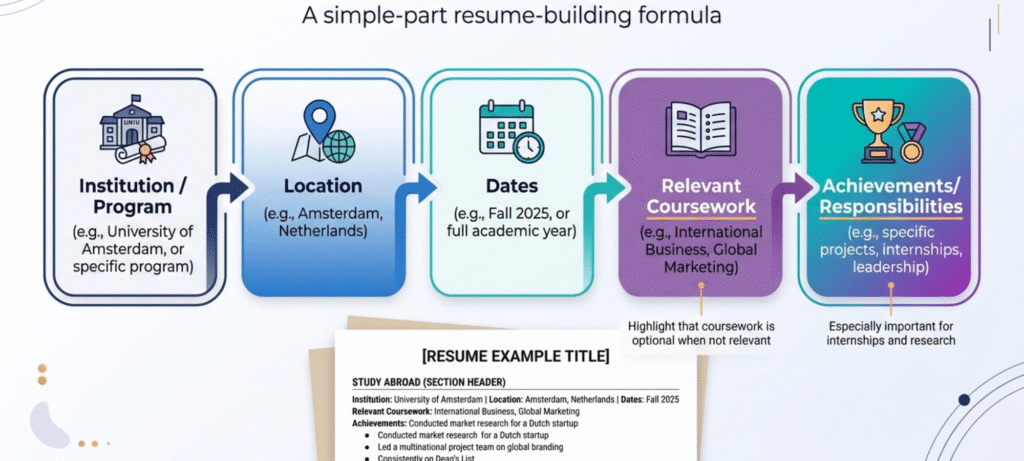
Most study abroad entries need the same core pieces of information, regardless of which section they land in.
Institution or program name. The actual name of the host university or program provider. If you went through a third-party program alongside a host university, list the university first and the program name if it adds credibility.
Location. City and country.
Dates. Term and year is usually enough (Fall 2025, Spring 2025).
Coursework. Two or three courses that connect to the job, not your full transcript.
Achievements or responsibilities. For internships or research roles, this is where the real substance goes.
Not every entry needs all five details crammed in. Working with a tight one-pager? Three might do the job fine. But if your resume is genuinely built around international experience, go ahead and use all five.
Semester Abroad vs. Summer Program vs. Exchange: What Actually Changes on the Resume
People use these three words like they mean the same thing. On a resume, they don’t quite work the same way.
Take a full semester, or better yet a full academic year, and you’ve simply got more room to build something. Time for a real project. Time for a research piece to actually develop into something worth mentioning. Sometimes even a grade record worth including. This is also usually the version that ends up on your home university’s official transcript — which matters the second an application asks for transcripts directly.
A summer program moves faster and covers less ground. Sometimes it’s a whole course squeezed into six, maybe eight weeks. There just isn’t enough time to finish anything substantial, so the entry usually ends up built around a specific skill or course instead, a language you picked up, a technical subject you dug into, rather than some big achievement.
Exchange semester means something a bit more specific: your home university has an actual formal partnership with the host school. Credits usually flow straight onto your home transcript instead of living somewhere separate. Doesn’t really change how the resume looks, honestly. But it matters if your GPA ever comes up in conversation. Grades folded into your home GPA already? Nothing to explain. Grades sitting on a separate transcript that never merged in, and your host GPA happened to be strong? Worth its own line.
Host university or home university, which one goes on the resume? Both, ideally. Host university and program sit under Education. Home university and your actual degree stay as the main entry. The study abroad line works as a sub-entry under your degree — not a replacement for it.
Study Abroad Program on a Resume: Naming It Correctly
“Study abroad program” usually means a structured setup. Sometimes it’s run by your own university. Sometimes it’s a third-party outfit like IES Abroad or CIEE, handling logistics, coursework, sometimes even housing for a group of students at some host school.
If the program’s name actually means something in your field, or adds weight beyond just the host university’s reputation, keep it in:
University of Amsterdam, Amsterdam, Netherlands. Study Abroad Program | Fall 2025. Relevant Coursework: International Business, European Economics, Global Marketing.
If it’s just a generic exchange nobody’s heard of, the host university is doing most of the heavy lifting anyway. Drop the program label if space is tight — nobody will miss it. If you’re still in the planning stage and haven’t left yet, it’s worth sorting out the documents you’ll need before you study abroad early, since a lot of that paperwork ends up shaping the program name and dates you’ll eventually list on the resume.
How to Add Study Abroad Coursework to a Resume
Don’t list eight classes just because you took them. Two or three that connect to the role are usually enough.
Applying for marketing: Relevant Coursework: International Marketing, Consumer Behavior, Global Business Strategy. Applying for finance: International Finance, Financial Markets, Economics. Applying for communications: Intercultural Communication, Media Studies, Global Communications.
If none of your coursework connects cleanly to the job, skip the line and lean on achievement bullets instead. IFSA’s guide to including study abroad on a resume makes a similar point: relevant coursework only earns its place if it actually matches what the reader is looking for, not because it fills space.
One detail worth knowing: if a course had a different name at the host institution than its home-university equivalent, use whichever name is more recognizable to the reader, usually the English translation or the home-university equivalent, rather than the exact foreign transcript title.
How to Add Study Abroad Experience to a Resume
“Study abroad experience” is broader than the academic program itself. This is where you translate what happened into evidence rather than a claim.
Weak: “Developed excellent communication and adaptability skills.”
Stronger: “Collaborated with students from five countries on a semester-long market research project, presenting findings to a mixed academic and industry audience.”
A useful test: would the sentence survive being asked “okay, but what did you actually do?” If it wouldn’t, it needs another pass.
How to Add a Study Abroad Internship to a Resume
If your program included real work, list it the way you’d list any other internship: a title, an organization, a location, and responsibilities. Note in a single line that it was completed through a study abroad program if that context is useful.
Marketing Intern | ABC International — Madrid, Spain Summer 2025 (completed through a study abroad program)
- Assisted with campaign planning for two regional product launches
- Analyzed customer engagement metrics across three channels
- Presented findings to a cross-functional team of five
Study Abroad Resume Examples by Program Type
These are sample entries, not descriptions of a real person’s experience. Swap in your own institution, dates, and specifics.
Research abroad
Research Assistant, University of Cape Town — Cape Town, South Africa Spring 2025
- Collected and coded survey data for a study on urban water access
- Co-authored a summary report for the sponsoring department
Volunteer abroad
Volunteer, Local Education Nonprofit — Nairobi, Kenya Summer 2025
- Assisted with after-school tutoring for a group of primary school students
- Helped organize a community literacy event with local staff
Language immersion program
Intensive Language Program, Sorbonne University — Paris, France Summer 2025
- Completed roughly 200 hours of intensive French instruction
- Lived with a host family and communicated primarily in French for eight weeks
Study Abroad on a Resume by Career Stage
The same experience gets treated a little differently depending on where you are when you’re writing the resume.
Current college student. This is often one of the strongest entries on the resume at this stage, since there isn’t much competing professional experience yet. Give it real space.
Recent graduate. Still worth including, usually under Education alongside your degree, even a year or two after graduating. It fades in relevance the further you get from graduation, but it doesn’t disappear immediately.
No work experience yet. If internships or jobs aren’t really on your resume yet, study abroad, especially one that involved research, an internship, or some kind of substantial project, can end up carrying more weight than it would for someone with a longer work history behind them. Give it real bullet points here rather than squeezing it into a single line.
Several years into your career. By this stage, study abroad usually shrinks down to just a single line under Education, assuming it even stays on the resume at all. Employers at this point care a lot more about your recent professional achievements than a college semester from years back.
Study abroad from several years ago. If it happened five or more years ago and has nothing to do with your current field, it’s completely fine to drop it altogether, or trim it down to just the host institution’s name with no bullets attached. One exception worth noting: if it directly connects to an international role you’re going after right now, a brief mention can still earn its place, no matter how long ago it actually happened.
Graduate students. A graduate-level study abroad program or research placement often deserves to be treated like real Experience, even without a formal job title attached, since graduate research usually comes with actual deliverables, a thesis chapter, a dataset, a conference presentation, things that read a lot closer to work than to ordinary coursework.
International students. If you’re an international student within your own country’s education system, and what you’re calling “study abroad” was really a degree partly completed overseas, the same logic applies: Education for the coursework itself, Experience for anything that came with real responsibilities. It’s also fine to mention the language of instruction if it wasn’t your first language, since that’s genuinely useful information a reader might not otherwise pick up on.
Career changers. If you’re shifting into a new field and your study abroad experience happens to overlap with it, an engineer who took international business courses abroad and is now moving toward consulting, for example, it’s worth moving that entry higher up on the resume or expanding it a bit further. It’s doing more work for a career change than it would for someone staying in their original lane.
Study Abroad Resume Skills
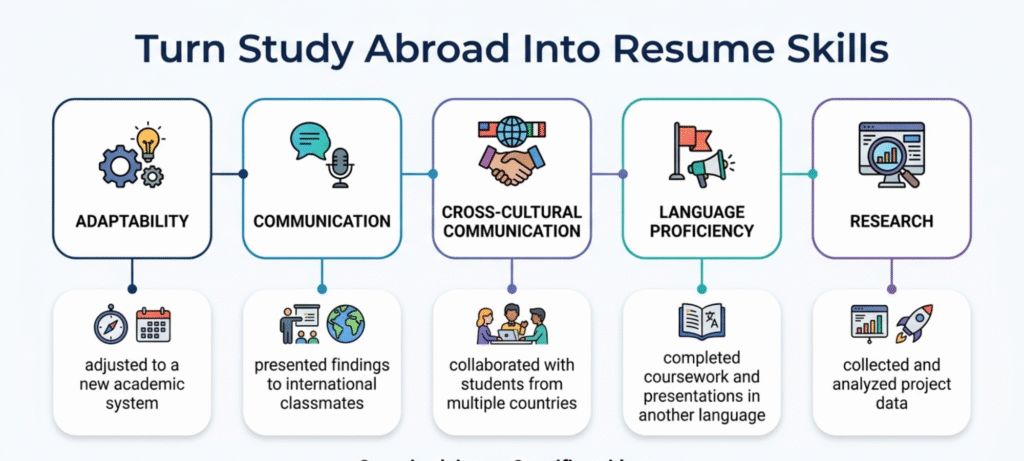
Cross-cultural communication, adaptability, problem-solving, and independence show up on basically every piece of study-abroad resume advice out there, and there’s a good reason for that. These traits genuinely can be worth highlighting, especially when there’s a specific example backing them up instead of just the bare label sitting on its own.
| Skill | What it can look like on a resume |
|---|---|
| Adaptability | Adjusted to a new academic system and a different grading structure |
| Communication | Presented findings to a group of international classmates and faculty |
| Cross-cultural communication | Collaborated with students from four countries on a group presentation |
| Language proficiency | Completed upper-level coursework in Spanish and delivered presentations in Spanish |
| Research ability | Collected and analyzed survey data for a semester-long project |
| Problem-solving | Navigated an unfamiliar academic system and administrative process independently |
| Independence | Managed coursework and daily logistics in an unfamiliar city without a support network |
| Time management | Balanced coursework, a part-time role, and travel logistics across a single term |
One caution: don’t overstate what the experience actually gave you. A single semester in France doesn’t make someone fluent; if your French is conversational, say “conversational proficiency,” not “fluent.” The University of Arizona’s guidance on updating a resume with international experience makes the same point, that specific, honest examples read better than broad self-assessments of ability.
Turning a Skill Into an Actual Bullet
Skill: adaptability. Bullet: “Adjusted to a new grading system and academic calendar while maintaining a full course load.”
Skill: collaboration. Bullet: “Worked with a four-person, three-nationality team to complete a semester-long consulting project.”
How to Tailor Study Abroad to a Specific Job
Match what the job description asks for to something specific you actually did. If a listing mentions cross-cultural communication, describe the actual project instead of restating the skill by name. If it mentions Spanish proficiency, describe the coursework and the presentations you gave in Spanish rather than writing “bilingual.” If the role is in international business or global operations specifically, the study abroad entry can move earlier in the resume or get more space, since it’s more directly relevant to what’s being evaluated.
Study Abroad Resume Examples by Major
Formatting stays consistent across majors; the coursework and bullet content is what should shift.
Business: Copenhagen Business School — Copenhagen, Denmark. Relevant Coursework: International Business Strategy, Nordic Economic Models. Completed a group consulting project for a local startup, presenting recommendations to a mixed Danish and international panel.
Engineering: Technical University of Munich — Munich, Germany. Relevant Coursework: Renewable Energy Systems, Applied Thermodynamics. Worked in a lab group on a small-scale solar efficiency project.
Computer Science: KTH Royal Institute of Technology — Stockholm, Sweden. Relevant Coursework: Distributed Systems, Human-Computer Interaction. Built a group project application as part of a semester-long coursework requirement.
Data Science: University of Edinburgh — Edinburgh, Scotland. Relevant Coursework: Applied Statistics, Machine Learning Foundations. Completed a group project analyzing public transit usage patterns using open city data.
Marketing: University of Barcelona — Barcelona, Spain. Relevant Coursework: International Marketing, Consumer Behavior. Worked on a team project analyzing regional marketing strategy differences across three European markets.
Finance: Bocconi University — Milan, Italy. Relevant Coursework: International Finance, European Financial Markets. Completed a group equity analysis project comparing two publicly traded companies.
Economics: London School of Economics — London, United Kingdom. Relevant Coursework: International Trade, Development Economics. Wrote a research paper comparing trade policy outcomes in two regional economies.
Communications / Journalism: University of Amsterdam — Amsterdam, Netherlands. Relevant Coursework: Global Media Studies, Intercultural Communication. Produced a short documentary project with a team of students from four countries.
Political Science / International Relations: Sciences Po — Paris, France. Relevant Coursework: European Union Policy, Comparative Government. Wrote a comparative policy brief with three international classmates and presented it to visiting faculty.
Psychology: University of Queensland — Brisbane, Australia. Relevant Coursework: Cross-Cultural Psychology, Research Methods. Assisted with data coding for a faculty research project on bilingual cognitive development.
Biology / Environmental Science: James Cook University — Cairns, Australia. Relevant Coursework: Marine Biology, Tropical Ecology. Participated in a field research project collecting reef health data alongside graduate researchers.
Nursing / Pre-Med: University of Cape Town — Cape Town, South Africa. Relevant Coursework: Global Health Systems, Community Health. Observed clinical operations at a community health clinic as part of a supervised coursework placement.
Architecture: Politecnico di Milano — Milan, Italy. Relevant Coursework: Urban Design, Sustainable Architecture. Completed a semester-long design studio project proposing adaptive reuse for a historic industrial site.
Education: University of Helsinki — Helsinki, Finland. Relevant Coursework: Comparative Education Systems. Observed classroom instruction in the Finnish public school system as part of a coursework placement.
Pre-Law: University College London — London, United Kingdom. Relevant Coursework: Comparative Legal Systems, International Human Rights Law. Completed a research paper comparing common law and civil law approaches to a specific case study.
Does Study Abroad Look Good on a Resume?
It can, but it isn’t automatic. An employer isn’t impressed simply because you left the country for a semester. What tends to land is language ability, cross-cultural collaboration, independence, or subject-matter knowledge that connects to the job, explained with actual detail rather than a generic mention. Study abroad by itself isn’t a qualification. It’s the specific, demonstrable things you can point to from the experience that actually do the work on a resume.
Should I Add Study Abroad to My Resume?
Usually yes, especially if you’re a student or recent graduate without a long professional history. Here’s a quick way to think through it:
| Situation | Include It? |
|---|---|
| Current student | Usually yes |
| Recent graduate | Usually yes |
| Relevant language skills gained | Yes |
| Applying for an international-facing role | Definitely consider it |
| Study abroad included an internship | Yes |
| Resume already full of stronger, relevant experience | Shorten it |
| Experience is old and unrelated to your field | Usually brief or omit |
| Weekend travel with no academic or work component | Leave it off |
How to Add Study Abroad to a One-Page Resume
If you’re figuring out how to add study abroad to resume when space is limited, give the experience only as much room as it deserves. A standard academic semester may need just a few lines, while an internship, research project, or substantial volunteer role can justify additional bullet points.
For a normal academic semester:
University of Barcelona — Barcelona, Spain Study Abroad Program | Spring 2025 Relevant Coursework: International Marketing, Consumer Behavior
No bullets needed if there isn’t a specific achievement behind it. If you completed an internship, research project, or substantial volunteer role, give that entry more room and describe it with bullets, the same way you would any other job.
Study Abroad and Applicant Tracking Systems
A resume that’s easy for both applicant tracking software and human recruiters to read is usually the safer choice either way. Use standard section headings like Education and Experience instead of creative labels. Keep information as actual text rather than embedding it in an image or graphic. Use the full name of the host institution rather than an abbreviation the system might not recognize, and stick to a conventional date format.
If the job description uses a specific term, like “cross-cultural” or “international operations,” it’s fine to use that language where it’s accurate. Compare “global experience and excellent communication skills” to “collaborated with international students on a semester-long market research project.” The second one reads better to a human and does just as much for a keyword scan. The same principle applies across resume types generally, our breakdown of how to write a resume for a Salesforce analyst role covers this same specific-over-generic approach for a very different field, which shows it’s not just a study-abroad quirk.
What Not to Include
Your resume isn’t a travel journal. Leave out the cities you visited on weekends, sightseeing, personal travel stories, every single course on your transcript, broad statements about “experiencing a new culture,” language ability you haven’t actually reached, and extracurricular details that don’t connect to the job.
The real question isn’t what you experienced abroad. It’s which parts of that experience help make the case that you’re a good fit for this particular role.
Common Mistakes
A few worth checking for: hiding an actual internship under a generic Education entry instead of listing it as work experience, forgetting the dates or the host institution’s name entirely, using the exact same bullet points for every job application instead of adjusting them to the role, and leaning on adjectives (adaptable, driven, culturally aware) with nothing behind them to back it up.
Study Abroad on LinkedIn
LinkedIn gives you more room than a resume, so you don’t have to compress everything into two lines. Depending on what the program involved, it can sit under Education, Experience, or get a mention in your About section if it’s genuinely central to your story. The same Education-versus-Experience logic from earlier still applies: coursework goes under Education, a job or research role goes under Experience.
Frequently Asked Questions
How do I add study abroad to my resume?
The best way to add study abroad to resume depends on what you did during the program. Put a standard academic program under Education with the host institution, location, dates, and relevant coursework. If the experience included an internship, research position, or substantial volunteer work, list it under Experience and describe the responsibilities and results.
Do I put study abroad on my resume?
In most cases, yes, particularly if you’re a student or recent graduate. It carries more weight when it connects to the job or shows something concrete, like language skills or a specific project.
Does studying abroad look good on a resume?
It can, but it isn’t automatic. What matters more than the fact that you studied abroad is how specifically you describe what you did there.
Where should study abroad go on a resume?
Education for a standard academic program, Experience for an internship, research role, or substantial volunteer work.
Should study abroad go under Education or Experience?
It depends on what actually happened. Coursework and academic credit go under Education. A job title, responsibilities, and results go under Experience.
How do I add a study abroad semester to my resume?
The same way as any other academic program: institution, city and country, term and year, and a short line on relevant coursework or outcomes.
Should I add study abroad to my resume if it happened several years ago?
If it’s unrelated to your current field and you have stronger recent experience, it’s fine to shorten it or leave it off. If it’s directly relevant to a role you’re applying for now, a brief mention is still worth keeping.
Final Thoughts
Knowing how to add study abroad to resume becomes much easier once you separate academic experience from professional experience. If your time overseas was mainly about coursework, keep it under Education and focus on the institution, dates, location, and the classes that matter for the job. If you completed an internship, research project, or meaningful volunteer role, give that experience more space and describe what you actually accomplished.
The strongest resume entries do not simply say that studying abroad made you adaptable or independent. They show those qualities through specific projects, responsibilities, language use, collaboration, or results. Keep the details relevant to the position you’re applying for, and shorten older experiences when stronger professional achievements have taken their place.