

When to start studying for Step 1 sounds like a single question, but it’s really a few different ones stacked together. Some people mean “when should I begin planning?” Others mean “when do I open my first question bank?” And plenty mean “when does full-time dedicated study begin?” Each has its own answer, and mixing them up is where most of the panic comes from. This guide separates them, gives you a timeline you can actually use, and covers the awkward cases like starting late, starting too early, and studying as an IMG.
Quick Answer: When Should You Start Studying for Step 1?
Start light and early, then go full-time later.
Most US students build small, steady habits during MS1 and MS2, then move into a dedicated full-time period after preclinical coursework ends. Many prep resources cite roughly 5 to 8 weeks for that dedicated stretch. Treat that as a commonly reported planning range, not a rule. No official body says every student needs exactly six weeks.
If you’re specifically asking when to start studying for Step 1 USMLE, the answer leans more on your school’s curriculum and your planned exam date than on your year alone. A student at a school with an early, integrated curriculum and a student at a traditional one can be in the same year and need very different plans.
Is There a Right Time to Start Studying for Step 1?
Not a single one. There’s a right range for each phase.
MS1 is for foundation. MS2 is for growing board integration. Dedicated is for intensity. An IMG may need a longer runway, an accelerated program may compress everything, and anyone with a shaky foundation might need extra time before dedicated even starts.
That’s less satisfying than a date on a calendar, I know. But a fake-precise answer would just set you up to feel behind for no reason.
Planning vs Longitudinal Review vs Dedicated Study
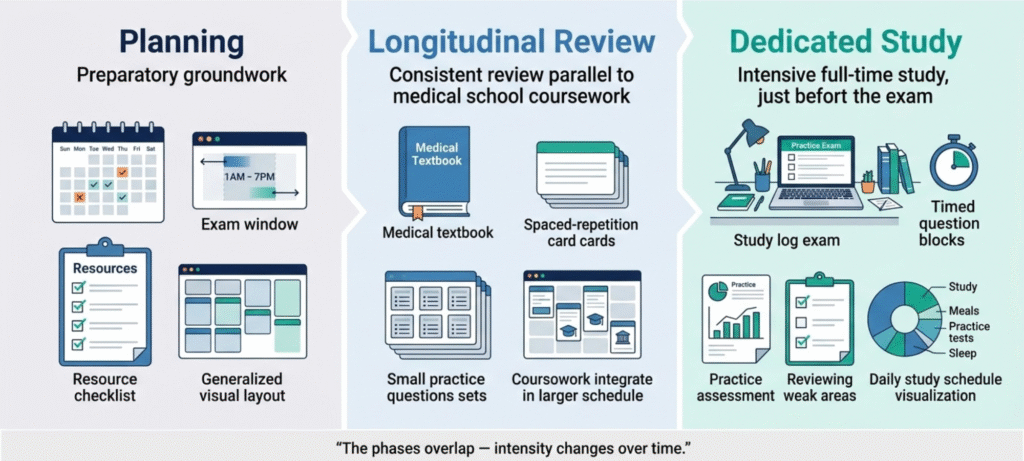
Here’s the framework that clears up the confusion.
Planning is the early groundwork: learning your school’s timeline, choosing a few resources, sketching a rough testing window. An AMA piece on Step 1 advice recommends beginning that planning at least six months out, ideally closer to twelve. Planning, not grinding.
Longitudinal review runs alongside your classes. Spaced repetition, a few questions, connecting lectures to how they’re tested.
Dedicated study is the full-time phase, usually right after preclinical courses.
So the 6 to 12 months figure and the 5 to 8 weeks figure aren’t rivals. They describe different things. Before you lock in any dates, check current eligibility and registration details on the official USMLE website, since policies and scheduling windows can change.
Step 1 Study Timeline From MS1 to Exam Day
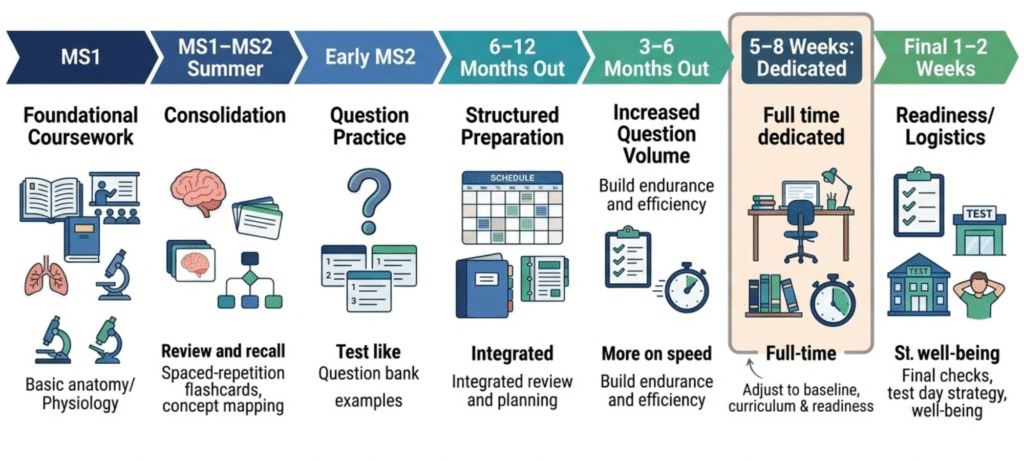
| Time | Main goal | What to do |
|---|---|---|
| MS1 | Build foundation | Master coursework, spaced repetition, light board review |
| MS1 to MS2 summer | Consolidate | Patch weak foundational subjects |
| Early MS2 | Build board habits | Add regular question practice |
| 6 to 12 months out | Structured preparation | Build a schedule, pick resources, set a question routine |
| 3 to 6 months out | Increase intensity | More questions, cumulative review, a practice assessment |
| 5 to 8 weeks out | Dedicated | Full-time Step 1 preparation (a common planning range) |
| Final 1 to 2 weeks | Readiness | Practice exams, weak areas, test-day logistics |
| Final days | Protect performance | Light review, sleep, logistics |
The right starting point also depends on what your medical school already builds into the curriculum. Some programs introduce board-style questions, spaced repetition, and basic-science integration from the first year, while others leave more of the Step 1 review to the period after preclinical coursework. That difference matters because your independent study should fill gaps rather than duplicate everything your school is already doing.
Before creating a separate Step 1 schedule, look at your current weekly workload, recent exam performance, and how much of the core material you can recall without notes. If you’re consistently understanding course material and retaining it, gradual board-focused review may be enough until MS2. If you’re repeatedly forgetting older subjects, start cumulative review earlier instead of waiting for dedicated.
Use it as a scaffold. Your school and your baseline will bend it.
When to Start Studying for Step 1 During MS1
Here’s where the “start early” advice gets overcooked. Starting early does not mean starting dedicated Step 1 prep in MS1.
Picture a first-year, call her Maya, who spends a Sunday color-coding a Step 1 master schedule while still fuzzy on renal physiology from class. That schedule won’t help her. Understanding the class material will.
Reasonable in MS1: spaced repetition on lectures you understood, connecting concepts to board-style thinking, an occasional question set, and learning the basic sciences properly.
Usually unnecessary: a full question bank schedule, eight to ten hour “board days,” multiple question banks, or constant practice exams.
And if you’re wondering how to start studying First Aid, most students treat it as a reference to organize what they’ve learned, often opening it in late MS1 or early MS2, rather than reading it cover to cover as a first pass.
When to Start Studying for USMLE Step 1 During MS2
MS2 is where the dial turns up. Early on, keep your coursework first and your review habits consistent. Mid-year, questions become a bigger slice of your week, and you start seeing which systems keep tripping you. By late MS2, you should be measuring, not guessing.
That’s really the answer to how to study for Step 1 during second year. Increase question volume gradually, and take a baseline practice assessment before dedicated starts so you know where you stand while there’s still time to fix things.
Should You Start 6 Months or 12 Months Before Step 1?
Both can be reasonable, because they mean different things.
At about 12 months out, you’re planning. Choose resources, understand your school’s timeline, and start gradual review.
At about 6 months out, things get more structured. More question practice, weak subjects identified, and a rough test window set.
At 1 to 2 months out, you’re in or near dedicated mode. Timed blocks, practice exams, targeted weak areas.
If you’re at 12 months and doing nothing, that’s fine. If you’re at 12 months and doing eight-hour days, that’s a burnout plan.
How to Start Step 1 Prep
If you’re staring at a blank page, here’s a five-step way in.
- Find your expected exam window.
- Assess your current knowledge with a low-stakes practice set.
- Choose your core resources, and keep the list short.
- Build a longitudinal routine you can actually sustain.
- Increase question volume as dedicated approaches.
That’s it. Boring works.
How Do You Know You’re Ready for Dedicated Step 1 Study?
Don’t rely on a week count alone. Look for signs: you’ve finished the core preclinical curriculum, you know your weakest subjects, your main resources are chosen, you can work through practice questions consistently, and you have a realistic exam window plus enough uninterrupted time.
Then get real data. NBME offers self-assessments for Step 1 examinees, including a comprehensive basic science option, and those are a stronger gauge than random question sets alone. If your results say you’re not there, that information is worth more than any schedule.
Another useful checkpoint is whether your study process is becoming sustainable rather than simply intense. Before dedicated begins, you should know how you will review missed questions, how you will track recurring weak areas, and which resources you will keep using when the schedule gets busy. You don’t need to finish every question bank or memorize every page of a review book before dedicated. You need a workable system that lets you identify a weakness, review it, test it again, and move on.
How Long Should You Study for Step 1?
People ask how long Step 1 preparation takes, and the answer splits into two kinds of time.
Calendar time is often 6 to 12 months of gradual preparation plus several weeks of dedicated study. Daily time is lighter during coursework and much heavier during dedicated. That’s how to think about how much time Step 1 prep needs: enough to fix your weak areas, plus room for practice exams and rest.
More isn’t automatically better. A longer dedicated block only helps if you use it on real weak spots.
Is 6 Weeks Enough for Step 1? What About 7?
For some students, yes. Weeks are a container. What you put in them, and where your scores sit going in, is the point. Seven weeks with steady practice results can be plenty. Six weeks with a thin foundation might not be. Let your baseline assessment and your question performance settle it, not the number.
Is 4 Months Enough to Study for Step 1?
It depends which four months you mean.
Four months part-time, balanced with coursework or work, is workable for many people. Four months full-time is a much heavier commitment. Four months after a long gap from basic sciences may require rebuilding foundations first. And four months with a strong baseline can be structured very differently.
Ask what your practice assessments say. That should shape the timeline more than the label.
Can You Study for Step 1 in 1 Month?
A one-month plan is a compressed strategy, not a universal recommendation, and it won’t suit everyone. It tends to make sense mainly for students who already have a strong foundation. If that’s you, this 1-month Step 1 study plan shows how someone might structure four tight weeks.
What If You Haven’t Started Studying Yet?
Breathe. Then sort yourself.
In MS1, you’re not late. Pick one habit and begin. In MS2 with dedicated a while off, build a system now and schedule that baseline assessment. If dedicated starts soon and you’ve done almost nothing, it’s workable but uncomfortable. Prioritize high-yield systems, test early, and consider moving your date if your scores and the exam rules allow.
So when do you start if you’re behind? Today, with the smallest useful step.
When Should You Book Step 1?
Don’t book just because you hit a certain number of weeks. Weigh your school’s requirements, your eligibility window, testing center availability, and your practice results. Some students book early to secure a slot, others wait for a baseline score first. Both are fine. Guessing at the rules isn’t, so verify the current policies before you commit.
How Many Hours a Day Should You Study for Step 1?
There’s no magic number. During coursework, short and steady beats long and rare. During dedicated, most people settle into structured full-time days with real breaks. Twenty questions reviewed properly beats six hours of passive rereading.
Can You Start Studying for Step 1 Too Early?
Starting early isn’t the problem. Starting dedicated-style studying too early is. It can lead to burnout, repeated relearning, resource overload, neglected coursework, and motivation running dry before the exam. If you feel yourself sliding, this piece on dealing with academic burnout offers ways to reset before it derails your prep.
When Should an IMG Start Studying for Step 1?
Not every IMG needs the same runway. Someone who recently finished basic sciences has a different timeline than a graduate who’s been away from foundational science for years. Factors worth weighing: distance from basic-science coursework, curriculum differences, comfort with English-language question stems, whether you’re studying while working, and whether foundations need rebuilding. A baseline assessment beats guessing.
What Do Students on Reddit Say About When to Start Step 1?
If you’ve searched when to start studying for Step 1 Reddit style, you know the threads disagree. Recent discussions show some students starting Anki in MS1, others separating “Step studying” from simply keeping up with coursework, some beginning more serious prep around MS2, and some waiting for dedicated. That variety is the point. There’s no single community-approved start date.
When to Start Studying for Step 1: What About SDN?
Older Student Doctor Network threads can show how students approached the exam, but read them carefully. Step 1’s scoring and format have changed since many of those posts, so treat them as context, not current guidance.
2026 Step 1 Exam Format: What Changed?
For exams on or after May 14, 2026, USMLE says Step 1 is a one-day exam in one 8-hour session, split into fourteen 30-minute blocks, with at least 55 minutes of break time and a 5-minute optional tutorial. Practice with shorter blocks so the pacing feels familiar on test day.
Frequently Asked Questions
When should I start studying for Step 1?
Begin light, board-style habits in MS1, build them in MS2, then start full-time dedicated study after preclinical coursework, often for several weeks.
How many weeks before Step 1 should dedicated studying start?
Many students plan roughly 5 to 8 weeks, adjusted for their foundation and practice scores.
Is MS1 too early to start?
No, if you keep it light. Spaced repetition and a few questions are fine. Full dedicated days are too much.
Is 4 months enough to study for Step 1?
It can be, depending on whether it’s part-time or full-time and where your baseline is.
When should I book my Step 1 exam?
After checking eligibility, school requirements, and readiness. Verify current rules with USMLE first.
What if I haven’t started?
Take a baseline assessment, target high-yield weak areas, and consider adjusting your date if scores suggest you need more time.
When do you take Step 1, 2 and 3?
Typically Step 1 after preclinical years, Step 2 CK during clinical training, and Step 3 around residency.
Final Thoughts
When to start studying for Step 1 comes down to matching the right kind of effort to the right stage. Plan early, prepare gradually, and go full-time only when your practice results say you’re ready. You probably have more time than the panic suggests.