
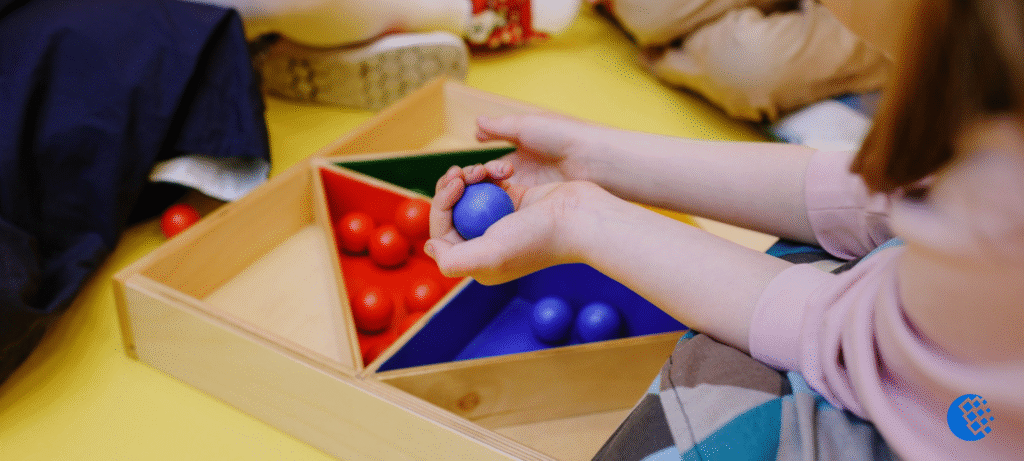
Montessori games for preschoolers are small activities that a child can do on their own with real objects, like pouring rice from one jug to another or sorting buttons into piles. They don’t call for a classroom or a cupboard full of expensive wooden toys. A few bowls, a basket and some bits from the kitchen are usually enough to get started.
If you’ve already read a pile of activity lists and still don’t know what to set out on the table tomorrow, this one tries to be more practical. It covers fifteen ideas for children aged three to five, along with what to prepare, what your child will probably do, and what to try when things don’t go the way you pictured.
What Are Montessori Games for Preschoolers?
Maria Montessori was an Italian doctor who spent years watching small children, and what she kept seeing was that they learn far more when they’re allowed to figure things out themselves. That’s why her activities don’t feel like games in the usual sense. There’s no winning, no scoring, no turns. Your child chooses a job, sticks with it for as long as it interests them, and often goes straight back to the start once it’s done. Don’t worry if they do the same tray fifteen times. That repeating is how the learning happens.
Look closely at Montessori-style activities and you’ll notice the same few things. The objects are real, so your child handles an actual jug or a proper metal spoon, not a plastic pretend one. Plenty of tasks also catch their own mistakes. A lid that won’t screw on, or two shakers that sound nothing alike, shows your child something’s off before you’ve said a word. And you stay out of the way. Show the activity once, slowly, then back off and let them try. Curious how the people who train Montessori teachers describe it? The Association Montessori Internationale has plenty to read.
Here’s something that surprises a lot of parents. A wooden toy ordered online isn’t Montessori just because it looks the part. A tray, two bowls and a handful of beans can be. What matters is what your child is doing, and how much of it they manage without you jumping in.
How to Choose Activities for Ages 3 to 5
Age is a rough guide at best. Two four-year-olds can be miles apart. So watch your child instead. If they give up after a minute, shrink the task. If they finish in thirty seconds and drift off, add a step.
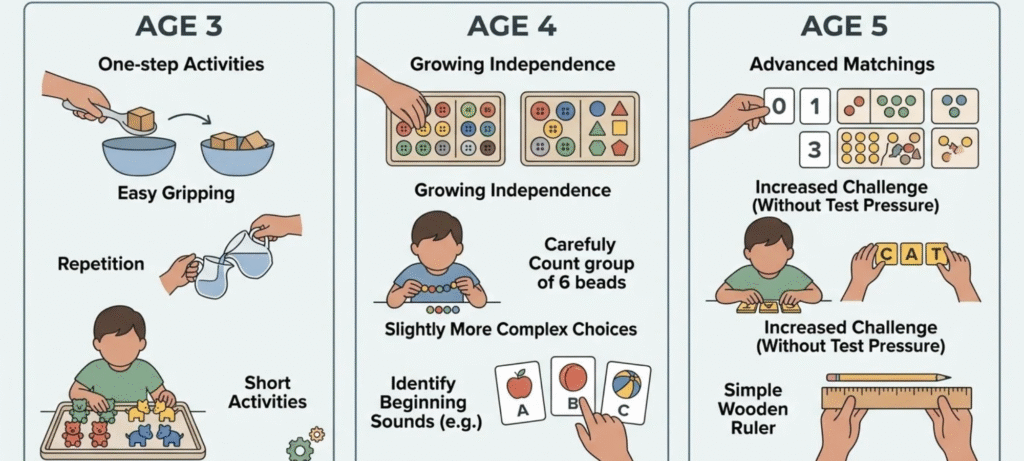
Three-year-olds tend to like short, simple jobs: matching two things, carrying a tray across the room, spooning beans, pouring rice. Use fewer items than you think you need, and pick ones big enough to grip easily.
By four, plenty of children can sort by two rules at once, like red and round. Many can count up to ten objects, and they’re starting to hear the first sound in a word.
Five-year-olds usually want more of a challenge. Matching number cards to groups of objects, building short words with letter tiles, measuring with a ruler, putting a few steps in order: all of these suit them.
And if you’re wondering where play fits next to more structured learning, this piece on how preschool workbook activities support early learning is a handy follow-up.
15 Montessori Games for Preschoolers to Try at Home
Each of these takes only a few minutes to set up. I’ve sorted them into loose groups, though many of them cover more than one skill. A pouring game, for instance, builds focus as well as coordination, and a sorting game gives your child plenty to talk about.
Sensory and Matching Games
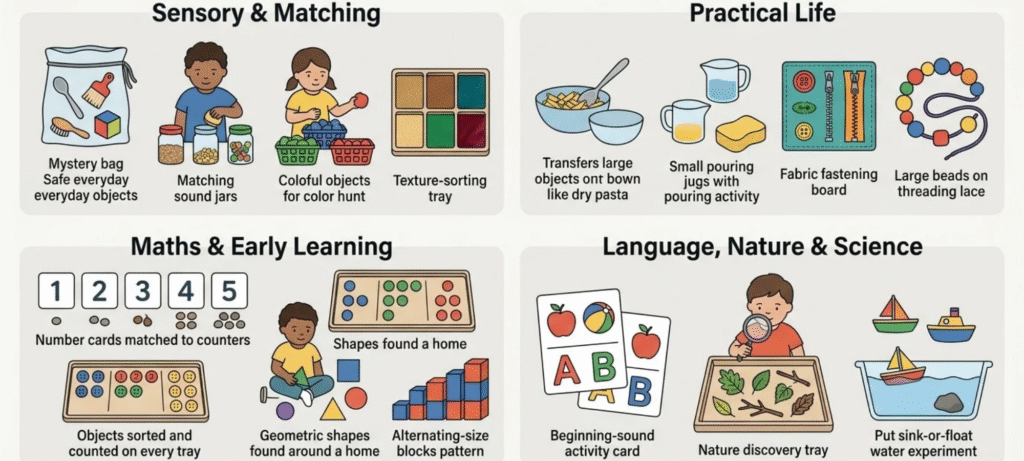
1. Sensory mystery bag. Find a cloth bag, or an old pillowcase, and put in four or five things from around the house. A spoon, a toy horse, a hairbrush, a wooden block, whatever’s close. Your child reaches in, closes a hand round something and has a guess. Don’t let them pull it out yet. Ask what it feels like first, and you’ll get answers like “bumpy”, “cold” or “spiky” that never come up when they can see. Got an older one? Try a toothbrush and a hairbrush together. Trickier than it sounds.
2. Sound matching jars. This needs six small lidded jars, or any containers that shut properly. Rice goes in two, lentils in two, a tiny bell in the last pair. Mix them up. Your child shakes them one by one, listening, and tries to find the twins. Then open each pair together to see if they were right. One warning: tape those lids down first. Lentils and small mouths are a bad combination.
3. Colour scavenger hunt. Shout out a colour, and off they go. Red and yellow are easiest, so begin there. Once they’ve got the hang of it, ask for three different greens and brace yourself, because the argument over whether the teal cushion counts can go on for a while.
4. Texture sorting tray. Tip a handful of safe objects onto a tray, then ask your child to make four piles: rough, smooth, soft, hard. It won’t go smoothly, and that’s the best bit. A pinecone is rough and hard, so where does it go? Let your child decide and explain their choice. Nobody’s marking it.
Practical Life and Fine-Motor Games
Practical life jobs are a big part of Montessori homes. Kids like them because they look like what grown-ups do all day, just smaller.
5. Spoon transfer. Two bowls, one spoon, and chickpeas or big pom-poms in the first bowl. The job is to move them across, one at a time. Expect some to roll under the sofa. It’s hard not to jump in, but try. Your child can chase them down and carry on, and that bit of patience is part of the lesson.
6. Pouring between small jugs. Put two small jugs on a tray with a splash of water and a sponge nearby. The first few goes will be messy. That’s what the sponge is for, so your child wipes up their own spills. Not ready for water? Dry rice works, and water can come later. A little jug with a decent spout beats a heavy kitchen pitcher every time, because small wrists can’t manage the pitcher.
7. Dressing and fastening practice. Fasten some chunky buttons, a zip, a few snaps and a strip of Velcro onto a bit of fabric, or just hand over an old jacket. It’s so much easier to practise at the table on a quiet afternoon than at eight in the morning with shoes still missing. Skip the tiny buttons for now.
8. Bead threading patterns. Large wooden beads, a stiff lace, and a card showing a simple pattern, say red, blue, red, blue. Younger children often ignore the card and thread whatever they like, which is perfectly fine. Older ones might copy the pattern. If the lace goes floppy, a bit of tape round the end fixes it.
Montessori Maths and Early-Learning Games
9. Number and object matching. Lay out number cards from one to five, or one to ten for a more confident child. Your child puts the right number of counters under each card and touches each one while counting out loud. It sounds easy, but this is the point where the written “5” starts to mean five actual things.
10. Sorting and counting tray. Tip a mix of buttons, shells or blocks onto a tray. Ask your child to sort them by colour, size or shape and then count each group, and ask which group has more and which has fewer. They’re learning to compare quantities without anyone calling it maths.
11. Shape hunt. Walk around the house looking for circles, squares, triangles and rectangles. Plates, windows, the roof of a toy house and the cover of a book all count. Finding a shape on a real object tends to stay with a child longer than colouring one in on a worksheet.
12. Block patterns. Start a pattern with blocks, such as big, small, big, small, and ask what comes next. Once your child is comfortable, swap roles so they build a pattern and you continue it. Making a deliberate mistake now and then can get a few laughs, and your child will probably enjoy correcting you.
Language, Nature and Science Games
13. I spy with beginning sounds. You already know the game, but there’s a twist. Use the sound, not the letter name. So it’s “I spy something that starts with /b/,” said as a short pop of sound, never “bee”. It looks like a simple guessing game, and it is, but it also trains your child’s ear to pick out the separate sounds inside words. That’s called phonological awareness, and it’s a big help when reading comes along later. Ending sounds tripping them up? This guide to teaching final consonant deletion has a few tips worth trying.
14. Nature discovery tray. Next time you’re out on a walk, pick up some leaves, a big pinecone or two, a few smooth stones and a twig. Back home, lay them on a tray with a magnifying glass. Then let your child poke about. Ask what they notice. Which one feels heaviest? Which is the roughest? The best questions are the ones with no right answer, so don’t worry about steering them anywhere.
15. Sink or float. Half fill a basin with water and line up a cork, a spoon, a stone, a feather and a plastic lid. Before each one goes in, get a guess: sink or float? Then drop it and watch. Kids get it wrong a lot, and the look on their face when something heavy-looking bobs along the top is half the fun. One rule: stay right beside the water the whole time, no popping out to answer the phone.
Montessori Math Games for Preschoolers
Maths at this age doesn’t begin with memorising numbers. It begins with quantity. A child sees five objects, holds them, counts them, and only later learns what the written “5” looks like. The counting and sorting games above all follow that order.
You may come across Montessori materials like the Pink Tower or number rods while reading about this. They’re nice to have, but you can manage without them. Ten matching cups, a handful of dried beans or a row of blocks can teach the same ideas, including more and less, counting one at a time and putting things in order. If you do want to spend some money, a sturdy basket and a couple of trays will get more use than most toys.
Free, DIY and Indoor Montessori Games
Almost everything on this list costs nothing. Bowls, spoons, jars and rice all come from the kitchen, and scraps of fabric work well for the texture tray. Old greeting cards cut in half make good matching pairs, a shoebox with a hole in the lid becomes a mystery box, and a scarf can replace the cloth bag.
On rainy days you can bring the activities indoors with a colour hunt around the living room, pouring at the kitchen table or a pattern laid out on the floor. It helps to keep only a few activities out at a time, on a low shelf or in a basket, and to swap them every week or two. A crowded shelf can make it hard for a child to settle on one thing. If you enjoy crafts, these crepe paper art activities for kids might also be worth a look.
Are Online Montessori Games for Preschoolers Worth Using?
Plenty of apps and websites describe themselves as Montessori-style and offer matching, counting and shape games. Used occasionally, they’re fine, and they can come in handy on a long car journey or on a day when you’re worn out.
They just can’t do what real objects do. A screen can’t show a child how heavy a full jug feels, or what it’s like to push a button through a buttonhole. I’d treat online games as a small extra and keep the hands-on activities as the main thing.
How Parents Can Support Play Without Taking Over
The hardest part for most parents is staying quiet. Show the activity slowly and say very little, so your child can watch what your hands are doing. Then sit down nearby and let them get on with it.
If a bead slips off the lace or water spills on the table, wait a few seconds before you step in. A lot of the time the child notices and fixes it without any help. You can step in if they ask, if they get properly upset or if something isn’t safe. When they finish, mention something specific, such as “you kept going even after it spilled”, instead of a general “good job”.
Short sessions are perfectly fine. If your child walks away after five minutes, put the tray back on the shelf and try again another day, perhaps with an easier or slightly harder version.
Safety and Common Mistakes
Preschoolers still like to test things with their mouths, so choose beads, buttons and counters that are too big to swallow and keep small pieces away from them. Stay within arm’s reach whenever water is involved, even if it’s only a shallow tray. Check for food allergies before using rice, beans or similar items. If you want your child to slice a banana, give them a child-safe knife and sit right next to them.
For general advice on safe play at this age, the American Academy of Pediatrics’ HealthyChildren.org is a reliable place to look.
The common mistakes are fairly easy to spot. Parents sometimes help too much, set up something that’s too hard, or treat the activity as a test with right and wrong answers. A bored child usually needs a bigger challenge, while a frustrated child needs something simpler, so adjust it and try again.
Frequently Asked Questions
What are some Montessori games I can play at home?
A sensory mystery bag, a colour hunt, pouring between jugs, a sorting and counting tray and a nature tray are good places to begin. You probably have most of the things you need already.
What are good Montessori games for 4-year-olds?
Four-year-olds often enjoy block patterns, beginning-sound games, number matching, shape hunts and sorting by two features at once. If an activity feels too easy or too hard, change it to suit your child.
Are there free Montessori games for preschoolers?
Yes, plenty. Most activities in this guide use bowls, spoons, jars, paper and blocks you already have at home. Free Montessori games for preschoolers work just as well as boxed sets, because what matters is the task and not the packaging.
Can I find Montessori games for preschoolers online?
You can, and a few offer extra practice with counting or shapes. Treat them as an add-on and not a replacement for hands-on play.
What is the golden rule of Montessori?
Follow the child. Set up a safe space, show how an activity works, and then let your child try it alone.
Final Thoughts
Good Montessori games for preschoolers don’t need to be expensive or complicated. A tray, one clear task and an adult who doesn’t hover are plenty. Pick two or three ideas from this list, leave them where your child can reach them, and see which ones they choose. You’ll learn a lot just by watching, and your child will get better at concentrating, using their hands and trusting their own abilities.