A soccer ball is stitched together from pentagons and hexagons, while a honeycomb is made of nothing but hexagons. Draw a triangle on a globe and its three angles can add up to 270 degrees. These aren’t party tricks. Behind each one sits a rule, and honestly, the rule is usually the better story.
I’ve sorted the cool geometry facts below by topic. Every one comes with the reason it works, plus a worked example wherever numbers make things clearer. Some of these ideas are thousands of years old. Others took far longer to pin down: the honeycomb conjecture, for instance, wasn’t proven rigorously until 1999. A few might even make you doubt something you learned at school. Don’t worry, though. What you were taught was almost always correct for a flat sheet of paper. It just wasn’t the full picture.
Cool Geometry Facts Start With the Word Itself
1. Geometry means “earth measuring.” Break the word in two and you get geo, meaning earth, and metron, meaning measure. It fits, because the subject started out as a job, not a theory. Herodotus, the Greek historian, passed on a tradition about Egyptian surveyors who had to measure farmland all over again once the Nile flood washed away the boundary markers. Maybe it happened exactly that way, maybe not. Either way it gets the spirit right: geometry grew out of people who simply needed to know how big a field was.
2. Nobody invented it alone. Ask who introduced geometry and the honest answer is “a lot of people.” Surveyors in Egypt and builders in Mesopotamia were already using geometric rules long before anyone wrote a proof. So what did Euclid do, around 300 BCE? Something different. He collected the known results and arranged them into one logical system, The Elements, where every claim rests on a short list of starting assumptions. That’s organizing a subject, not discovering it, and the two aren’t the same achievement. One of his assumptions, the fifth, is about parallel lines. Keep it in mind, because it comes back later in this list. Questioning it is what opened the door to a whole new kind of geometry.
3. A point has no size. Euclid described a point as something with no parts: no length, no width, no height. It marks a position, and that’s the whole job. When you press a pencil to paper, the dot you make is really a tiny blob standing in for a point, a bit like a pin on a map standing in for a place. Lines, circles and cubes are all built out of these idealized points. That’s exactly what lets mathematicians prove things that are true exactly, not just roughly.
Fun Facts About Shapes
4. A circle has infinitely many lines of symmetry. Fold one along any diameter and the two halves match, and you can pick any diameter you like. That’s the whole trick. A square only gets four, a regular hexagon six, and in general a regular polygon with n sides gets exactly n. So add sides and add sides, and the shape slowly turns into a circle while the count of fold lines climbs right along with it.
5. Say you’ve got 100 square meters of ground to fence off. Go square and each side is 10 meters, so you’re buying 40 meters of fence. Go circular and the radius works out to about 5.64 meters, which means a circumference of roughly 35.4. Nearly five meters saved, just by changing the shape. That’s no fluke: of all flat shapes with the same area, the circle always has the shortest perimeter. Mathematicians call it the isoperimetric property. It’s a flat-shape rule, mind you. Its 3D cousin, the sphere, is why raindrops and soap bubbles round themselves off.
6. Pi never changes, whatever the circle. Divide the circumference by the diameter and you get 3.14159, then the digits just carry on. A bicycle wheel 70 centimeters across rolls forward about 2.2 meters every turn (70 times pi is close to 220), and a stadium track gives you the same ratio, only bigger. And because pi is irrational, its decimals never end and never repeat. So any number you see printed is an approximation, however many digits it has.
7. Triangle angles add up to 180 degrees. On a flat surface, always. You can see it by tearing the three corners off a paper triangle and lining them up edge to edge. They form a straight line. The proof works the same way: draw a line through one corner parallel to the opposite side, and the angles that appear on either side of that corner match two of the triangle’s own angles. Together with the third, they make a straight angle. Hold onto this one. Fact 17 breaks it.
8. Polygon angles follow a formula. Here’s a quick way to see it. Take a quadrilateral and pick any corner. Draw a diagonal to the corner across from it and you’ve cut the shape into two triangles, and two triangles at 180 degrees each make 360. Do the same with a hexagon and you get four triangles, which makes 720. That’s the formula at work: subtract two from the number of sides, then multiply by 180 degrees, so (4 − 2) × 180 = 360 and (6 − 2) × 180 = 720. The triangles only appear when you draw diagonals from one corner of a convex polygon to every corner it doesn’t already touch. The result depends on nothing except the side count, which is handy when some angles are missing. And if the polygon is a regular hexagon, all six angles match, so 720 divided by six leaves 120 degrees for each one.
9. Walk around the edge of a convex polygon and turn at every corner. Each of those turns is an exterior angle. By the time you’re back at the start, facing the way you began, you’ve made exactly one full circle, so the exterior angles always total 360 degrees. Try a regular hexagon: six identical turns, so each is 360 divided by 6, which is 60 degrees. Now look back at Fact 8. The interior angle there was 120, and 120 plus 60 gives a straight 180 at every corner. Swap the hexagon for a triangle or a decagon and nothing changes, because the total stays put.
10. Triangles resist squashing; rectangles don’t. Push the top of a rectangular frame sideways and it folds into a parallelogram without any of its sides changing length. Triangles can’t do that. Once three side lengths are fixed, the angles are fixed too, so the shape can’t deform without something breaking. That’s why bridges, roof trusses, bicycle frames, and electricity pylons are crowded with triangles. Add a single diagonal brace to a wobbly rectangle and you’ve turned it into two triangles, and the wobble disappears.
11. Circles aren’t the only shapes of constant width. A Reuleaux triangle, a three-cornered shape with gently curved sides, measures the same distance across in every direction, just like a circle. That constant width is why a round manhole cover can’t slip through its own opening: wherever you turn it, the narrowest gap is as wide as the hole. A square cover is a different story. Its diagonal is longer than its side, so a square lid sitting on a square opening of exactly the same size could be tilted and dropped through. Constant-width shapes also roll a load smoothly, which is why some are used in engineering and even, occasionally, as coin shapes.
Geometry in Nature
Some of the best cool things in geometry aren’t on a blackboard at all. They’re in a beehive, a bubble, or a flake of snow.
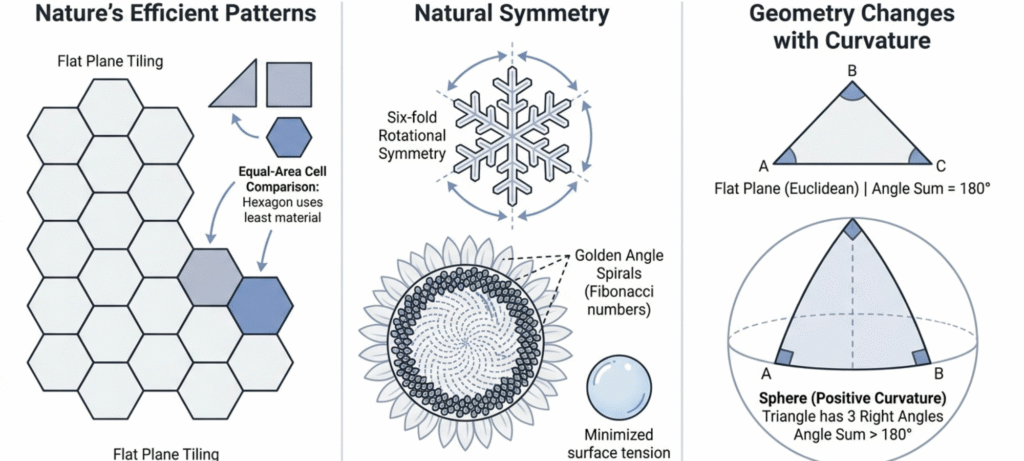
12. Honeycomb hexagons are mathematically hard to beat. Only three regular shapes tile a flat surface with no gaps: equilateral triangles, squares, and hexagons. Compare them by boundary length when each cell has the same area, say one square unit. The triangle needs about 4.56 units of boundary, the square needs 4, and the hexagon needs about 3.72. (When neighbors share edges, each cell effectively pays for half of that, but the ranking stays the same.) For roughly two thousand years people claimed this made hexagons the most economical way to divide a surface, but nobody could prove it for all possible shapes, including ones with curved sides. Thomas Hales did in 1999. His result says any way of splitting the plane into regions of equal area has total perimeter at least that of the regular hexagonal tiling. You can read the paper on arXiv. Notice what it doesn’t say. It proves something about perimeters on a plane, not every detail of how bees build. Warm wax softens, and cells are thought to settle into hexagons partly through simple physical forces.
13. Soap bubbles are spheres for a reason. Out of every possible shape, a sphere is the one that holds a given volume with the least surface area. A bubble’s thin film has surface tension, and that tension keeps tugging it toward the smallest area available, which is why it rounds out. Pile bubbles together and the geometry shows up again: the walls between them meet in threes, always at 120 degrees. Peer into the foam on your sink the next time you wash up and you’ll spot that angle everywhere.
14. Snowflakes have six arms. Ice is built from water molecules locked into a hexagonal lattice, so a growing crystal carries a six-fold pattern from the start. While a flake drops through air of changing temperature and humidity, every arm meets nearly identical conditions at any given moment, and the arms end up growing alike. The small details do vary from one flake to the next, because each one follows its own route down. The symmetry holds regardless.
15. Spirals on pineapples and sunflowers often follow Fibonacci numbers. That sequence goes 1, 1, 2, 3, 5, 8, 13, 21, 34, 55, and every number is the sum of the previous two. Count the spirals on a pineapple and a pair such as 8 and 13 is common. Sunflower heads often give 34 and 55. Seed placement is the probable cause: each new seed sits about 137.5 degrees around from the one before, an angle that spaces seeds evenly and leaves no radial gaps. Common doesn’t mean universal, though. Varieties differ, and plenty of specimens break the pattern.
16. The golden-ratio nautilus is mostly a myth. A chambered nautilus really does grow in a logarithmic spiral, meaning the shell widens by a constant factor with each turn. That part is true. What doesn’t survive is the claim, repeated in countless design posts, that the spiral follows the golden ratio exactly. Once people measure actual shells, it falls apart. A golden spiral grows by one particular factor, and real shells grow at different rates. It makes a nice story, but the math says otherwise.
Mind-Bending Geometry
17. A triangle can have three right angles. Imagine standing at the North Pole. Two lines of longitude, set 90 degrees apart, run south until they reach the equator. Join their endpoints with a stretch of the equator and you have a triangle on the globe. Each meridian meets the equator at a right angle, and the two meridians meet each other at the pole at 90 degrees. That’s three right angles, total 270. This works because the globe is curved. The 180-degree rule from Fact 7 only holds on a flat plane. On a sphere, a triangle’s angles always add up to more than 180, and the bigger the triangle, the bigger the excess.
18. On a saddle, triangles come up short. Switch from a bulging surface to one that curves like a saddle, or a potato chip. Triangles drawn there have angle sums below 180 degrees, and larger triangles lose more. This is hyperbolic geometry, and it’s a complete, consistent system rather than a trick. Nineteenth-century mathematicians discovered it by questioning Euclid’s parallel assumption from Fact 2. Once they allowed that more than one parallel line could pass through a point, a whole new geometry opened up.
19. On a sphere, there are no parallel lines. The straightest possible paths on a globe are great circles, which are circles that share the center of the sphere, like the equator or any line of longitude. Any two distinct great circles cross, and they cross at two opposite points. Lines of longitude show this clearly: they look parallel near the equator, then all meet at both poles. Flights between far-apart cities often arc toward the polar regions on a flat map, because the shortest route follows a great circle.
20. The Königsberg bridges can’t be walked. In 1736 Leonhard Euler studied a city with four land areas joined by seven bridges and asked whether you could cross each bridge exactly once. He ignored distances and drew the problem as dots and links. Here’s the key idea: every time you pass through a land area, you use one bridge to enter and another to leave, so land areas in the middle of a walk need an even number of bridges. In Königsberg, three areas had three bridges and one had five. Four odd ones, too many, so no such walk exists. That way of thinking helped launch graph theory, the math behind networks, maps, and route-finding software.
21. A Möbius strip has one side. Try it yourself. Cut a long strip of paper, give one end a half-twist, and tape the ends together. Now put a pencil on the surface and draw a line down the middle without lifting it. You’ll come back to the start having covered what looked like both sides. There’s only one surface. Now cut along that center line. You might expect two separate loops, but you get a single loop that’s twice as long. Cutting a third of the way in from the edge gives something stranger still: two linked loops of different sizes.
22. Wallpaper patterns come in exactly 17 types. Any pattern that repeats across a flat surface in two directions falls into one of 17 symmetry groups, and mathematicians have proven there’s no eighteenth. The building blocks are shifts, rotations, mirror flips, and glide reflections, which combine a flip with a slide. A repeating pattern can only have rotations of 2, 3, 4, or 6 positions per full turn. Five-fold rotation doesn’t fit a repeating grid, which is why you’ll never see a seamless wallpaper built from regular pentagons. Colors and motifs vary wildly. The symmetry options don’t.
23. Two straight lines meet at most once in a plane. On a flat sheet, two different lines either cross at one point or never cross at all. Move into three dimensions and there’s a third option: the lines can miss each other without being parallel. These are called skew lines. Think of a pipe running east-west on the ceiling of a basement and another running north-south along the wall below it. They never touch and never run side by side.
3D Geometry Facts
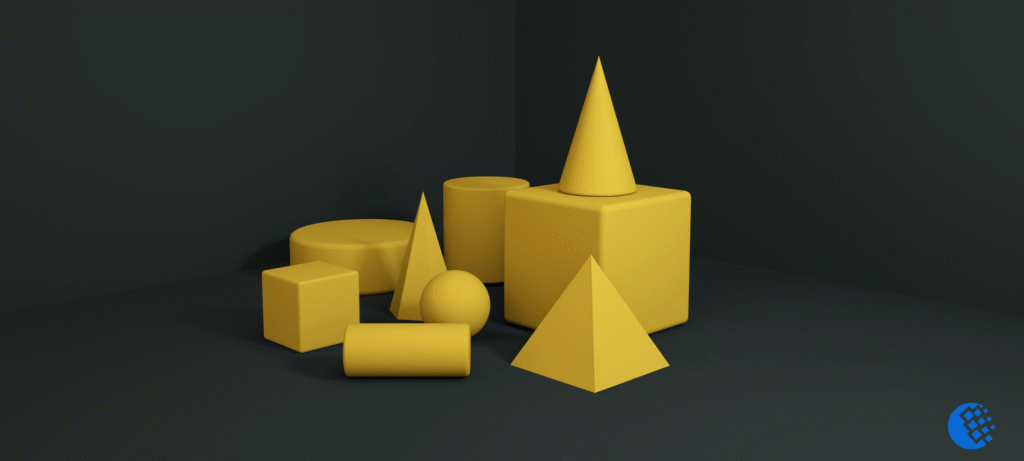
24. Only five Platonic solids exist. The tetrahedron, cube, octahedron, dodecahedron, and icosahedron are the only regular convex polyhedra, meaning every face is the same regular polygon and the same number of faces meet at every corner. The reason comes down to angles. At each corner, the face angles have to add up to less than 360 degrees, or the corner flattens out. Try triangles, which have 60-degree angles: three at a corner gives 180 (tetrahedron), four gives 240 (octahedron), five gives 300 (icosahedron), and six gives 360, which lies flat. Squares at 90 degrees allow three (270, the cube), but four reach 360. Pentagons at 108 degrees allow three (324, the dodecahedron). Hexagons already hit 360 with three. That’s the complete list.
25. Euler’s formula links every convex polyhedron. Count the vertices, edges, and faces, and the numbers always satisfy V − E + F = 2. A cube has 8 vertices, 12 edges, and 6 faces: 8 − 12 + 6 = 2. A tetrahedron: 4 − 6 + 4 = 2. An octahedron: 6 − 12 + 8 = 2. A dodecahedron: 20 − 30 + 12 = 2. It’s a handy error check when you’re counting parts of a solid, and it was an early sign of a deep idea in topology: some properties don’t change when a shape is stretched or squeezed.
26. A cone holds one-third of a matching cylinder. Give them the same base and the same height, and the cone’s volume is exactly a third of the cylinder’s. Take a radius of 3 and a height of 6. The cylinder holds π × 3² × 6 = 54π, which is about 169.6 cubic units. The cone holds 18π, about 56.5. Pour a full cone of water into the cylinder three times and it’s full. Archimedes worked this out more than two thousand years ago, long before calculus gave an easy method.
27. A sphere fills two-thirds of its cylinder. Take a sphere with radius r, and a cylinder with radius r and height 2r, so the sphere fits snugly inside. The sphere’s volume is exactly two-thirds of the cylinder’s. Using r = 3 again: the cylinder holds π × 9 × 6 = 54π, and the sphere holds (4/3) × π × 27 = 36π. That’s two-thirds. Add a cone with the same radius and a height of 2r, and the three volumes are 18π, 36π, and 54π: a ratio of 1 to 2 to 3. Archimedes reportedly valued this result enough to want the diagram on his tomb.
28. A traditional soccer ball is a truncated icosahedron. Take an icosahedron and slice off each of its twelve corners. Each cut leaves a pentagon, and the original triangular faces turn into hexagons. The classic 32-panel design has twelve pentagons and twenty hexagons, sixty corners, and ninety edges. Check it against Euler’s formula: 60 − 90 + 32 = 2. Many modern match balls use different panel layouts, so this describes the classic design only. The shape caught on because it’s close to round while still being flat enough to cut from leather.
29. A Rubik’s Cube can always be solved in 20 moves or fewer. The cube has about 43 quintillion possible positions, which is far too many to check one by one. In 2010, researchers split them into huge groups, used symmetry to cut the work down, and ran the search on spare computer time donated by Google. The result is called God’s Number, and the full story is at cube20.org. It holds in the face-turn metric, where a 180-degree turn of a face counts as one move. Count only quarter turns and the maximum rises to 26. Some positions, like the so-called superflip, genuinely need all 20.
Geometry in Everyday Life
30. Paper sizes depend on the square root of 2. An A4 sheet is about 210 by 297 millimeters, and 297 divided by 210 is roughly 1.414. Fold it in half and you get 148.5 by 210, which is A5. Divide again: 210 divided by 148.5 is also about 1.414. Same shape, half the area. The whole series is designed this way, with A0 sized at about one square meter, so sixteen A4 sheets fit that area. It’s why a photocopier can scale a page to fit a bigger or smaller size without cropping or stretching.
31. A circle has 360 degrees partly thanks to Babylon. Babylonian mathematics counted in base 60, which divides neatly, and a year is close to 360 days if you round. Another practical reason: 360 has twenty-four divisors, including 2, 3, 4, 5, 6, 8, 9, 10, and 12, so a circle splits evenly into many sensible slices. Compare that with 100, which divides far less flexibly. Historians tend to blame several causes together, and none of it is settled as a single answer.
32. One radian is about 57.3 degrees. A radian is the angle you get when you lay a circle’s own radius along its edge. Since the full circumference is 2π times the radius, a full turn is 2π radians, which means 180 degrees equals π radians. The payoff is simple: arc length is radius times angle in radians. An angle of 2 radians on a circle with a radius of 5 centimeters cuts off an arc of 10 centimeters. Degrees can’t do that without a conversion factor. Radians feel odd at first, but calculus formulas get far cleaner when you use them.
33. A clock’s hands form a right angle 22 times in 12 hours. That’s 44 times in a full day. Here’s the reasoning. The minute hand moves 6 degrees per minute and the hour hand moves 0.5 degrees per minute, so the minute hand pulls ahead at 5.5 degrees per minute. Over 12 hours, which is 720 minutes, that adds up to 3,960 degrees of relative movement, or exactly 11 full turns. During each full turn, the angle between the hands passes through 90 degrees once on the way up and once on the way back around. Eleven turns times two is 22.
34. Launching at 45 degrees gives the longest throw. For a projectile launched and landing at the same height with no air resistance, the range is v² × sin(2θ) ÷ g. The sine term is largest when 2θ equals 90 degrees, so θ is 45. Try a launch speed of 20 meters per second: at 45 degrees the range is about 40.8 meters, and at 30 degrees it drops to roughly 35.3 meters. Real javelins, golf balls, and shot puts behave differently. Athletes often use lower angles because of air drag and release height, which is why the textbook answer is only the ideal case.
35. Parallel lines don’t meet, yet they look like they do. In Euclidean geometry, parallel lines never intersect. Stand between a pair of railway tracks and they seem to converge toward a single point on the horizon. That’s called a vanishing point, and it comes from perspective projection: objects shrink in the image the farther away they are, so equal gaps appear to narrow. The same math lets artists draw convincing rooms, lets cameras be modeled in software, and lets game engines turn 3D scenes into flat screens.
Geometry Facts for Kids, Students and Adults
For kids: Begin with circles, symmetry, snowflakes, and the Möbius strip. These ideas click when children can fold paper, trace shapes, and hold a twisted strip in their hands.
For students: Triangle angles, polygon formulas, Euler’s formula, and cone volume line up with what school mathematics covers. If exams are coming up, our guide on how to study for a math exam has practical tips.
For high school readers: Spherical geometry, wallpaper symmetry, radians, and curved surfaces show how mathematical rules depend on their starting assumptions. That’s a useful habit of mind well beyond geometry.
For adults: The honeycomb theorem, Rubik’s Cube calculations, and paper-size standards show geometry at work in engineering, computing, and daily life. For hands-on ideas to try with younger learners, see our roundup of STEM activities for middle school.
Frequently Asked Questions
What are some interesting facts about geometry?
A circle has infinitely many lines of symmetry, the hexagonal honeycomb pattern was proven in 1999 to have the least perimeter among equal-area tilings of the plane, and a triangle drawn on a sphere can have three right angles.
What is the most interesting fact about geometry?
It depends on who you ask, but many mathematicians point to curved-space geometry, where triangle angles can add up to more or less than 180 degrees.
What are some fun facts about shapes?
Hexagons tile without gaps, triangles make rigid structures, a sphere holds the most volume for its surface area, and a Reuleaux triangle has the same width in every direction, like a circle.
Who first developed geometry?
No single person did. Egyptians and Mesopotamians used geometry for surveying and building. Euclid later organized it into a formal system around 300 BCE.
Why are hexagons common in honeycombs?
Hexagons fit together with no gaps and enclose equal areas using less total edge than other tilings. Hales proved this mathematically, though the way bees actually build also involves physical effects.
Can a triangle’s angles add up to more than 180 degrees?
Yes, on a curved surface such as a sphere. On a flat plane, the sum is always exactly 180 degrees.
What are the five Platonic solids?
The tetrahedron, cube, octahedron, dodecahedron, and icosahedron. Each has identical regular polygon faces, with the same number of faces meeting at every vertex.
Final Thoughts
Pick any fact here and keep pulling the thread. The triangle angles lead to curved space. The honeycomb leads to a proof that took about two thousand years. The Rubik’s Cube leads to a computer search spread across a huge amount of idle machine time. That’s what separates cool geometry facts from a trivia dump: they open doors rather than close them.
If you only remember two, take number 7 and number 17 together. A rule that’s perfectly true on paper can fail on a globe. Spotting the assumption behind a rule is half of thinking like a mathematician.