

Finding the right congruence reasoning about triangles common core geometry homework answers is a major hurdle for many high school students because it requires a shift from simple arithmetic to logical proof-writing. In the Common Core curriculum, geometry is no longer just about memorizing formulas; it is about understanding how shapes interact in a coordinate plane through rigid motions. When you are staring at a worksheet full of triangles, the goal is to find a set of minimum requirements—postulates—that prove two shapes are identical without having to measure every single side and angle.
What is congruence in triangles?
Congruent triangles are triangles that have exactly the same size and shape. In Common Core geometry, two triangles are congruent if one can be mapped onto the other using a sequence of rigid motions, such as translations, rotations, or reflections. When two triangles are congruent, all their corresponding sides and angles are equal. This definition is vital because it links the physical movement of a shape to its mathematical properties.
Table of Contents
- The Essential Five Postulates for Triangle Congruence
- Homework Answers and Solved Examples
- Quick Reference Table for Student Reasoning
- Practice Questions and Answer Key
- Understanding Rigid Motions and Transformations
- Why CPCTC is the Goal of Every Proof
- Tips for Avoiding Common Geometry Mistakes
- FAQs
The Essential Five Postulates for Triangle Congruence
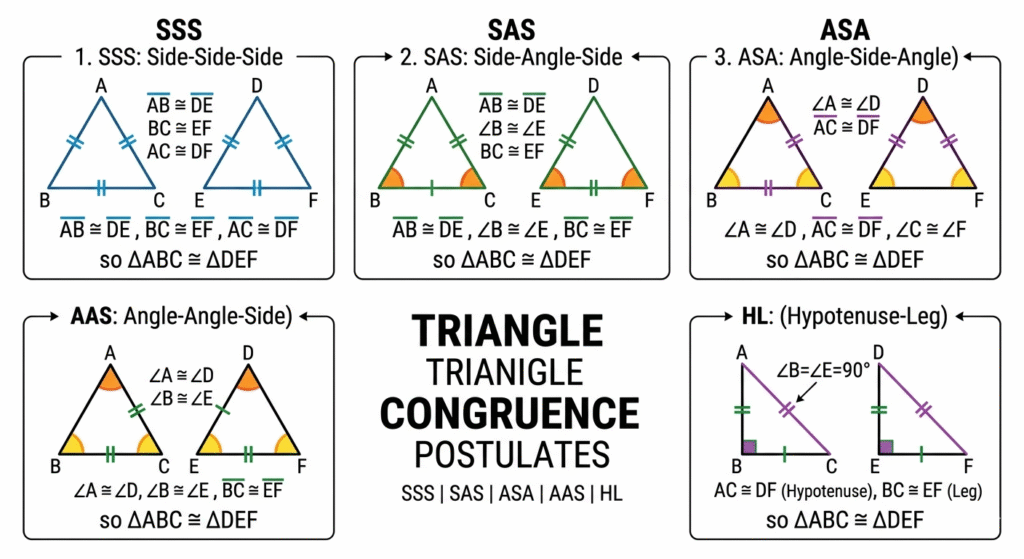
The heart of your homework lies in five specific postulates. These are the shortcuts that mathematicians use to declare two triangles “twins.” If you can identify one of these patterns in your diagram, you have solved the logic puzzle.
SSS (Side-Side-Side)
This is probably the easiest postulate to spot. It basically says that if all three sides of one triangle match the three sides of another, they’re identical. On your homework, look for those little “tick marks” on the lines. If both triangles have matching sets of one, two, and three marks, you’ve found SSS. You don’t even need to know the angles for this one to work.
SAS (Side-Angle-Side)
SAS is where a lot of students get tripped up. It requires two sides and the included angle. Think of it like a sandwich—the angle must be “squished” right between the two sides you’re looking at. If the angle is somewhere else on the triangle, SAS won’t work, and you might be looking at a trick question.
ASA (Angle-Side-Angle)
In ASA, the side is the one doing the squishing. If you have two matching angles and the side that connects them is also the same length, you’ve got congruent triangles. This pops up a lot in problems where two triangles are joined together, sharing a single side that acts as a bridge between their angles.
AAS (Angle-Angle-Side)
AAS is a close cousin to ASA. It tells us that if two angles and a non-included side match up, the triangles are still congruent. This is a reliable rule because of the 180-degree rule—if two angles match, the third one has to match anyway, making the whole shape a perfect copy.
HL (Hypotenuse-Leg)
The HL theorem is like a “VIP rule” for right triangles. If the longest side (the hypotenuse) and one of the shorter legs match another right triangle, they are congruent. Just make sure you see that little 90-degree square in the corner before you try to use this reasoning on your worksheet.
Homework Answers and Solved Examples
Let’s look at how these rules actually work when you’re staring at an assignment. Spotting these patterns is most of the battle.
Problem 1: The Shared Side Scenario
Scenario: Imagine two triangles, $\Delta ABD$ and $\Delta CBD$, sharing a middle line $BD$. You’re told $AB = CB$ and $AD = CD$.
Reasoning: Even though the problem only gives you two sides, they share that middle line. By the Reflexive Property, $BD$ is equal to itself. Now you have three matching sides.
Answer: The triangles are congruent by SSS.
Problem 2: The Parallel Line Twist
Scenario: Line $L$ is parallel to line $M$, and a transversal line cuts through both. You see a “Z” shape forming.
Reasoning: Parallel lines are a dead giveaway that you need to find Alternate Interior Angles. Once you find that second angle using the “Z” shape, you usually have enough for an ASA proof.
Answer: Find the missing angle, then apply ASA.
Problem 3: The Midpoint Clue
Scenario: The problem says “Point $M$ is the midpoint of segment $AB$.”
Reasoning: A midpoint is basically a divider. It means segment $AB$ is split into two equal pieces, $AM$ and $BM$. That’s one “Side” ready for your proof.
Answer: Use that midpoint for your first side, then look for vertical angles to find a SAS or ASA pattern.
Helpful => Homework and Practice Workbook Answers
Quick Reference Table for Student Reasoning
Keep this “cheat sheet” handy while you work. It’ll help you pick the right rule based on what’s marked on your paper.
| Postulate | What You Need | Best Used When… |
| SSS | 3 Matching Sides | All sides are marked or shared. |
| SAS | 2 Sides + Middle Angle | The angle is “inside” the sides. |
| ASA | 2 Angles + Middle Side | The side is the “bridge” between angles. |
| AAS | 2 Angles + Outside Side | The side isn’t between the angles. |
| HL | Right Angle + Hypotenuse + Leg | There is a 90° angle present. |
Practice Questions and Answer Key
Give these a try before you hand in your homework. Checking your own work is the best way to learn.
- Identifying ASA: If two triangles have two congruent angles and the side connecting them is also congruent, what’s the rule?
- The Reflexive Property: When two triangles share a side, what property says that side is equal to itself?
- The AAA Trap: If two triangles have matching angles but different sizes, are they congruent?
- CPCTC Check: If $\Delta ABC \cong \Delta XYZ$ and Side $AB = 5$, how long is Side $XY$?
Answers: 1. ASA; 2. Reflexive Property; 3. No (they are just Similar); 4. 5.
Understanding Rigid Motions and Transformations
Common Core is big on the “physics” of math. It’s not just about static shapes; it’s about how they move. If your homework asks for a transformation, you’re explaining how one triangle “becomes” the other.
- Translation: A simple slide. The triangle moves across the paper but doesn’t turn.
- Reflection: A flip. It’s like the triangle is looking in a mirror.
- Rotation: A turn. The triangle spins around a fixed point.
Getting comfortable with these moves makes it much easier to understand basic angle relationships and how they work in proofs. If you can show that a simple flip maps one triangle onto another, you’ve already proven they are congruent.
Why CPCTC is the Goal of Every Proof
Most people think the job is done once they write “congruent by SAS.” But often, the homework asks you to find a specific side or angle after that. This is where CPCTC comes in. It stands for “Corresponding Parts of Congruent Triangles are Congruent.”
Think of it as the “logical payoff.” If the two triangles are proven to be perfect twins, then every single part of them has to match. For a better look at how this logic builds up, check out our guides on parallel line theorems which often act as the starting point for these proofs.
Tips for Avoiding Common Geometry Mistakes
Even the best students fall into these traps. Here’s what to watch for:
- The SSA Trap: Side-Side-Angle is NOT a valid rule. If the angle isn’t between the sides, the triangles could be totally different.
- Ordering the Letters: When writing $\Delta ABC \cong \Delta XYZ$, $A$ has to match $X$, $B$ to $Y$, and so on. If you mix them up, it’s technically wrong.
- Vertical Angles: If triangles meet at a point (like a bowtie), the angles across from each other are equal. They’re usually not marked, so you have to find them yourself.
FAQs
Q: Why doesn’t AAA work for congruence?
AAA shows they are the same shape, but one could be tiny and the other huge. That makes them “Similar,” not “Congruent.”
Q: What is an “Included Angle”?
It’s the angle tucked right between the two sides you’re talking about. Like the hinge on a pair of scissors.
Q: Can I use HL without a right angle?
Nope. HL (Hypotenuse-Leg) is strictly for right triangles only.