

If you are currently studying for a BLS (Basic Life Support) or ACLS (Advanced Cardiovascular Life Support) certification, you’ve probably seen this question on every practice quiz: “Which team role makes treatment decisions and assigns roles?” It’s a classic for a reason. In the high-stakes environment of emergency medicine, the difference between a successful resuscitation and a failure often comes down to clear leadership.
The answer, as you likely know, is the Team Leader. But knowing the name of the role is only 10% of the battle. To truly understand how a high-performance team functions—and to pass your 2026 exams—you need to look at how this role interacts with the “Resuscitation Triangle” and the logic behind every decision made during a code.
What Does a Team Leader Actually Do?
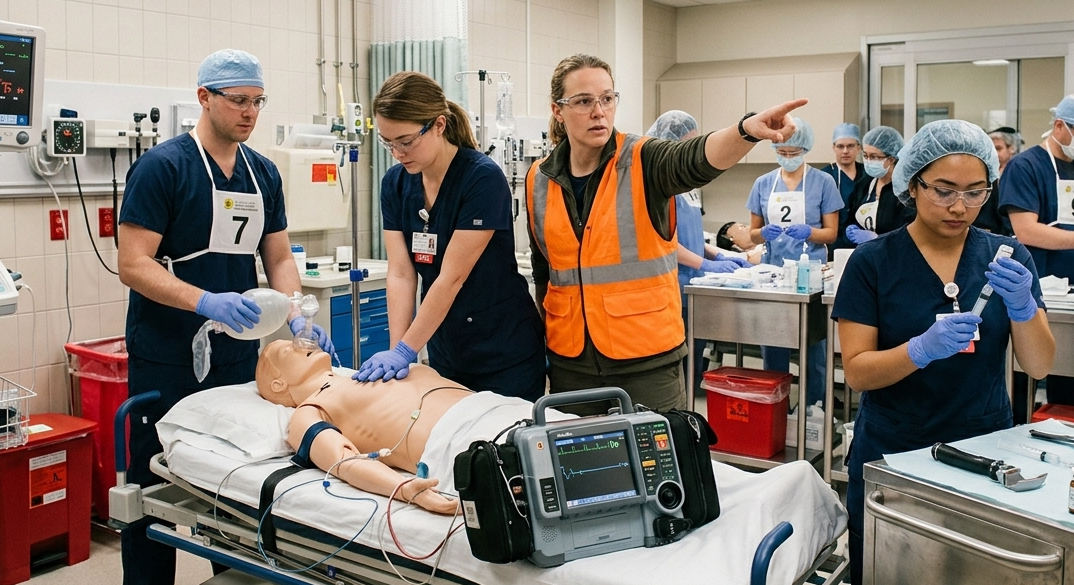
Think of the Team Leader as the conductor of an orchestra. They aren’t playing the violin (doing compressions) and they aren’t playing the flute (managing the airway). Instead, they are standing at the foot of the bed, watching everyone else to ensure the music stays on beat.
1. Assigning Roles and Delegating Tasks
One of the first things a Team Leader does when they arrive on the scene is “clear the air.” They identify what needs to be done and who is going to do it.
- They assign a Compressor to handle chest compressions.
- They designate an Airway Manager to focus on ventilations.
- They appoint an AED/Monitor/Defibrillator operator to watch the heart rhythm.
- They ensure a Timer/Recorder is tracking every intervention.
Without this initial delegation, you often see two people trying to grab the bag-mask while nobody is on the chest. The Team Leader stops that chaos immediately.
2. Making Critical Treatment Decisions
This is the “brain” part of the job. The Team Leader is constantly processing data. They are looking at the EKG monitor, checking for pulses during rhythm checks, and deciding if it’s time for a shock or a dose of Epinephrine.
- Interpretation: They must correctly interpret cardiac rhythms like V-Fib or PEA.
- Protocol: They ensure the team is following the latest AHA (American Heart Association) algorithms.
- Adjustment: If the patient’s condition changes, the Team Leader is the one who pivots the strategy.
The Resuscitation Triangle: Hands-On Support
While the Team Leader is the “role that makes treatment decisions,” they can’t do it alone. Most high-performance teams use the Resuscitation Triangle model to organize the three most critical hands-on tasks.
- The Compressor: Positioned at the side of the patient. Their only focus is high-quality compressions—depth of at least 2 inches and a rate of 100-120 bpm.
- Airway Manager: Positioned at the head of the patient. They manage oxygenation and ventilation.
- AED/Monitor/Defibrillator: Positioned on the opposite side of the compressor. They manage the “electricity” of the code.
The Team Leader stands outside this triangle so they can maintain a “global view” of the room. This helps them see things the hands-on rescuers might miss, like a compressor getting tired or an IV line becoming dislodged.
Communication: The Secret Sauce
You can have the best doctors in the world, but if they don’t communicate, the patient loses. A Team Leader uses Closed-Loop Communication to ensure every decision is executed correctly.
- The Order: Leader says, “John, give 1mg of Epinephrine now.”
- The Confirmation: John says, “Giving 1mg of Epinephrine now.”
- The Completion: John says, “1mg of Epinephrine has been given.”
This sounds repetitive, but in a noisy room, it is the only way to prevent medication errors.
Frequently Asked Questions (Exam Prep)
Who typically fills the Team Leader role?
Usually, it is the most experienced clinician on the scene—often a physician, a nurse practitioner, or a senior paramedic. However, in some BLS settings, the first person to arrive who has leadership training will take the lead until someone more senior arrives.
What is the “Big Picture” view?
This is a term used in ACLS to describe the Team Leader’s perspective. By not doing compressions themselves, the leader can monitor the “Chest Compression Fraction” (the percentage of time compressions are actually happening) and ensure interruptions are kept under 10 seconds.
Can the Team Leader change during a code?
Yes. This is called a “Transfer of Leadership.” If a more experienced provider arrives, the current leader will provide a quick “SBAR” (Situation, Background, Assessment, Recommendation) report and hand over the clipboard.
Practical Application: Beyond the Quiz
If you are currently training for these roles, it’s important to remember that leadership is a skill that requires practice. Just like a student needs a clean desk to study (as we discuss in our piece on Workspace Design for Productivity), a medical team needs a “clean” communication environment to function.
Furthermore, medical leadership isn’t just about the “now.” It’s about understanding where you sit in the larger hierarchy of care. If you are interested in how different academic and professional levels are structured in high-performance environments, our guide on Academic Decathlon Competition Levels provides a great parallel for how “teams” move from local scrimmages to national-level execution.
Final Summary Table
| Team Role | Primary Responsibility | Key Focus |
| Team Leader | Makes treatment decisions & assigns roles | Big Picture / Coordination |
| Compressor | Performs high-quality chest compressions | Circulation |
| Airway | Manages ventilations & oxygen | Breathing |
| AED/Monitor | Rhythms & Defibrillation | Electricity |
| Timer/Recorder | Tracks time & meds | Documentation |
Conclusion: Why the Team Leader Wins
At the end of the day, when a question asks “which team role makes treatment decisions and assigns roles,” it is testing your understanding of hierarchy. In a code, democracy doesn’t work; leadership does.
The Team Leader is the anchor of the resuscitation effort. They take the burden of decision-making off the rescuers who are physically exhausted from doing compressions, allowing the entire team to function as a single, life-saving unit.
For more official resources on team dynamics, we highly recommend checking out the latest guidelines from ACLS Online or reviewing the high-performance team modules at ProTrainings.