
Why Better Roads Start With Smarter Maintenance
Across cities and highways, road deterioration is an ongoing challenge. Cracks, potholes, and uneven surfaces don’t just affect appearance; they impact safety, driving comfort, and long-term infrastructure costs. As transportation networks expand and age, governments and contractors are under increasing pressure to find maintenance methods that are both effective and budget-friendly.
One of the most practical solutions is asphalt milling. Instead of tearing up an entire roadway and rebuilding from the base, milling focuses on removing only the damaged surface layer. This targeted approach helps restore road quality while significantly reducing costs and material waste. It has become a cornerstone of modern pavement rehabilitation because it balances performance, efficiency, and sustainability.
Understanding Asphalt Milling in Simple Terms
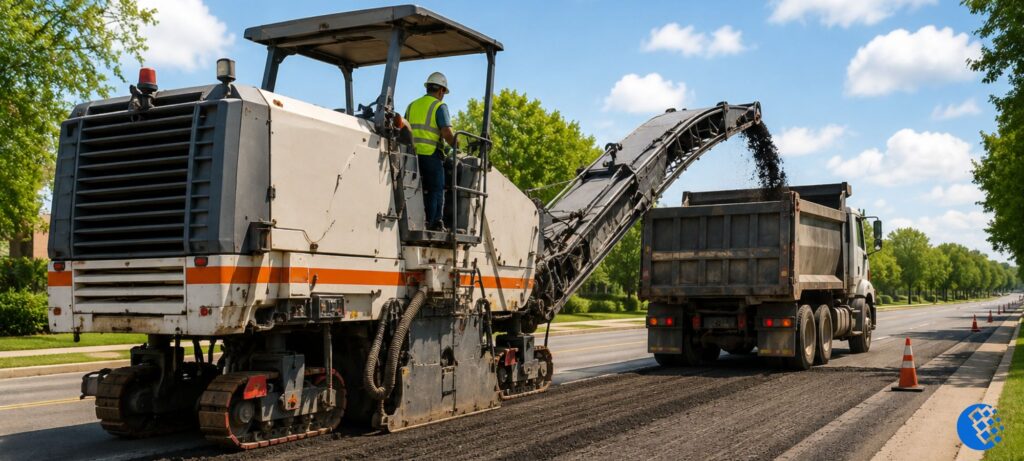
Asphalt milling is a controlled process that removes the top layer of an existing asphalt surface using specialized machinery. These machines grind and scrape off worn or damaged pavement to a precise depth, leaving a stable base underneath intact.
Once the top layer is removed, the surface is cleaned and prepared for new asphalt. This allows contractors to rebuild the road without starting from scratch. Compared to full reconstruction, milling is faster, less disruptive, and far more resource-efficient.
It is commonly used on highways, city streets, parking lots, and industrial roads where the foundation is still strong but the surface has deteriorated over time.
How Milling Creates Stronger, Smoother Roads
One of the biggest advantages of asphalt milling is how it improves overall road quality. By removing the damaged top layer, contractors eliminate surface-level problems such as cracks, potholes, and uneven patches.
This creates a clean, level foundation for new asphalt to bond properly. A smooth base is essential because it ensures the new layer adheres evenly, reducing the risk of future surface failures.
Milling also helps improve drainage. Old, uneven roads often trap water, which accelerates deterioration. A freshly milled surface allows for better water flow, reducing long-term damage caused by moisture infiltration.
The result is a safer, smoother driving experience with fewer maintenance issues in the years ahead.
The Real Cost Savings Behind Asphalt Milling
One of the strongest reasons asphalt milling is widely used is its cost efficiency. Full road reconstruction requires large amounts of new materials, heavy labor, and extended road closures. Milling significantly reduces all of these expenses.
Since only the top layer is removed, contractors can reuse a large portion of the existing material. Recycled asphalt pavement (RAP) can be processed and incorporated into new projects, lowering material costs and reducing environmental impact.
Labor and equipment usage are also reduced because the process is faster and more focused. Roads can be reopened sooner, minimizing economic disruption for businesses and commuters.
Over time, this approach leads to fewer repairs and longer-lasting pavement, making it a smart financial decision for municipalities and private property owners alike.
A More Sustainable Approach to Road Repair
Beyond cost savings, asphalt milling also supports environmental sustainability. Instead of sending old asphalt to landfills, much of it is recycled and reused in new pavement projects.
This reduces the demand for raw materials such as stone and petroleum-based products, both of which require significant energy to produce. By reusing existing materials, milling helps lower the overall carbon footprint of road construction.
It also aligns with modern green infrastructure goals, making it a preferred method for environmentally conscious projects. In many cases, recycled asphalt performs just as well as new materials, making it both a practical and eco-friendly choice.
When Asphalt Milling Is the Right Choice for a Project
Asphalt milling is not always necessary for every road, but it is highly effective in specific situations. It works best when the surface is damaged, but the underlying foundation remains structurally sound.
This makes it ideal for urban streets, highways, parking areas, and commercial zones where wear and tear occur frequently but complete reconstruction is not required.
For example, in regions like Arizona, where road conditions can be affected by heat and traffic load, contractors often rely on milling to extend pavement life without high cost. In fact, Infinity Paving offers Phoenix asphalt milling services to help restore worn surfaces efficiently while minimizing downtime and expense.
Proper evaluation by professionals is essential to determine whether milling is the right solution, ensuring that the existing base can support a new surface layer effectively.
The Long-Term Value of Choosing Asphalt Milling
Asphalt milling continues to stand out as one of the most practical solutions in modern road maintenance. It improves surface quality, enhances safety, and significantly reduces long-term repair costs.
By focusing only on the damaged layer rather than rebuilding entire roads, it offers a balanced approach that saves time, money, and materials. At the same time, it supports sustainability efforts through recycling and reducing waste.
For municipalities, contractors, and property owners, asphalt milling represents a smart investment in infrastructure longevity, delivering strong performance today while preventing costly problems in the future.