

Let’s face it: pre-trained, off-the-shelf AI tools are great for quick demos, but they usually hit a hard ceiling when dropped into a complex business environment. Every company runs on its own unique workflows, handles localized data, and targets specific operational goals. When you try to force a generic, one-size-fits-all API to understand your highly specialized industry terms or niche customer habits, it often stumbles over edge cases.
That is exactly why forward-thinking organizations are moving away from public tools and investing heavily in bespoke architecture. By collaborating with a dedicated custom machine learning solutions provider, businesses can build tailored models trained exclusively on their proprietary data. This approach doesn’t just improve accuracy—it builds a sustainable competitive advantage that competitors cannot easily copy using public tools.
What Are Custom Machine Learning Solutions?
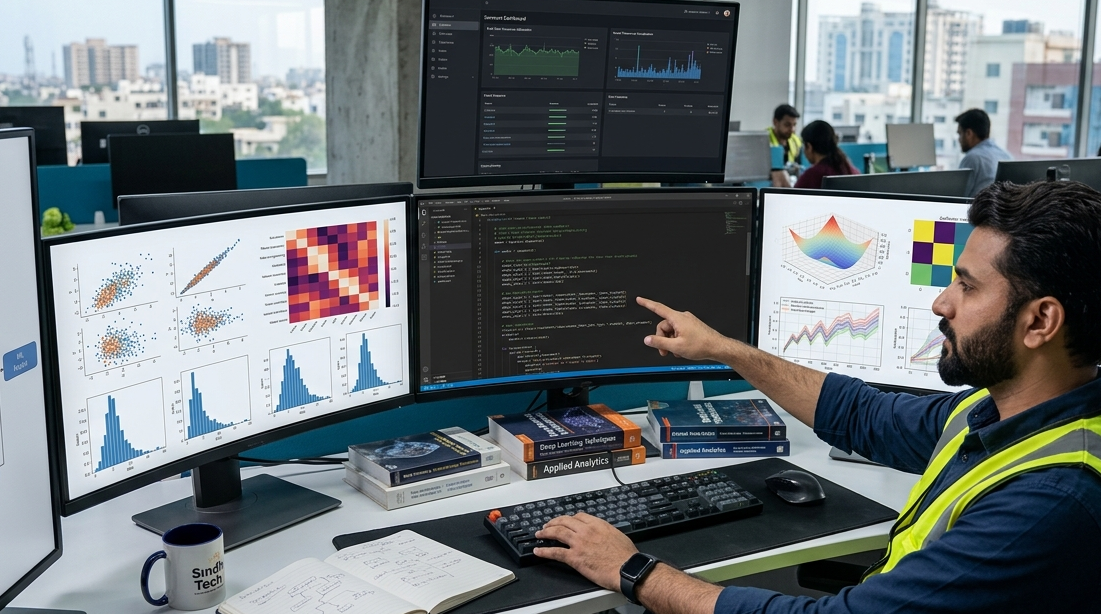
At its core, custom machine learning solutions are tailor-made artificial intelligence systems designed and engineered from scratch to solve specific operational problems. Unlike generic AI software development that relies on broad, publicly available datasets, custom machine learning models are built directly on top of your company’s historical data footprint.
By using techniques like supervised learning for classification and regression tasks, or deep learning for highly advanced data processing, these tailored systems align perfectly with your daily engineering reality. Whether you are aiming to build predictive analytics systems or automate manual workflows, custom AI development ensures the math behind the software is actually optimized for your specific key performance indicators (KPIs).
Why Businesses Need Custom Machine Learning Instead of Generic AI
Opting for public, pre-trained models can look incredibly tempting because of the low upfront cost. However, the long-term trade-offs in accuracy and security are often massive.
Core Differences At a Glance
| Feature Category | Custom Machine Learning Solutions | Off-the-Shelf AI APIs |
| Data Training Foundation | Built entirely on your proprietary data. | Trained on massive, generalized public data. |
| Domain-Specific Accuracy | Hyper-specific; easily handles custom business logic. | High error rates with niche terminology. |
| Competitive Moat | You own the model assets and training weights. | Shared capabilities accessible to all competitors. |
| Data Security & Privacy | Full control over compliance (GDPR, HIPAA). | Data often flows back to public model providers. |
Generic AI models don’t know your operational constraints, your specific supplier risks, or your exact customer personas. Custom models, on the other hand, are calibrated to weigh your internal business logic, making them far more effective at delivering reliable, automated decisions.
Key Benefits of Custom Machine Learning Solutions
Investing in a bespoke machine learning pipeline delivers clear, practical advantages across your entire corporate structure:
- Unmatched Model Accuracy: Because the algorithms are trained specifically on your data distributions, they drastically reduce false positives in fields like anomaly detection or text processing.
- Intelligent Automation: Instead of basic, rule-based automation that breaks down when a variable changes, ML models adapt smoothly to changing data trends.
- Total Data Security: Keeping your data pipelines fully in-house or inside isolated cloud environments means you easily maintain absolute compliance with strict regulatory frameworks like GDPR or HIPAA.
- True Enterprise Scalability: Custom models can be optimized to run efficiently on your existing infrastructure, keeping your ongoing inference costs predictable as your data volume grows.
Custom Machine Learning Solutions for E-Commerce
The retail sector is where tailored algorithms provide an almost immediate return on investment. Implementing custom machine learning solutions for e commerce completely changes how brands interact with their shoppers.
┌────────────────────────────────────────────────────────┐
│             E-COMMERCE ML OPTIMIZATION STACK           │
├────────────────────────────────────────────────────────┤
│  ▲ Revenue Layer:      Hyper-Personalized Recommendations│
│  ▲ Operations Layer:   Dynamic Inventory Demand Forecasting│
│  ▲ Marketing Layer:   Cart Abandonment Predictive Engines│
└────────────────────────────────────────────────────────┘
A generic recommendation tool can suggest popular items, but custom machine learning solutions for e-commerce analyze granular customer analytics—like individual click paths, seasonal local weather trends, and past return behaviors. This allows systems to build highly accurate recommendation engines that drive real conversions.
Furthermore, retail brands utilize these bespoke models for dynamic pricing and proactive inventory demand forecasting, ensuring popular items stay fully stocked without over-activating storage capital.
Industry Use Cases
Bespoke intelligence is actively reshaping how major industries handle data analysis and automation:
Healthcare
Physicians and medical networks utilize custom deep learning models for disease prediction and customer analytics. By training models on specialized patient files, systems can highlight subtle risk factors early, heavily improving patient care pathways while maintaining strict privacy walls.
Finance
In banking and fintech, speed is everything. Custom classification algorithms handle real-time fraud detection by analyzing millions of transaction patterns instantly, shutting down fraudulent activities without ruining the purchasing flow for legitimate clients.
Manufacturing
Heavy industry relies on predictive maintenance models to optimize complex supply chains. By streaming live data from IoT sensors placed on factory machinery, a neural network can spot micro-vibrations that signal an upcoming equipment failure, cutting unexpected downtime down to zero.
Structural Strategy: Smart Digital Transformation
When you are modernizing your company’s digital architecture, building smart data tools is only one piece of the puzzle. For example, brands looking to streamline their online customer support channels often integrate custom algorithms directly with advanced AI Chatbot Development frameworks. This ensures your front-facing conversational tools can pull deep insights straight from your custom predictive models, offering shoppers instant, highly accurate resolutions without needing human agent intervention.
At the same time, shifting your internal operations toward an AI-driven structure requires your workforce to understand these tools inside out. Many enterprises choose to Outsource eLearning program creation to specialized instructional designers. This allows companies to quickly roll out tailored training courses that teach staff members how to interact with new data pipelines, manage internal business intelligence dashboards, and make the most of your corporate software investments.
Custom ML Development Process
Building a functional, production-ready machine learning solution requires a highly disciplined, iterative development pipeline:
  Step 1: Data Strategy & Labeling ──► Step 2: Feature Engineering
                                                    │
  Step 4: MLOps Deployment & Tracking ◄── Step 3: Model Architecture
- Data Collection & Strategy: Gathering your raw historical data and executing precise data labeling to ensure the algorithms have an optimized foundation to learn from.
- Data Cleaning & Feature Engineering: Isolating the most critical data points, removing corrupt inputs, and preparing your internal data pipelines.
- Model Selection & Architecture Design: Choosing the ideal underlying code structure—whether that means lightweight tree-based models or complex neural networks.
- Model Training & Hyperparameter Tuning: Running training cycles and adjusting system parameters to maximize model accuracy and F1 scores.
- Model Deployment & MLOps Monitoring: Moving the finalized system into your live infrastructure and setting up automated tracking systems to stop model drift as real-world data distributions evolve.
Technologies Used in Custom Machine Learning
To maintain absolute data science standards, developers build these solutions using robust, industry-tested open-source libraries and enterprise cloud platforms:
- Core Frameworks: Python, TensorFlow, PyTorch, and Scikit-learn.
- Cloud Infrastructure: AWS SageMaker, Microsoft Azure Machine Learning, and Google Vertex AI.
- Data Engineering Hubs: Databricks and specialized data pipeline tools for managing enterprise scale.
Custom Machine Learning Solutions vs Traditional Analytics
Traditional business intelligence (BI) is entirely descriptive—it uses dashboards to show you exactly what happened in the past.
┌─────────────────────────────────────────────────────────────────┐
│               THE ANALYTICS EVOLUTION                           │
├─────────────────────────────────────────────────────────────────┤
│  Traditional BI:       Descriptive ("What happened last quarter?")│
│  Custom ML Solutions:  Prescriptive ("What will happen tomorrow?")│
└─────────────────────────────────────────────────────────────────┘
Custom machine learning models shift your corporate strategy from reactive to proactive. Instead of just organizing historical rows, these systems deliver predictive and prescriptive analytics, automatically serving up optimal business paths and executing complex automated decisions in real-time.
How Much Do Custom Machine Learning Solutions Cost?
The capital investment required for custom machine learning depends directly on your data quality, system complexity, and scaling needs:
| Project Scale Tier | Typical Engineering Components | Ideal For | Estimated Budget Range |
| Small Pilot / MVP | Basic feature engineering, single-source data integration, standard classification models. | Validating a specific automation use case or testing an initial pilot model. | $20,000 – $45,000 |
| Mid-Sized Enterprise System | Multi-source data pipeline, tailored NLP or computer vision models, initial MLOps tracking. | Mid-market brands optimizing core workflows like e-commerce demand forecasting. | $50,000 – $120,000 |
| Premium Core Infrastructure | Real-time high-throughput inference, deep learning models, full cloud cluster integrations. | Large-scale finance or manufacturing setups requiring absolute precision and low latency. | $150,000 – $500,000+ |
How to Choose the Right Custom Machine Learning Solutions Provider
When you are ready to contract an outside team to architect your systems, use this practical evaluation checklist:
- Proven MLOps Experience: Ensure they don’t just know how to train a model on a local laptop, but have a clear record of moving models into production environments.
- Clear Security Blueprints: They must display full mastery over modern data privacy rules and isolated data handling protocols.
- Post-Deployment Support Plans: Models are living software assets; your provider must offer clear support options to handle regular maintenance and combat model drift down the line.
Future of Custom Machine Learning Solutions
We are moving quickly toward a world where systems handle their own optimization. The future of custom machine learning centers around explainable AI (XAI)—letting human engineers see exactly why a deep neural network made a specific choice—and agentic AI systems that can execute complex, multi-step operations completely unprompted based on predictive insights.
Frequently Asked Questions
What are custom machine learning solutions?
They are purpose-built AI models engineered from scratch using an individual company’s unique data footprints, specifically tuned to solve concrete operational inefficiencies.
How much does a custom ML solution cost?
A basic pilot validation or proof of concept typically starts around $20,000, while complex enterprise-grade systems processing massive real-time data streams can pass $150,000 depending on overall engineering hours.
Are custom machine learning models better than pre-trained AI?
For domain-specific tasks, yes. Pre-trained models excel at generic text generation or broad tasks, but custom models deliver far higher accuracy when handling custom company logic and unique data sets.
How long does it take to build a custom machine learning solution?
A standard production-ready deployment usually takes anywhere from 3 to 6 months, depending on the current state of your data pipelines and the complexity of the target architecture.
What is the difference between AI and machine learning?
Artificial Intelligence is the broad vision of making computers act intelligently. Machine Learning is a specific subset of AI focused on building algorithms that automatically learn patterns from data without being explicitly hard-coded.
- TensorFlow Core Customization Guides: For deep technical documentation regarding custom model architecture design, hyperparameter tuning workflows, and layer management.
- Google Cloud Vertex AI Reference Frameworks: To explore enterprise MLOps deployment blueprints, pipeline monitoring tools, and secure data labeling methods.