

Many cybersecurity candidates spend weeks memorizing options for tools like Nmap, Wireshark, and Metasploit, yet they still freeze up when they log into the actual exam interface. It is one thing to look at a cheat sheet; it’s an entirely different challenge to dissect a raw firewall log under a strict four-hour countdown.
Working through a realistic ethical hacking practice exam helps bridge that gap. It shows you exactly how abstract concepts translate into tricky exam scenarios, forcing you to apply your knowledge rather than just repeating technical definitions.
Quick Answer: What is the purpose of a CEH practice exam?
Quick Answer: The purpose of a CEH practice exam is to help candidates evaluate their cybersecurity knowledge, become familiar with exam-style questions, and identify areas that need more study before taking the Certified Ethical Hacker certification exam.
What Is an Ethical Hacking Practice Exam?

An ethical hacking practice exam gives you a way to measure your hands-on security skills before putting money down for the actual test. The biggest difference between reading a standard study guide and taking a CEH-style test is application. Practice exams put you directly into situations where you have to look at an output log and immediately decide what action makes sense.
Instead of quizzing you on basic definitions, a solid practice run tests how well you know core infrastructure security, such as:
- Footprinting and Reconnaissance: Tracking down host details and open-source intelligence (OSINT) without triggering security alerts.
- Scanning Networks: Reading live port behaviors and operating system signatures using utilities like Nmap.
- System Hacking: The mechanics of architectural exploitation, gaining elevated privileges, and hiding access trails.
- Vulnerability Analysis: Pinpointing exploitable flaws across an organization’s network infrastructure.
- Perimeter Defense: Setting up or bypassing real-world firewalls, intrusion detection networks, and honeypots.
- Cryptographic Controls: Spots where encryption algorithms, public key infrastructure (PKI), and wireless standards (like WPA3) fail.
Why CEH Practice Exams Matter
Passing the CEH isn’t about reading a thousand-page book once. Most candidates improve when they follow a simple preparation routine and test themselves regularly. Relying too heavily on reading theory is an easy trap to fall into, but real practice tests change how you study by shifting your focus toward operational problem-solving.
Managing Your Time Under Pressure
The official multiple-choice test sets a fixed window to answer a large pool of questions. It’s incredibly easy to spend ten minutes stuck on a single difficult subnetting puzzle or a complex piece of malware code. Practicing with full-length timed CEH practice exams teaches you the pacing needed to flag tough questions, move past them, and return to clean them up at the end. For more structural testing advice, look over our 3 Secret Study Tips to optimize your revision schedule.
Uncovering Hidden Weak Domains
We naturally want to spend time on topics we already understand. If you spend your days building Linux environments but rarely touch mobile application platforms or cloud buckets, your study habits will likely skew toward your comforts. A baseline mock exam highlights exactly where your accuracy drops, giving you an objective look at where your notes are lacking.
Learning Question Styles
Even prepared candidates can lose marks because they rush, second-guess answers, or spend too long on one difficult question. Modern cybersecurity questions rarely ask something straightforward like “What port does HTTPS use?” Instead, they will hand you a messy Wireshark packet capture snippet or a firewall log rule and ask you to determine what type of attack is currently underway. If you find yourself struggling with exam anxiety, reading about How JC Students Can Build Real Exam Confidence offers useful techniques for managing stress.
Free Ethical Hacking Practice Exam Questions
Review these realistic, exam-style practice questions to see where your security knowledge stands. The explanation after each answer is where the real learning happens—it shows why one option fits perfectly and why the others fail the scenario rules.
Question 1: Scanning & Reconnaissance
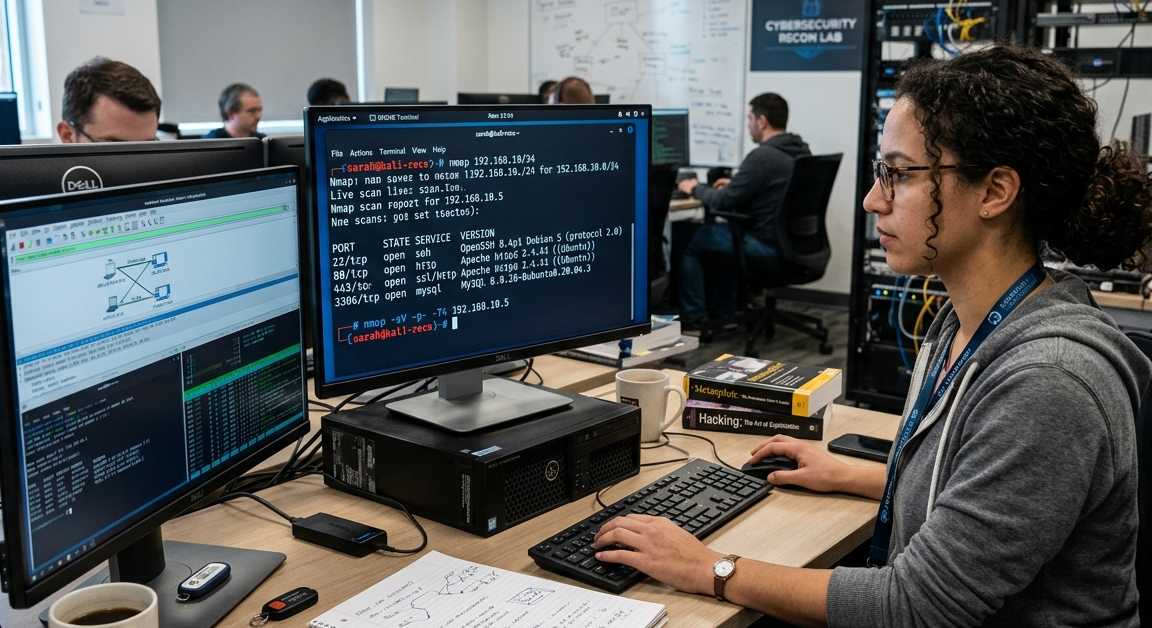
A security professional is running a network scan against a remote target subnet. They want to perform a scan by establishing a partial TCP connection without completing the full three-way handshake. Which Nmap command flag should they use?
- A.
nmap -sT 192.168.1.0/24 - B.
nmap -sU 192.168.1.0/24 - C.
nmap -sS 192.168.1.0/24 - D.
nmap -sA 192.168.1.0/24
Correct Answer: C. nmap -sS 192.168.1.0/24
Explanation: The
-sSflag triggers a TCP SYN scan, also known as a half-open or stealth scan. It sends a SYN packet and waits for a SYN/ACK response. If received, it immediately tears down the connection with a RST packet rather than sending a final ACK. Option A (-sT) performs a full connect scan, which logs a complete connection. Option B (-sU) is for UDP, and Option D (-sA) is an ACK scan used to map out firewall rulesets.
Question 2: Web Application Attacks

During a security assessment of a company’s public web portal, an engineer inputs the string ' OR '1'='1 into the username field of the login page. The application bypasses authentication entirely and logs the engineer into the first administrative account in the database. What vulnerability was exploited here?
- A. Cross-Site Scripting (XSS)
- B. SQL Injection (SQLi)
- C. Insecure Direct Object References (IDOR)
- D. Cross-Site Request Forgery (CSRF)
Correct Answer: B. SQL Injection (SQLi)
Explanation: This example shows SQL injection because the input changes the database query logic instead of being treated as normal text. By injecting characters that modify the query structure, the statement evaluates to true (
'1'='1'), tricking the database into granting access without a valid password. XSS involves running malicious scripts in a user’s browser, IDOR involves altering URL parameters to access unauthorized files, and CSRF forces an authenticated user to perform unwanted actions on a trusted site.
Question 3: Network Security Tools
A security analyst uses an open-source tool to inspect live local network traffic. They notice malicious traffic where an attacker sends spoofed ARP replies across the local area network. This tricks host computers into associating the attacker’s MAC address with the IP address of the default gateway. What utility is best suited to capture and visually analyze this raw packet data?
- A. Metasploit
- B. Burp Suite
- C. Wireshark
- D. John the Ripper
Correct Answer: C. Wireshark
Explanation: Wireshark is a dedicated network packet analyzer that allows you to capture, filter, and inspect frames flowing through a network interface card in real time. Metasploit is an exploitation framework used to launch payloads against target systems. Burp Suite is primarily a web proxy platform for testing web applications. John the Ripper is an offline password-cracking utility.
Certified Ethical Hacker Practice Exam Topics
Your practice questions should cover the exact same areas you will face on the test, including scanning, web attacks, malware, cryptography, and network defense. The table below outlines how these core domains translate into specific testing areas:
| CEH Core Domain | Tools & Sub-Concepts Covered | Practical Testing Area |
| Information Gathering | Footprinting, OSINT, network scanning, and enumeration. | Using Nmap, Shodan, and targeted search engine queries. |
| Attacking Methodologies | System hacking, sniffing, social engineering, and session hijacking. | Finding system exploits and intercepting cleartext data. |
| Web Application Security | SQL injection (SQLi), Cross-Site Scripting (XSS), and CSRF. | Analyzing poor input validation and tracking broken cookies. |
| Malware & Threats | Trojans, backdoors, worms, ransomware, and sniffers. | Figuring out how malware spreads and tracing structural flags. |
| Perimeter & Cloud Security | Firewall evasion, cloud configuration errors, and IoT hacking. | Locating exposed cloud storage and bypassing filter rules. |
| Data Protection | Symmetric/asymmetric ciphers, hashing, and WPA3 wireless. | Cracking Wi-Fi handshakes and spotting cryptographic flaws. |
Who Should Use Practice Exams?
Students, IT professionals, network administrators, and CEH candidates can all use practice exams differently. Beginners usually rely on them to grasp overall exam difficulty and see how technical terms translate into situational scenarios. On the flip side, experienced infrastructure professionals utilize them to quickly identify weak knowledge areas, making sure they don’t waste voucher fees on sections they might have overlooked.
TestOut Ethical Hacker Pro Certification Practice Exam
The testout ethical hacker pro certification practice exam is another stellar option if you are looking for a practical way to check cybersecurity skills. Unlike traditional question-only tests, TestOut focuses heavily on simulations and practical tasks, allowing students to practice concepts in a virtual environment.
Using this platform helps reinforce standard command-line proficiencies and switch configurations without requiring a dedicated physical lab. It serves as a strong bridge between abstract multiple-choice scenarios and hands-on tool deployment, making it highly complementary to standard study guides.
How to Choose a Reliable CEH Practice Exam Resource
Not all question pools on the internet are accurate or worth your time. When you are looking at different study options, make sure they check these boxes:
- Matches the Current Version: The questions must match the active testing blueprint provided by the exam body.
- High-Quality Explanations: The engine needs to show you exactly why an option fails, saving you from endless guessing games.
- Realistic Layouts: Look for choices that force you to parse code strings, script blocks, and network logs.
- Timed Mode Available: You need software that lets you simulate the multi-hour pressure cooker environment.
- Detailed Domain Scores: A helpful interface breaks down your final percentage by topic so you can prioritize your study calendar.
How Many Practice Exams Should You Take Before CEH?
There is no magical number of tests that guarantees a passing grade. However, most successful candidates find that taking three to five completely unique, full-length tests provides a solid baseline.
The goal here isn’t to memorize the question order; it’s to train your brain to recognize the underlying security concept within thirty seconds of reading a prompt. Try running a baseline test early in your prep, a checkpoint exam midway through your studies, and two or three full simulations in the final weeks before your test date.
Certified Ethical Hacker Practice Exam PDF: Are Downloads Worth It?
When searching for extra questions online, you will inevitably find links to a certified ethical hacker practice exams pdf. A dynamic testing engine is always better for simulating real pressure, but offline files can serve a purpose if used carefully.
- The Risk of Old Info: Security threats evolve fast. A PDF created a few years ago might focus heavily on outdated software versions while completely ignoring modern cloud buckets or mobile security vulnerabilities.
- Bad Answer Keys: Free documents shared on forums often contain flat-out wrong answer keys, which can lead you to memorize faulty technical data.
- The Brain Dump Trap: Relying on illicit question dumps encourages rote memorization rather than a deeper understanding. Real problem-solving skills become apparent during technical job interviews or live operational incidents where adaptive thinking is required.
If you like printing out documents for quick evening review sessions, stick to unedited files from trusted educational publishers. Use them to memorize flags or commands, but keep your primary focus on interactive platforms.
CEH Practical Exam vs. Practice Exam
It is incredibly common to confuse a standard knowledge-based practice test with the formal certified ethical hacker practical exam. They use distinct formats to measure different skill sets:
| Feature / Metric | Standard Practice Exam | Official CEH Practical Exam |
| Format | Multiple-choice questions. | Live, hands-on laboratory environment. |
| Testing Style | Knowledge retention, scenario analysis, and core concepts. | The CEH Practical exam is a hands-on assessment that tests penetration testing skills in a simulated environment. |
| Environment | Web browser or desktop testing engine. | A proctored virtual machine lab containing tools like Kali Linux. |
| Primary Goal | Prepares you for the knowledge-based multiple-choice test. | Focuses on applying your skills to real cybersecurity tasks. |
If your long-term goal is to clear the Practical version, clicking options in a multiple-choice simulator isn’t enough. You will need to spend significant hours inside a virtual lab typing commands directly into terminal interfaces.
How to Prepare for CEH in 30 Days
If you have a foundational background in networking and system operations, here is a practical 30-day study timeline to focus your efforts:
[Week 1: Foundations & Recon] ──► [Week 2: Exploits & App Security]
                                               │
                                               ▼
[Week 4: Final Polishing & Review] ◄── [Week 3: Tool Practice & Full Mock Tests]
Week 1: Networking, Reconnaissance, and Scanning
Spend your first seven days mastering network basics and info-gathering techniques. Learn your Nmap switches inside and out, focus on how to read Wireshark streams, and make sure you understand how basic scanning rules react to different operating system environments.
Week 2: Exploits, Malware, and Application Security
Shift your study blocks toward active system hacking. Spend time learning how SQL injections, Cross-Site Scripting (XSS), and session hijacking function at the packet level. Review malware categories so you can quickly differentiate a Trojan from a standard worm or rootkit.
Week 3: Tool Practice and Full Mock Tests
This is where you move away from reading and start doing. Set up a local virtual environment to run basic scripts, look closely at command structures, and take your first two full-length practice tests under a strict timer to analyze your pacing.
Week 4: Fixing Weak Blocks and Final Review
Go through your practice history and isolate the domains where your scores dropped below 80%. Re-read those specific chapters, clear up any confusion around cryptographic algorithms or firewall rules, and run short, targeted quiz sets to lock in your confidence before you book your testing slot via official testing providers such as Pearson VUE.
Common Mistakes When Using Practice Exams
- Treating Tests as a Memory Game: If you run the exact same 100-question pool five times in a week, your score will climb to 100%. But ask yourself: do you actually understand the computer science concepts, or have you just memorized that question 42 is always “C”?
- Skipping the Explanations: The true value of a mock exam isn’t the score screen at the end; it’s the text block explaining why an answer is correct. Skipping these descriptions wastes the best educational content available.
- Booking Your Test Too Early: Try to resist scheduling your official test session when your mock scores are scraping right by the baseline passing line. Give yourself a safety net—aim to consistently hit 85% to 90% accuracy on brand-new question sets before you spend money on an official testing voucher.
A Useful Exam-Day Habit
💡 Analyze Log Patterns: When addressing complex scenario questions, look closely at the command syntax or log files provided. Attackers leave distinct indicators inside log entries, such as repetitive alphanumeric patterns like
%20or<script>, which pinpoint web vulnerabilities like URL encoding bugs or basic Cross-Site Scripting. Learning to spot these structural indicators during practice tests saves valuable time on your actual test day.
Frequently Asked Questions
What is an ethical hacking practice exam?
An ethical hacking practice exam is a mock test designed to simulate a cybersecurity certification environment. It evaluates your understanding of vulnerability scanning, penetration testing techniques, security tools, and data defense methodologies.
How many questions are on the official CEH exam?
The CEH exam format can vary by version, so candidates should always check the latest EC-Council exam guide before scheduling their test. Traditionally, the standard multiple-choice knowledge exam features a pool of 125 questions to complete within a four-hour window.
Are practice tests harder than the real exam?
Many reputable practice platforms design their questions to be slightly more complex than the actual test. This encourages deeper analysis of technical logs and flags, making the actual evaluation more manageable.
Can I use PDF files for practice exams?
Yes, official study guides and review resources are available in PDF format. Ensure any document you download matches the current official exam blueprint to avoid studying outdated tool sets or missing critical infrastructure updates.
Conclusion
Using a comprehensive ethical hacking practice exam is an effective way to align your study habits with the expectations of professional testing. While reading textbooks builds foundational knowledge, working through realistic scenarios trains you to apply that information under pressure. By identifying your knowledge gaps early, refining your pace, and analyzing the technical reasoning behind every answer, you can approach your official certification session with confidence.