
If you are trying to learn a language, you probably spend a lot of time scrolling through mobile apps, flipping flashcards, or listening to audio tracks while making dinner. While those methods work fine for picking up words, they don’t help much when you need to write an email to a business partner in Madrid, draft a school essay, or text a friend in Mexico City. You end up freezing. That happens because listening and reading are passive skills, but writing forces you to build sentence structures completely from scratch.
To bridge that gap and actually get comfortable using your skills, you need to rely on consistent Spanish writing practice. Stepping away from passive apps and forcing your brain to produce real sentences is the only way to build lasting confidence.
The exercises below are designed to solve that exact problem, starting with simple sentences and gradually moving to longer texts, so you can feel more comfortable expressing your ideas in Spanish without feeling stuck.
Table of Contents
- Why Writing Practice Overhauls Your Language Skills
- Common Mistakes I See Spanish Learners Make
- Beginner Spanish Writing Exercises (CEFR A1–A2)
- Intermediate Writing Practice (CEFR B1–B2)
- Advanced Spanish Writing Exercises (CEFR C1–C2)
- Spanish Writing Exercises Based on Real-Life Situations
- Free Ways to Practice Every Single Day
- Real-World Practice: Spanish Writing Examples and Answers
- The 15-Minute Daily Spanish Writing Practice Routine
- About This Spanish Writing Practice Guide
- Frequently Asked Questions
Why Writing Practice Overhauls Your Language Skills

Here’s the honest truth: when you are speaking Spanish, you have about two seconds to think before the conversation gets incredibly awkward. That pressure causes a lot of Spanish learners in places like the United States, the United Kingdom, and other non-Spanish regions to completely lock up.
Writing gives you something speaking does not: time to think. It gives you the physical space to slow down, analyze the Spanish alphabet, check your spelling, and figure out your gender agreement. You have time to look at a noun and ensure your adjectives match perfectly. If you don’t build these habits on paper, you won’t use them correctly when speaking.
Navigating these deep structural differences is a natural part of expanding your linguistic horizons. This challenge comes up constantly, missing piece by missing piece, when you are trying to master Romance languages or looking at how they stack up against entirely different frameworks like the Different Levels of Chinese Programmes.
Too many learners fall into the trap of thinking their drafts have to be flawless right out of the gate, which is just a complete myth. The actual breakthrough happens when you muddle your way through a messy, imperfect paragraph, spot a verb conjugation that looks totally off, and fix the error on your own.
Common Stumbles for Spanish Students
It catches a lot of people off guard to see how quickly straightforward concepts can trip you up. For instance, explaining your age seems like a total no-brainier, but Spanish completely flips the script by forcing you to use Tengo 20 años. Hitting these structural differences head-on is exactly why sitting down to write out sentences is so incredibly valuable.
Another classic pitfall is accidentally matching your descriptive adjectives with the person speaking rather than the actual noun they are modifying. New learners also get tangled up constantly when trying to pick the right past tense, especially when they need to set a background scene instead of marking a single, finished event. Building a regular practice routine gives you the space to catch these specific quirks before they lock into permanent habits.
Beginner Spanish Writing Exercises (CEFR A1–A2)
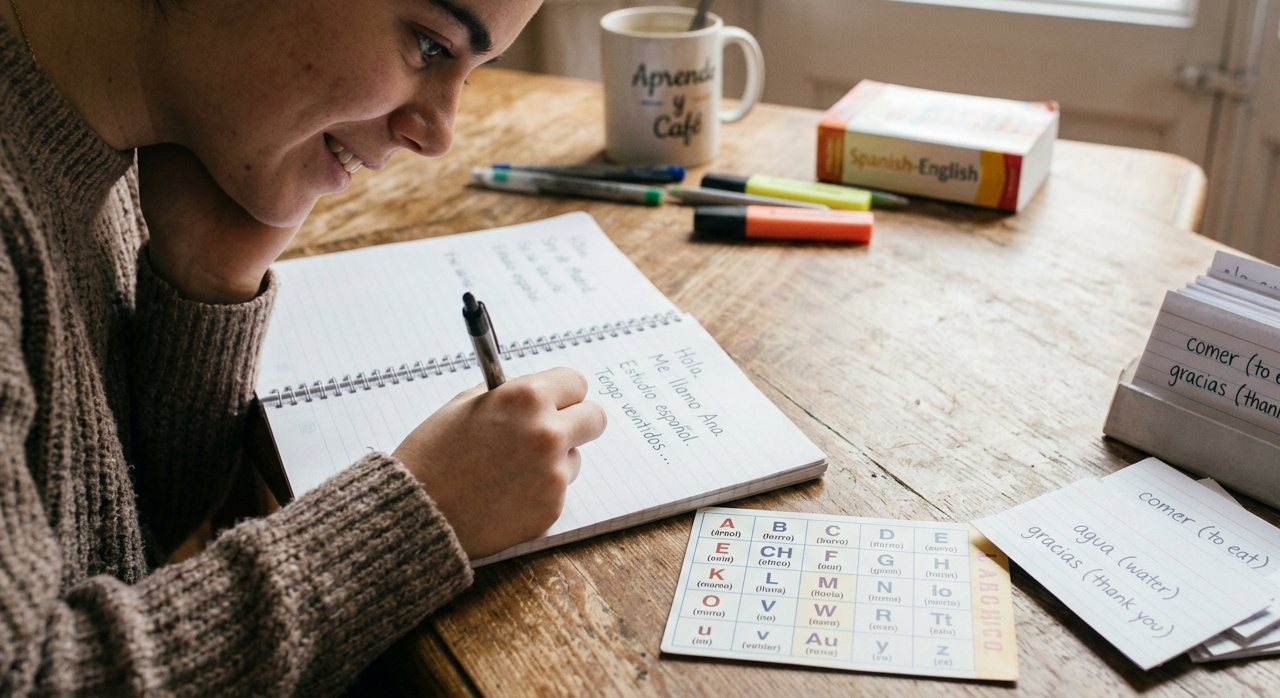
When you first start out, you really want to spend most of your energy on the absolute basics—getting your sentence structure right, remembering capital letters, and picking up daily words. These early steps match up with what the Council of Europe CEFR Guidelines suggest for beginner levels. Don’t worry about writing long, complicated essays or anything deep just yet.
Write About Yourself (Introduction Practice)
Imagine you just moved into an apartment building in Buenos Aires and want to write a short introductory note to your neighbors. Write five simple sentences. Include your name, your age, where you are from originally, your current job or study focus, and one simple hobby you enjoy on the weekends.
Pay special attention to three important verbs here: ser, estar, and tener. These are simple verbs, but beginners often confuse them. Remember, Spanish speakers do not use ser to say how old they are; they use tener to declare how many years they possess.
Try to write this out using a specific persona: introduce yourself as a 29-year-old software tester who loves reading historical fiction.
Chronicling Your Early Morning Habits
Ever wonder how much vocabulary is hidden in your initial waking moments? Try putting together a brief paragraph that follows your movements from the exact second you open your eyes until you walk out the door. Push yourself to include at least three reflexive verbs to chart your movements. Jumping into quick, practical challenges like this is a massive shortcut for cementing daily vocabulary and figuring out how conversational sentences actually fit together.
Make sure to watch where your reflexive pronouns (me, te, se) land, and double-check that your masculine or feminine endings align with any household items you mention. For this specific task, build your paragraph around throwing off the blankets at 6:30 AM, heading to the sink to wash up, making breakfast, and relaxing with a hot mug of tea.
Advancing to Intermediate Strategies (CEFR B1–B2)
Once you move past simple word lists, it’s time to ditch the choppy, mechanical sentences and figure out how to bridge your thoughts into a cohesive narrative. This phase focuses entirely on pacing your stories, mixing past tenses fluidly, and dropping in smart transition words so your paragraphs have an actual rhythm.
When a Vacation Completely Flops
Think of a getaway—either something that really happened to you or a setup you make up on the spot—where everything went entirely off the rails. Put together four to six sentences contrasting your original plans against the chaotic reality you found when you got there.
This specific prompt forces you to navigate the tricky line between the preterite and imperfect past tenses. Lock in the preterite for distinct, completed milestones that happened and finished (fui, llegué, compré). Use the imperfect to paint the scene, describe weather conditions, or show how you felt (hacía sol, estaba cansado, quería). To keep things focused, write about showing up at a beach hotel right in the middle of a massive storm, finding out the pool is completely closed, and getting stuck inside playing cards all afternoon.
Jotting Down Career Goals and Expectations
Draft three standalone sentences focusing on your professional life. Detail what an ideal workplace setup looks like to you, what you need a manager to do to support the team, or what milestone you want to hit during your next career jump.
The main challenge here is triggering the subjunctive mood. When you start an independent clause with expressions of desire, emotion, or doubt like Espero que… (I hope that…) or Quiero que… (I want that…), the subordinate verb must shift out of the indicative mood. If you are preparing for advanced academic evaluation, mastering these shifts is just as critical as expanding your structural lexicon through resources like our AP Spanish Language Vocabulary guide.
Advanced Spanish Writing Exercises (CEFR C1–C2)
Advanced study demands high-level analytical thinking, sophisticated idiomatic expressions, and flawless management of accent marks that can completely alter the meaning of a word if misplaced.
Write an Editorial Debate
Pick a complex issue that you feel strongly about. For example: Should public transportation be entirely free for everyone in major cities? Or does artificial intelligence threaten creative writers? Write a detailed paragraph defending your viewpoint.
Focus on using complex connector phrases (a pesar de que, por lo tanto, sin perjuicio de), advanced vocabulary building, and maintaining strict gender agreement across complex abstract nouns ending in -dad, -ción, or -tud.
Try a Strict Translation Audit
Take a crack at translating this dense English snippet into natural, flowing Spanish. Skip the automated translation apps for this one, and focus on capturing the actual vibe and meaning rather than doing a strict word-for-word swap:
“Had the director known that the logistical team was going to face such severe border delays, she would have postponed the international product distribution until late autumn.”
Spanish Writing Exercises Based on Real-Life Situations
To make your practice functional, it helps to focus on scenarios you will actually encounter. Here are three practical situations to try.
1. Writing a Hotel Email
Write a short email to a boutique hotel in Barcelona asking about room availability for a weekend next month, their check-in times, and if breakfast is included in the price.
2. Sending a WhatsApp Message
Write a text message to a casual friend inviting them to go to a new Mexican restaurant downtown this Friday. Suggest a time to meet outside the subway station.
3. Professional Workplace Writing
Write a short introduction for a professional profile or guest post biography. Explain your field of expertise, how long you have worked in the industry, and your interest in international markets.
Free Ways to Practice Every Single Day
You don’t have to drop hundreds of dollars on fancy courses or thick textbooks just to build a solid habit. A lot of people find that mixing physical notebooks with Spanish writing practice online works best for tracking progress. Honestly, you can find free ways to practice right around you:
- The Raw Nightly Journal: Toss a small notebook on your nightstand. Before hitting the lights, scribble down exactly three sentences about how your day went. If you are a beginner, just stick to basic present tense stuff. If you are intermediate or advanced, use the conditional or past tenses. Do not edit as you write; just let the words flow out.
- The Living Room Photo Description: Open any news website or photo gallery. Pick a random picture, set a timer on your phone for four minutes, and write down every single physical detail you notice. Describe the lighting, what the people look like, what they are wearing, their apparent expressions, and what might happen next in the scene.
- The Vocabulary Sandbox: Take one new Spanish word or idiom you discovered while listening to music or watching a show today. Force yourself to write it into three completely different sentences: one as a standard fact, one as a question directed at a friend, and one as a hypothetical scenario.
Real-World Practice: Spanish Writing Examples and Answers
Checking your own work is the only way to ensure you are not repeating the same errors over and over. Use these curated Spanish writing examples to evaluate your structures.
Beginner Level Correction
- The Task: Introducing yourself, your age, location, and a student status.
- Sample Correct Text: Me llamo Ana. Tengo treinta años y vivo en Chicago. Soy estudiante de diseño y me gusta salir a correr por las mañanas.
- Why this text works: It uses tengo for age instead of soy. Notice also that you do not put the word una before estudiante. In Spanish, you drop the indefinite article when stating your profession or status unless you are modifying it with an adjective.
Intermediate Level Correction
- The Task: Combining past tenses to describe an event.
- Sample Correct Text: El viernes pasado quería ir a la playa porque hacía mucho calor. Sin embargo, cuando llegué, empezó a llover y tuve que regresar a casa.
- Why this text works: Quería and hacía do the heavy lifting here by using the imperfect tense to set the scene. They give you the background context—the hot weather and what someone felt like doing—right before the main events kicked off.
Advanced Level Correction
The Goal: Figuring out how to translate a tricky, hypothetical “what-if” sentence.
Example of It Done Right: Si la directora hubiera sabido que el equipo de logística iba a enfrentar retrasos fronterizos tan graves, habría pospuesto la distribución internacional del producto hasta finales del otoño.
Breakdown of why this works: Look closely at how the grammar handles something that didn’t actually happen. It uses hubiera sabido (pluperfect subjunctive) for the “if” part, and then answers it with habría pospuesto (conditional perfect). This specific combination is exactly how you talk about a past scenario that never actually played out.
Getting in Your 15 Minutes of Spanish Daily
Forget about trying to force yourself to study for hours at a time. That usually just leads to burnout. Instead, you’ll get way better results if you just pick a tiny, 15-minute window every day and stick to it. Consistency always wins out over cramming.
| Time Block | Focus Activity | Practical Steps |
| Minutes 1–3 | Prompt Selection | Pick your theme instantly. Do not waste precious minutes overthinking what to write about. |
| Minutes 4–10 | Continuous Writing | Keep your pen moving across the page. If you forget a specific word, do not stop. Leave a blank line and keep writing your thought. |
| Minutes 11–13 | Grammar and Polish | Go back through your sentences. Check every single noun to make sure its matching adjective has the correct gender and plural ending. |
| Minutes 14–15 | Rhythmic Read-Aloud | Read your sentences aloud. Listen to the natural flow, check your verb accents, and verify that your question marks are placed correctly. |
About This Spanish Writing Practice Guide
This guide focuses squarely on the exact hurdles language students face every single day: getting past tenses twisted, forgetting to match gender endings across longer sentences, and freezing up when trying to string individual words into a smooth paragraph. To really sharpen the skills that take the friction out of writing, you can easily pair these prompts with other practical study tools, such as our walkthroughs on beginner vocabulary builders or core grammar exercises.
Frequently Asked Questions
How do you say writing exercise in Spanish?
A writing exercise in Spanish is translated as ejercicio de escritura. If you are discussing a collection of them, the phrase shifts to ejercicios de escritura. If you are explicitly talking about a prompt to get you started, you can use the phrase propuesta de escritura.
What is the most effective way to get free corrections when practicing alone?
While automated browser extensions can catch basic spelling mistakes, they often miss deep stylistic nuances. For authentic feedback from real human beings, try submitting your written paragraphs to online communities like Reddit’s r/WriteStreakES. It is a forum where native speakers look over your text and fix your grammar mistakes completely free of charge.
Should I practice using Spanish writing exercises for adults that focus on Spain or Latin America?
The foundational grammar rules, primary sentence structures, and core spelling systems are virtually identical across the globe. The differences mostly come down to regional vocabulary and whether you use vosotros (common in Spain) or ustedes (common across Latin America). Pick the specific region where you plan to spend your time or the people you talk to most, and focus your vocabulary practice there.
How much do accent marks actually matter when doing a writing exercise in Spanish?
They are absolutely critical because an accent mark can completely transform the tense, meaning, and pronunciation of a word. For example, camino means “I walk” (present tense), but caminó means “he or she walked” (past tense). Leaving out an accent can completely distort the message you are trying to send to the reader.
Can I find Spanish writing exercises PDF worksheets or is it better to type on a laptop?
Printable PDF worksheets can be highly effective because they allow you to practice without digital distractions. Writing by hand with a physical pen and notebook is generally superior for memory retention. The slow physical act of shaping letters forces your brain to focus on the individual spelling, accent placement, and structural layout of each word, which helps your grammar knowledge stick much deeper in your long-term memory.
Why do my written paragraphs always sound so stiff and unnatural?
This usually happens because you are thinking in English and translating word-for-word directly into Spanish. To break this habit, use shorter sentences, avoid overly complicated English figures of speech, and pay close attention to how native authors structure their thoughts when you read articles, short stories, or books.
Can I look up words in a dictionary while I am drafting my paragraphs?
Try to avoid stopping mid-sentence to flip through a dictionary or an app. It breaks your creative momentum and pulls you out of the language-building mindset. Draft your entire thought first using the words you already possess, leave a placeholder mark for the term you do not know, and look up the proper Spanish translation only after your paragraph is fully finished.
What are the best Spanish writing exercises for beginners?
The best exercises focus on high-frequency present-tense structures, daily routines using reflexive verbs, and short descriptive paragraphs about your current environment, city, or family members.
How often should I practice Spanish writing?
Daily practice for 10 to 15 minutes is significantly more effective than studying for two hours once a week. Short, consistent writing sessions keep your brain accustomed to retrieving vocabulary and applying grammar rules regularly.
Are Spanish writing exercises useful for speaking skills?
Yes. Writing acts as a slow-motion rehearsal for speech. Because it gives you the time to consciously process sentence order, verb endings, and prepositions, those correct patterns eventually become automatic, making it easier to voice them spontaneously during oral conversations.
Where can I find Spanish writing practice online?
You can find interactive prompts and community corrections on platforms like Reddit’s WriteStreakES Community, language exchange apps like HelloTalk or Tandem, and dedicated educational blogs that offer guided feedback systems.
Actionable Takeaways
Improving your Spanish writing is a gradual process. Some days you will write easily, and other days you will forget simple words. That is normal. The important thing is creating a habit and learning from each mistake. Do not let the fear of making mistakes keep you from putting your thoughts on paper. Pick one of the basic or intermediate prompts from this guide, open up a blank notebook, and write down your first paragraph right now. The purpose of these spanish writing exercises is not to create perfect sentences immediately. The real progress comes from writing regularly, finding mistakes, and improving with every attempt.