
Trying to figure out the college volleyball recruiting scene can make your head spin. A lot of high school players honestly believe that if they just play hard and win a few local matches, college scouts will magically pop up in their home gym with a full-ride offer. Sadly, that is almost never how reality works. Getting your foot in the door takes a serious, proactive game plan that treats the whole process like a small business.
If you are currently trying to map out how to get a volleyball scholarship, you have to realize that raw talent on the court is just your baseline. The high school players who actually end up getting their college education funded are the ones who learn how to market themselves directly to an athletic department, take care of their academic eligibility, and build real relationships with college coaches across several different division levels.
Quick Answer: How Do You Get a Volleyball Scholarship?
To secure a volleyball scholarship, a student-athlete needs to play for a competitive club team to get noticed at national qualifiers, keep a high GPA, create a position-specific highlight video, register with the NCAA and NAIA eligibility hubs, and reach out to college coaches directly with a personalized player profile and email strategy.
Key Takeaways
- Club Over High School: College coaches do almost all of their real scouting at massive club tournaments, not regular high school matches.
- Academics Matter: A strong high school transcript makes you way easier to recruit because coaches can blend athletic aid with a merit scholarship.
- Be Proactive: Do not sit around waiting to be discovered. Fill out the online recruiting questionnaire on college sites and email assistant coaches directly.
- Know Your Metrics: Your vertical leap, approach touch, and blocking reach are crucial data points that programs use to filter out prospects.
- Broaden Your Search: Look beyond just Division I. Great scholarship packages and incredible competition exist in DII, NAIA, and junior colleges too.
Volleyball Scholarship Reality: By the Numbers
To figure out how tough it really is to land a volleyball scholarship, you have to look at the brutal math behind roster management and strict funding caps. Right now, around 450,000 high school players are competing across the country. Yet, a tiny fraction—just 1% to 2% of those athletes—will ever secure a spot on an NCAA Division I or Division II roster.
Fighting for one of these positions is incredibly competitive because governing bodies like the NCAA and NAIA place tight restrictions on athletic funding. Programs simply don’t have an endless pool of money to distribute. The table below breaks down the exact number of programs out there, giving you a realistic look at how your chances shift depending on the division level.
College Volleyball Scholarship Breakdown
| Governing Body / Division | Number of Programs | Scholarship Type | Max Scholarships Per Team | Competition Level | Roster Dynamics & Notes |
| NCAA Division I | ~334 (Women) / ~30 (Men) | Headcount (Women) | 12 (Women) / 4.5 (Men) | Elite | Women’s programs offer full-rides only; highly competitive. |
| NCAA Division II | ~300 (Women) / ~35 (Men) | Equivalency | 8 (Women) / 4.5 (Men) | Very High | Coaches slice up funding into partial scholarship packages. |
| NCAA Division III | ~430 (Women) / ~110 (Men) | Non-Athletic | 0 | High / Moderate | No athletic aid, but deep pots of need-based aid and merit money. |
| NAIA | ~220 (Women) / ~60 (Men) | Equivalency | 8 (Women) / 4.5 (Men) | High | Flexible recruiting calendar; great opportunity for early offers. |
| NJCAA (JuCo) | ~320 (Women) | Equivalency | Varies by Division | Moderate | Excellent two-year transfer pathway to four-year universities. |
How to Get a Volleyball Scholarship Step by Step
Chasing down college funding is a multi-year marathon, not a sprint. By breaking the journey down into clear, practical steps, you ensure you won’t miss crucial windows on an already hectic recruiting calendar.
Step 1: Maximize Your Club Volleyball Exposure
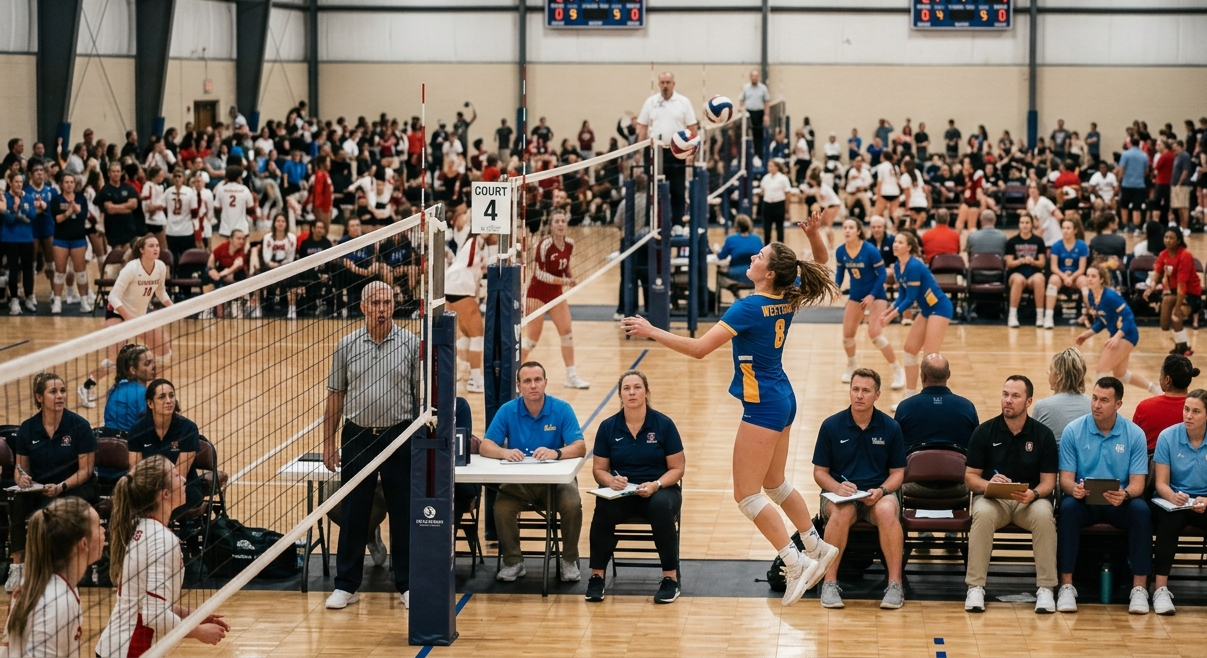
While playing varsity high school volleyball is great for building local leadership and school pride, college scouts rarely spend their tight budgets traveling to standard high school matches. Instead, they spend their time tracking down talent at massive club volleyball tournaments. Joining a club team affiliated with USA Volleyball or the Amateur Athletic Union (AAU) is pretty much a non-negotiable requirement these days. College coaches pack the sidelines at national qualifiers for a simple reason: efficiency. It allows them to evaluate hundreds of potential recruits under one roof over a single weekend.
Step 2: Build a Position-Specific Highlight Video
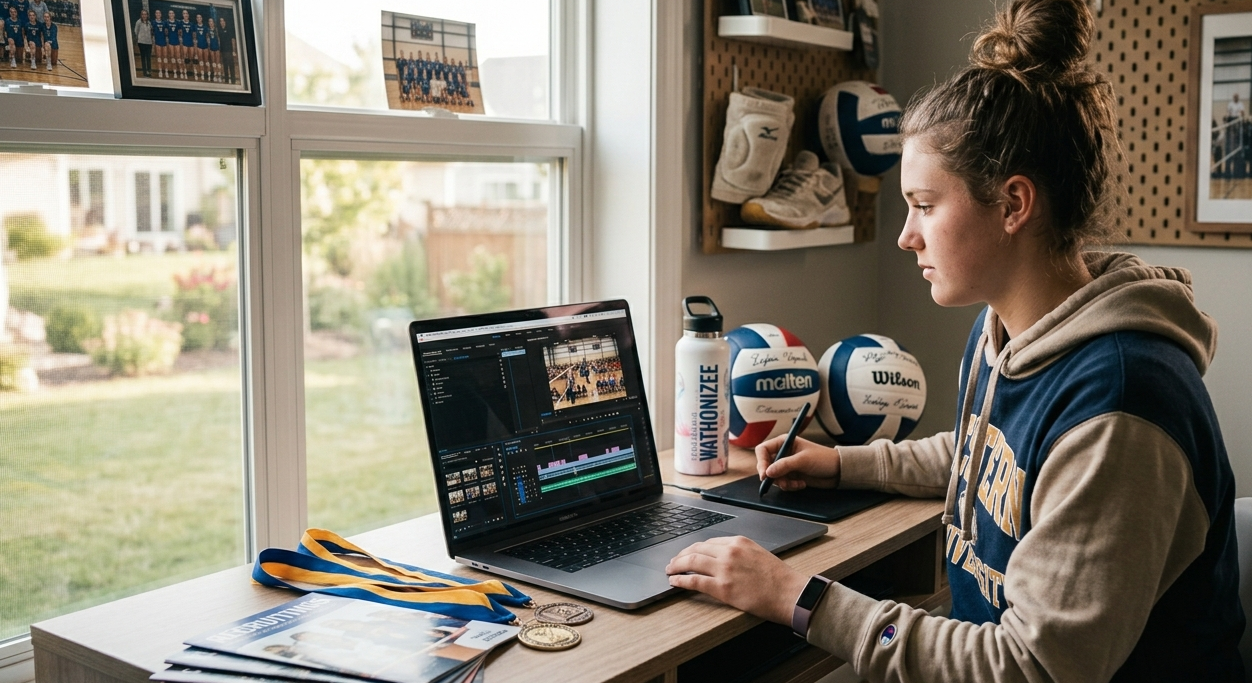
Your highlight video acts as your digital introduction to an athletic department. Keep the whole thing under five minutes. Start with a 60-second skills video showing your technical form in clean reps—such as hitting lines for an outside hitter, target reps for a setter, or defensive transitions for a libero. Follow that with unedited game footage from a real match. Coaches want to see your decision-making, your court communication, and how you react right after a tough mistake.
Step 3: Take Control of the Outreach Process
Coaches aren’t going to just stumble across your social media profile by accident while scrolling their feeds—you’ve got to make the first move. Start by hunting down the official athletic sites for your target schools, jump right over to the volleyball section, and knock out their recruiting questionnaire. Once you’ve checked that box, find the direct email address for the assistant coach or recruiting coordinator. Write them a quick, personalized note that cuts straight to the chase: tell them your graduation year, position, physical stats, academic interests, and drop a direct link to your YouTube highlight reel.
Step 4: Attend Targeted College Camps
Don’t waste thousands of dollars on massive, overhyped showcase camps that promise exposure to hundreds of schools but rarely move the needle. You’re far better off investing your time and travel budget into individual summer camps hosted right on campus by the coaching staffs of your top-tier choices. This setting gives you a multi-day window to put your work ethic, coachability, and on-court communication on full display directly in front of the people who actually call the shots on the roster.
Step 5: Leverage Your Verified Physical Metrics
Coaches rely heavily on raw data to filter their initial lists of prospects. You need to know your exact vertical leap, approach touch, and blocking reach. Getting these numbers officially measured at a verified volleyball combine or regional showcase adds immediate credibility to your player profile. If a coach knows you can consistently touch ten feet at the net, your email immediately goes to the top of the pile.
Key Performance Metrics for Net Positions (Outside Hitter, Middle Blocker, Opposite Hitter):
• Division I Target: Approach touch typically needs to exceed 10'0" to 10'3".
• Division II / NAIA Target: Approach touch generally ranges from 9'8" to 10'0".
• Division III / JuCo Target: Approach touch averages between 9'6" and 9'10".
Step 6: Master the Financial Aid Equation
Because full-ride scholarships are rare outside of women’s Division I, you must learn how to navigate the financial aid office. Plenty of universities actually let you stack an athletic scholarship right on top of a merit award or need-based assistance. When you get the chance to chat with a coach, make sure to ask exactly how their program pairs athletic funding with institutional grants to help drive down your family’s out-of-pocket tuition costs.
Step 7: Excel in Match Statistics
While film shows your form, your season statistics show your efficiency. Coaches look closely at metrics like attack percentage, serving accuracy, and digs per set. Maintaining an accurate, verified stat sheet through platforms like MaxPreps or your club program provides concrete evidence that you can perform when the pressure is on.
Step 8: Visit Campuses Early
Don’t sit around waiting for an official invitation during your senior year. Take matters into your own hands by taking unofficial visits to the campuses at the top of your list. Walk around the grounds, check out the training facilities, and try to book a quick chat with the coaches if NCAA recruiting rules allow it for your age group. Stepping foot on campus gives you a real feel for the place and helps you trim down your target list in a hurry.
Step 9: Build a Professional Online Player Profile
Keep all your recruiting details organized in one easy-to-read spot. It really doesn’t matter if you pay for a dedicated recruiting network or just set up a simple, free webpage of your own. The goal is to give coaches a single hub where they can instantly find your latest video clips, upcoming tournament schedule, current jersey number, club coach’s contact info, and an updated copy of your high school transcript.
Step 10: Finalize Eligibility Requirements Early
You cannot accept an athletic scholarship offer if you aren’t cleared to play by the governing bodies. By your sophomore year, head to the official eligibility portals to register your profile. This ensures your high school coursework aligns perfectly with college admissions standards well before graduation.
Volleyball Scholarship Requirements
To play collegiate sports, you have to satisfy both the academic standards of the college admissions office and the amateurism guidelines of the athletic associations.
- Academic Transcripts: You need to get your official high school transcripts over to the eligibility centers. The NCAA requires you to knock out a specific set of 16 core courses—spanning English, math, social sciences, and natural or physical sciences—before you can graduate.
- Core GPA: To compete as a freshman in Division I, you have to hold down a minimum 2.3 GPA in those core classes. For Division II, the baseline drops slightly to a 2.2. That said, aiming higher and graduating with a 3.5 GPA or better opens up serious doors for non-athletic institutional aid, making you a much more attractive recruit.
- Amateurism Certification: When signing up with the NCAA or NAIA Eligibility Centers, you’ll complete a questionnaire about your playing history. They just want to verify that you’ve never pocketed prize money, signed with a pro agent, or done anything else to compromise your status as an amateur student-athlete.
Year-by-Year High School Recruiting Timeline
The recruiting calendar moves incredibly fast. If you start the process as a senior, you are already way behind. Use this structural timeline table to keep your search on track.
High School Action Plan
| Grade Level | Focus Area | Essential Tasks to Complete |
| Freshman Year | Skill & Academic Base | Focus on technical development. Play high-level club. Build a strong GPA foundation. |
| Sophomore Year | Profile & Registration | Record initial skills video. Register with NCAA/NAIA eligibility centers. Build a list of 30 target colleges. |
| Junior Year | Active Coach Outreach | Send personalized emails with video updates. Attend individual college camps. Schedule unofficial visits. |
| Senior Year | Decisions & Commitments | Apply to admissions offices. Attend official visits. Review financial aid packages. Sign your commitment letter. |
How to Get a D1 Volleyball Scholarship
Snagging a roster spot at the absolute highest tier of college sports means hitting elite physical and competitive benchmarks. If you’re single-mindedly locked in on how to get a d1 volleyball scholarship, you have to face a tough reality: these coaching staffs lock down talent incredibly early. It’s common practice for powerhouse programs to scout and claim their top-priority recruits back during their sophomore year or the first half of junior year.
When building a Division I roster, coaches hunt for game-changing traits like extreme court coverage, raw speed, and massive vertical leap. Your typical outside hitters and middle blockers easily clear the 6’0” mark, routinely boasting an approach touch that breaks past the ten-foot ceiling. Don’t panic if you don’t have that kind of height, but realize your path to a D1 roster requires flawless, hyper-specialized talent. Setters have to bring blazing footwork alongside high-level tactical instincts, while a libero must read defenses like a pro, maintain a rock-solid serve percentage, and handle high-velocity serves without breaking a sweat.
How to Get a Volleyball Scholarship in High School Even If You Aren’t an Elite Recruit
If you aren’t a six-foot-two athlete playing for an elite open-division club team, you can absolutely still play college volleyball. The trick is expanding your horizons beyond the bright lights of Division I. A massive number of high school players miss out on great opportunities because they overlook alternative pathways.
Cast a wider net beyond just the massive D1 programs—NCAA Division II, Division III, and NAIA schools have a ton to offer. Sure, D3 programs aren’t allowed to hand out official athletic scholarships, but that doesn’t mean you’re stuck paying full price. Most of them sit on deep academic merit funds and need-based grants that can slash your tuition bills down to zero.
You could also take the Junior College (NJCAA) route for a couple of seasons. It’s an incredibly smart way to sharpen your skills, bank high-quality game tape against real college-level competition, and set up a clean transfer path to a four-year school that will help pick up the tab later on.
(Note: If you want to see how athletic funding models work across other collegiate sports, take a look at our comprehensive guide on Gymnastics Scholarships. Or, if your long-term goals involve philanthropic sports development, you can read our deep dive on How to Establish a Scholarship Fund.)
Common Mistakes That Ruin Your Recruiting Chances
- Waiting Too Long to Start: Assuming coaches will find you without any outreach on your part is the most common reason talented players go unrecruited.
- Sending Generic Form Letters: Coaches talk to each other. If you send a copy-pasted email that says “Dear Coach” without using their name or school, it will be deleted instantly.
- Allowing Grades to Slip: An incredible attack percentage means nothing if the admissions office rejects your application due to poor high school grades.
- Unprofessional Video Footage: Sending a video filmed from the stands on a shaky smartphone with no editing makes it impossible for a coach to track your movement on the floor.
Frequently Asked Questions
Can volleyball give you a scholarship?
Yes. College volleyball programs across NCAA Division I, Division II, NAIA, and NJCAA levels offer athletic scholarships to cover tuition, housing, and fees for qualified student-athletes.
How hard is it to get a volleyball scholarship?
It is highly competitive. Roughly 1% to 2% of high school players earn a spot on an NCAA Division I or II roster due to strict scholarship limits and team roster management constraints.
Is club volleyball required to get recruited?
While not officially required, playing club volleyball is highly recommended. College coaches do nearly all of their in-person scouting at major national club qualifiers and showcase tournaments.
Can walk-on players earn scholarships later?
Yes. Many coaches leave a roster spot open for walk-ons. If a non-scholarship player proves their value, maintains great grades, and excels in practice, a coach can award them an athletic scholarship if a spot opens up in a later season.
How many volleyball scholarships does each college offer?
Women’s Division I programs can offer up to 12 full-ride scholarships. Division II and NAIA programs are capped at 8 scholarships per team, which are typically divided into partial financial packages across the entire roster.
Final Thoughts
Securing a spot at the next level requires a balance of athletic performance, academic focus, and persistent self-marketing. Do not be discouraged if an assistant coach takes a few weeks to reply to your email; their offices are managing hundreds of profiles every single season. Keep your player profile updated, refine your highlight tapes after every major tournament, and look broadly across all collegiate divisions to find the program that fits your academic future and athletic goals. By taking full control of your recruiting journey early, you transform the daunting task of how to get a scholarship for volleyball into a manageable, step-by-step process that can change your entire educational path.