

A 1 month Step 1 study plan is exactly what you need if you’ve got four weeks until your USMLE Step 1 exam. You don’t need another article telling you to study hard and review your weak areas. You need a plan you can actually follow starting tomorrow morning, one that tells you what to study, how many UWorld questions to do, when to sit an NBME, and what to do if week two goes sideways.
That’s what this is. A one month Step 1 study plan built around four weeks, with a daily rhythm, a resource strategy, and honest answers to the questions people actually type into Google before dedicated. It also covers the 6 week, 2 month, 3 month and 6 month timelines, because the right schedule depends on where you’re starting from, not just how much time is left on the calendar.
Is a 1 Month Step 1 Study Plan Actually Enough?
Short answer: for some people, yes. For others, no. It depends less on willpower and more on where you’re starting from.
Who This Plan Is Designed For
A one month plan tends to work when you already have a decent foundation. You’ve been through most of your basic science coursework, you’ve used First Aid before, and you’ve got some UWorld mileage under your belt. In that scenario, the month becomes a period of consolidation and practice rather than first time learning.
Signs you’re a good fit for this timeline:
- You’ve completed a first pass of UWorld or a similar Qbank, even if incomplete
- You can sit through a 40 question timed block without your brain shutting off at question 25
- Your last practice exam score, if you’ve taken one, wasn’t wildly far from your target
- You can genuinely give this 8+ focused hours a day, most days, for four weeks
Who Should Not Use a One Month Plan
If you haven’t touched pharmacology since your first year, or you’ve never opened a UWorld block, cramming years of basic science into 28 days isn’t intensive studying. It’s closer to hoping. If that describes you, a study schedule built around six to eight weeks, or longer, will serve you better than forcing this exact plan into a month. You can check official USMLE Step 1 information for the current exam format and eligibility details before you commit to a timeline.
The real dividing line isn’t intelligence or effort. It’s whether you’re using this month for dedicated preparation on top of existing knowledge, or trying to build that knowledge from scratch while also practicing questions and sitting assessments. Those are two very different jobs, and only one of them fits into 28 days.
Can You Pass Step 1 in 4 Weeks?
Preparing for Step 1 in 4 weeks is possible for students who already have a strong basic science foundation, some prior UWorld experience, and the ability to study intensively for most of that month. In that case, four weeks is enough time to consolidate what you already know, close specific gaps, and get comfortable with exam level timing and question style.
It gets much harder for students trying to learn most of the material for the first time in that same window. Passing isn’t really about the number of days on the calendar. It’s about whether those days are being used to reinforce existing knowledge or to build it from nothing while also practicing questions and sitting assessments. If you’re unsure which category you fall into, a baseline NBME on day one will tell you far more than guessing.
Your 1 Month Step 1 Study Plan at a Glance
Before the day by day detail, here’s the shape of the whole month in one table:
| Week | Main Goal | Questions Per Day | Assessment |
|---|---|---|---|
| Week 1 | Baseline and weak foundations | 40 to 80 | NBME (day 1) |
| Week 2 | Systems based integration | 60 to 80 | Progress check |
| Week 3 | Mixed blocks and weak areas | 60 to 80 | Second NBME |
| Week 4 | Final review and exam readiness | 40 to 80 | Free 120 |
How to Build a 1 Month USMLE Step 1 Study Plan
Step 1: Take a Baseline Assessment

Do this on day one, before touching content review. It feels counterproductive to spend a day testing instead of studying, but the alternative is guessing at your weak areas for a week.
Step 2: Identify Your Weakest Systems
Use the subject and system breakdown from your baseline, not a gut feeling about which topics you dislike. The two often don’t match.
Step 3: Choose Your Core Resources
Pick one primary Qbank and one primary text. UWorld and First Aid cover most people’s needs. Add Pathoma, Sketchy or Anki only where they solve a specific problem, not because everyone else is using them.
Step 4: Set a Daily Question Target
Somewhere in the 40 to 80 range works for most people in a compressed timeline. The number matters less than whether you review every question afterward.
Step 5: Build Review Time Into Every Day
Reviewing a question properly usually takes longer than answering it. Budget for that instead of treating review as an afterthought squeezed in at the end of the day.
Step 6: Schedule Practice Exams in Advance
Decide now when you’ll take your NBMEs and the Free 120, rather than deciding in the moment. That way you’re not tempted to skip an assessment because you feel unprepared for it, which is usually exactly when you need the data most.
Your 4 Week Step 1 Study Schedule
Week 1: Baseline, Foundations and High Yield Review
Start with the NBME on day one. Once you have that data, spend the rest of the week doing UWorld in a mix of system based and random blocks, cross referencing wrong answers in First Aid, and annotating directly in the margins rather than making separate notes. Separate notes are where good intentions go to die in week three.
Priority subjects to weave in early: biochemistry, genetics, immunology, microbiology, pharmacology, pathology and physiology, weighted toward whatever your baseline flagged as weakest.
A rough daily shape for week one:
| Block | Focus |
|---|---|
| Morning | 40 to 60 UWorld questions, timed |
| Midday | Review every question, right and wrong, with explanations |
| Afternoon | Targeted First Aid reading on subjects tested that morning |
| Evening | Light Anki review if you’re using it, plus a short log of what tripped you up |
By day seven, do a short self check. Which two or three subjects gave you the most trouble? Those get extra attention next week.
Week 2: Systems Based USMLE Step 1 Review
This is where you stop treating pathology, pharmacology and physiology as separate silos and start seeing how they overlap inside a single organ system. Cardiology questions rarely test pure anatomy. They blend drug mechanisms, hemodynamics and pathologic findings in the same vignette.
Work through cardiovascular, respiratory, renal, GI, endocrine, reproductive, neurology, musculoskeletal and dermatology, in whatever order plays to your weaknesses from week one. Let your NBME breakdown decide the priority order rather than forcing equal time on every system.
Keep daily UWorld volume steady rather than spiking it. Grinding out 120 questions you don’t have time to review properly isn’t a shortcut. It’s a way to burn out by day 20.
Week 3: Random Questions and Weak Areas
Shift from system focused blocks to mixed, random ones, done in timed mode rather than tutor mode. The real exam doesn’t organize itself by system, so this is where your brain practices switching gears between a biochem question and an immunology question without warning.
Pull your incorrect and marked questions from weeks one and two and redo them cold, not just reread the explanations. Keep an error log of the ones you keep missing, because a topic that shows up in your log twice is telling you something a single miss doesn’t.
Take a second NBME near the end of this week. Compare it honestly against your baseline. A flat or declining score isn’t a reason to panic. It’s a reason to look at which systems moved and which didn’t, and rebalance week four accordingly.
Week 4: Final Review and Exam Readiness
This week is about narrowing, not expanding. Trying to learn new content five days before the exam usually does more harm than good.
Spend the first half of the week finishing remaining UWorld questions and doing a rapid pass through First Aid, focused on high yield facts rather than full paragraphs. Take the Free 120 with two or three days left, not the day before, so you have time to review what it flags. If your schedule allows it, a final NBME earlier in the week can also help confirm readiness.
The last two to three days should be light on new studying and heavy on logistics. Confirm your test center details, plan your sleep schedule backward from exam day, and do a calm review of your own error log rather than opening a textbook for the first time.
1 Month Step 1 Daily Study Schedule
People often ask what an actual day looks like, not just study 10 hours. Here are two versions depending on how much time you genuinely have.
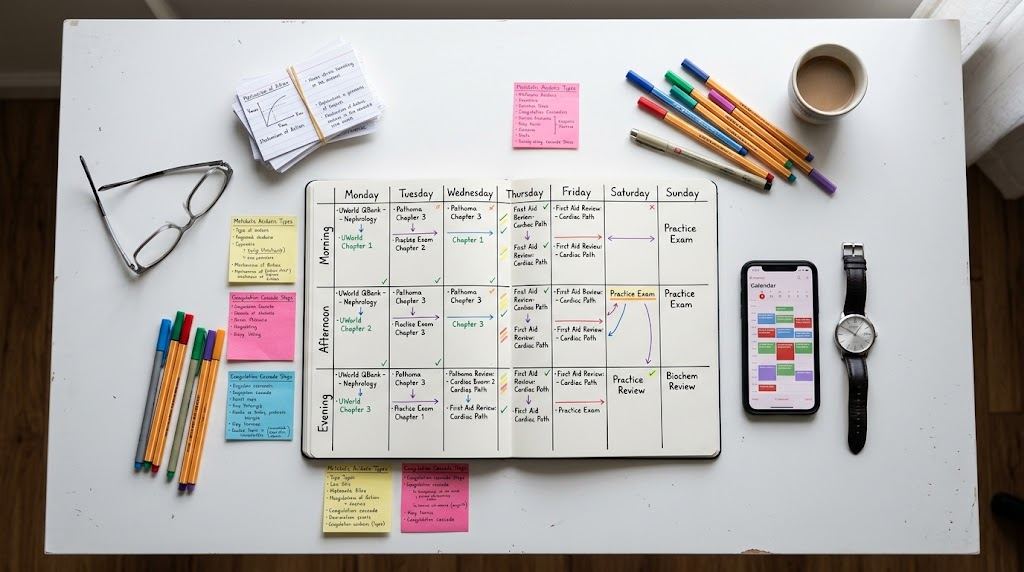
8 Hour Study Day
| Time | Activity |
|---|---|
| 8:00 to 9:30 | UWorld block, timed |
| 9:30 to 11:00 | Review that block |
| 11:00 to 11:30 | Break |
| 11:30 to 1:00 | Content review on weak topics |
| 1:00 to 2:00 | Lunch |
| 2:00 to 3:30 | UWorld block |
| 3:30 to 5:00 | Review that block |
10 Hour Study Day
| Time | Activity |
|---|---|
| 7:30 to 9:30 | UWorld block, timed |
| 9:30 to 11:00 | Review that block |
| 11:00 to 11:30 | Break |
| 11:30 to 1:00 | Content review on weak topics |
| 1:00 to 2:00 | Lunch |
| 2:00 to 3:30 | UWorld block |
| 3:30 to 4:30 | Review that block |
| 4:30 to 5:30 | Break, exercise if possible |
| 5:30 to 7:00 | Weak topic review, Anki if used |
| 7:00 onward | Dinner, light or no studying, real sleep |
Don’t treat either as gospel. If you’re sharper at night than in the morning, flip it. The point isn’t the exact clock times. It’s alternating focused question practice with genuine review and genuine rest, instead of sitting at a desk for 12 hours and calling it studying.
How Many UWorld Questions Should You Do Per Day?
There’s no single magic number, but here’s how the common ranges tend to play out within a 1 month Step 1 study plan:

- 40 questions a day suits someone still building comfort with timed blocks or balancing heavy content review alongside questions.
- 60 questions a day is a common middle ground for people with some UWorld experience already.
- 80 questions a day works for students who are mostly consolidating known material rather than learning it for the first time.
- 100+ questions a day is rarely worth it in a one month plan unless review time doesn’t suffer as a result, which for most people it does.
Timed mode over tutor mode is worth defaulting to, since the real exam doesn’t pause between questions. Mixing random blocks with system based ones, rather than sticking to only one style, also mirrors the actual exam more closely than either extreme.
What matters more than the count is what you do afterward. A 40 question block reviewed carefully, reading every explanation even for questions you got right, beats an 80 question block you rush through and barely look at again.
How to Use First Aid, UWorld, Anki, Pathoma and Sketchy in One Month
| Resource | Primary Purpose | How to Use It in 4 Weeks |
|---|---|---|
| UWorld | Question practice and learning | Daily, timed blocks |
| First Aid | Consolidation and annotation | Cross reference after each block |
| Pathoma | Pathology depth | Weak topics only |
| Sketchy | Micro and pharm memorization | Weak, memorization heavy areas only |
| Anki | Spaced repetition | Existing cards only, avoid starting a new deck |
| NBME | Assessment | Scheduled checkpoints, not random |
| Free 120 | Final readiness check | Near the end, with review time after |
3 Month Step 1 Study Plan
Not everyone belongs in a 1 month Step 1 study plan, and the timelines below exist for exactly that reason. A three month timeline gives you room to actually build content knowledge before shifting into pure practice and review.
Month 1: Foundation. Work through First Aid systematically alongside a first UWorld pass, organized by system. This is where you close genuine content gaps rather than just refreshing what you already know.
Month 2: Integration. Shift toward mixed UWorld blocks, revisit incorrect questions, and start layering in Anki if it fits your style. This is also a good point for a mid course NBME to check whether month 1 actually stuck.
Month 3: Dedicated Review. Move to random, timed UWorld blocks, focus heavily on weak areas identified by NBMEs, and finish with the Free 120 in the final week.
2 Month USMLE Step 1 Study Plan
An eight week timeline sits between the intensity of a one month plan and the depth of a three month plan.
Weeks 1 and 2: Foundation. Baseline assessment, then systematic content review paired with daily UWorld questions.
Weeks 3 and 4: Systems. Organ system based review, layering pathology, pharmacology and physiology together rather than separately.
Weeks 5 and 6: Mixed UWorld. Random blocks, timed mode, active error logging.
Weeks 7 and 8: Final Review. NBME checkpoints, high yield consolidation, and the Free 120 in the last few days.
6 Week Step 1 Study Schedule
Week 1: Diagnostic and weak areas. Baseline NBME, then prioritize whatever it flags.
Weeks 2 and 3: Core content. System based review with daily question practice.
Week 4: Integration. Mixed subject review, connecting pharmacology, pathology and physiology within each system.
Week 5: Mixed questions. Random, timed UWorld blocks and a second NBME.
Week 6: Final review. High yield consolidation, incorrect question review, and the Free 120 with a few days to spare.
6 Month Study Plan for USMLE Step 1
A six month timeline usually runs alongside ongoing coursework rather than as a fully dedicated block.
Months 1 and 2: Foundation. Slow, steady content review paired with your regular coursework, plus light UWorld exposure to get comfortable with the question style early.
Months 3 and 4: Systems and Qbank. Heavier UWorld volume, organized by system, with periodic NBMEs to track trends over time rather than reacting to any single score.
Month 5: Dedicated Preparation. This is closer to the intensity of a one month plan, shifting to mixed blocks and targeted weak area review.
Month 6: Final Review. High yield consolidation, incorrect question review, and the Free 120 in the final stretch before the exam.
Step 1 Study Schedule Template
Here’s a copyable weekly template you can adapt to your own subjects and pace:
| Day | Content Focus | Questions | Review Time | Anki |
|---|---|---|---|---|
| Monday | Cardiovascular | 60 | 2 hours | 30 minutes |
| Tuesday | Renal | 60 | 2 hours | 30 minutes |
| Wednesday | Gastrointestinal | 80 | 2.5 hours | 30 minutes |
| Thursday | Endocrine | 60 | 2 hours | 30 minutes |
| Friday | Mixed review | 60 | 2 hours | 30 minutes |
| Saturday | Weak topic focus | 40 | 1.5 hours | 20 minutes |
| Sunday | Light review or rest | 0 to 20 | 1 hour | Optional |
Swap in whatever systems your own NBME breakdown flags as priorities, and adjust the question counts to whatever range you settled on above.
What to Do If You’re Falling Behind on Your 1 Month Step 1 Study Plan
Falling a day or two behind in week one is normal and not worth losing sleep over. Build a little slack into the plan rather than treating every day as non negotiable. If you’re a full week behind by the start of week three, the honest move is to cut scope rather than cut sleep. Narrow your remaining content review to your weakest two or three systems and let lower yield topics go. A plan that covers 80 percent of the material well beats one that covers all of it in a fog of exhaustion. A lot of this comes down to how you handle pressure in the first place, and this piece on reducing exam stress through better preparation covers that side of things in more depth.
What Not to Do When You Fall Behind
- Don’t double your daily question count overnight to catch up
- Don’t eliminate sleep to buy extra study hours
- Don’t add three or four new resources hoping one of them fixes things
- Don’t restart First Aid from page one
- Don’t try to master every low yield topic on your list before moving on
What If My NBME Score Isn’t Improving?
This happens, and it doesn’t automatically mean the exam should be delayed. Instead of reacting to the overall number, use it to figure out what’s actually going wrong:
- Low content knowledge in specific areas points to more targeted content review, not a general redo of everything.
- Missing questions you understand the content for often points to question interpretation, meaning more time spent reading vignettes carefully rather than more content review.
- Running out of time on blocks points to practicing in strict timed mode rather than tutor mode.
- Careless mistakes on questions you clearly know points to slowing down and keeping an error log to spot the pattern.
- One or two systems consistently dragging the score down points to a dedicated half day on those systems rather than another scattered review session.
If your UWorld percentage and your NBME performance are telling very different stories, double check that you’re doing UWorld in timed, exam like conditions. The habits you build in practice tend to show up on test day.
Common 1 Month Step 1 Study Plan Mistakes
A few patterns show up again and again in people who struggle with a compressed timeline:
- Watching videos or lectures passively for hours without corresponding question practice
- Postponing UWorld until content review is finished, which rarely happens in a month
- Skipping the review of incorrect questions because it feels less productive than answering new ones
- Switching resources every few days instead of committing to one primary Qbank and one primary text
- Trying to complete every available resource instead of picking what actually helps
- Starting a brand new Anki deck from scratch this late in the process
- Watching entire video courses instead of using them for targeted weak topics
- Measuring progress only by UWorld percentage while ignoring NBME trends
- Taking practice exams without properly reviewing them afterward
- Studying 12 to 14 hours a day with declining concentration rather than fewer hours with real focus
- Sacrificing sleep repeatedly, which quietly erodes retention more than most people realize
None of these are dramatic mistakes on their own. They’re habits that compound over four weeks into a plan that looks busy but isn’t actually working.
Which Step 1 Study Schedule Fits You?
| Timeline | Best Fit |
|---|---|
| 1 month | Strong existing foundation, able to study intensively most days |
| 6 weeks | Moderate content gaps, wants more buffer for review |
| 2 months | Needs a full content pass plus dedicated question practice |
| 3 months | Building foundational knowledge alongside exam prep |
| 6 months | Studying in parallel with ongoing coursework |
If you’re not sure which bucket you’re in, the NBME’s own self assessment tools are generally considered a more reliable gauge than a forum thread, since they come directly from the organization that administers the exam. Whichever timeline you land on, this roundup of study tools for students is worth a look before you finalize your resource list.
Frequently Asked Questions
Is a 1 month Step 1 study plan realistic for everyone?
No. A 1 month Step 1 study plan works best for students who already have a solid foundation and can study intensively most days. Students with major content gaps are usually better served by a longer timeline like 6 weeks, 2 months, or 3 months.
Is one month enough to study for USMLE Step 1?
For students with a solid existing foundation and the ability to study intensively most days, yes. For students starting with major content gaps, a longer runway is usually the safer choice.
How many hours a day should I study?
Most people do well with 8 to 10 focused hours, split between question practice and review. More hours logged at a desk doesn’t automatically mean more retained.
How many UWorld questions should I do per day?
Somewhere between 40 and 80 questions in timed blocks works for most one month plans, provided every question gets reviewed thoroughly afterward.
Can I pass Step 1 in 4 weeks?
It’s possible for students who already have a strong content foundation and treat the month as consolidation rather than first time learning. It’s much harder for students starting close to zero.
Should I use UWorld or First Aid first each day?
Doing UWorld first and using First Aid to fill gaps tends to work better in a compressed timeline than reading First Aid cover to cover before touching questions.
How many NBMEs should I take before Step 1?
There’s no official requirement, but many one month plans work well with two to three checkpoints: an early baseline, a mid plan check in, and the Free 120 near the end.
When should I take the Free 120?
With two or three days left before the exam, leaving enough time to review what it flags rather than taking it the day before.
Is 6 weeks enough for Step 1?
For many students with a moderate foundation, yes, and it offers more buffer than a strict one month timeline.
Is 2 months enough for Step 1?
Generally yes for students who need a full content review pass alongside dedicated question practice.
What should I do if my NBME score isn’t improving?
Look at which systems are flat rather than the overall number, and give your two or three weakest systems focused attention rather than spreading review evenly across everything.
Can I study for Step 1 while still in medical school?
Yes, and a 6 month plan is generally built around exactly that, with lighter early months and a heavier dedicated stretch closer to the exam.
Is a longer study plan always better than one month?
Not automatically. A well run one month plan for someone with a strong foundation often outperforms a poorly structured three month plan for the same person. The timeline matters less than how deliberately you use it.
Final Takeaway
A 1 month Step 1 study plan isn’t magic, and it isn’t for everyone. But run with real structure, daily question practice, honest self assessment, and a review habit you actually stick to, and four weeks is enough time to walk into that exam prepared, not just exhausted.