
If you want to know how to memorize vocabulary and actually keep it past the weekend, the honest answer is that it’s less about willpower and more about sequence. Learn a small batch properly, put each word inside a real sentence, test yourself instead of rereading, and come back to it on a schedule instead of once and never again. Everything below fills in the detail, including a few parts most guides skip entirely, like what to do when a word simply refuses to stick.
Most people don’t have a bad memory. They have a method that was never designed to hold onto anything. Reading a list five times in a row feels productive, but it mostly builds familiarity, not memory, which is exactly why you can recognize a word on a page and still go blank trying to say it out loud.
How to Memorize Vocabulary: Why You Keep Forgetting New Words
There’s a real difference between recognizing a word, recalling it, and actually using it, and most study methods only ever train the first one.
- Recognition: “I’ve seen this word before.” This is what rereading a list gives you.
- Recall: “I can produce the word when I need it,” without the answer sitting in front of you.
- Usage: “I can use it correctly, in a sentence, without stopping to think about it.”
Each stage needs a different kind of practice. Flashcards and active recall build the second stage. Writing, speaking, and real conversation build the third. Reread your list only, and you get stuck permanently at the first one, which is a frustrating place to be, because it feels like you’ve “learned” the word right up until the moment you need it.
A few habits quietly work against people who are otherwise trying hard: learning 30+ words in one sitting instead of a manageable batch, memorizing a translation with no sentence attached, rereading instead of testing, learning a word once and never using it again, cramming right before a test and dropping it the next day, and treating nouns as the priority when small connecting words — because, although, still, almost — usually matter more early on. You can point at a chair to communicate “chair.” You can’t point at “although.”
The Core Method: How to Memorize Vocabulary Words Properly
Keep the batch small. Beginners: 5–10 new words a day. More experienced learners can comfortably handle 10–20 or more. There’s no universal number here — your review load matters far more than how many new words you add on any given day.
Choose words with a reason to exist in your life. Vocabulary tied to your job, your hobbies, or an actual upcoming conversation sticks, because your brain has a use for it.
Skip the mental detour of translating. Define “abundant” as “a lot of something” instead of routing it through your native language every time.
Write your own sentence, not the textbook’s. “She was reluctant to speak up because she’d forgotten her notes” beats “reluctant = unwilling,” because it’s specific and it’s yours.
Check the spelling, too. A word can sound familiar while its written form still trips you up. After learning it, try writing it from memory instead of just copying it off the screen.
Say it out loud — and hear it at natural speed, too. A word isn’t fully yours if you recognize it on paper but freeze the moment someone says it quickly in conversation.
Test before you check the answer. Cover the definition. Ask yourself what the word means before you look. That small moment of effortful struggle, even when you get it wrong, is what actually cements a word.
Not every word deserves the same amount of time, either. A common, easy word might only need a couple of passes. A long, abstract, unfamiliar-sounding word might genuinely need an example sentence, an association, and several separate recall attempts before it settles.
Build a Vocabulary List Your Brain Can Actually Handle
How you arrange a list matters almost as much as what’s on it, and this is where most study guides go wrong.
Textbook chapters group words by topic — five emotions in a row, six kitchen items in a row. It looks tidy, but each word actually loses some of its individual pull when it’s crowded by four near-identical neighbours. Mixing things up works better: a new word, then one you half-know, then something unrelated, then a word you’re confident about. The lack of a tidy theme isn’t a flaw — it keeps each word distinct enough to actually latch onto instead of blurring into its neighbours.
Let a stubborn word repeat, too. If a word refuses to stick, put it on your list twice, or carry it into tomorrow’s list as well. And don’t make every word brand new — mixing in a few words you already know gives you quick wins as you go, which makes the harder ones easier to sit with.
This is really a quantity-versus-quality trade-off, and the honest answer is you need a bit of both. Going too slow, trying to nail every word “properly” before moving on, means you cover almost nothing. Going too fast with zero structure means nothing sticks. The sweet spot is a reasonably sized, mixed, slightly redundant list you revisit, not a perfectly organized one you only look at once.
How to Easily Memorize Vocabulary Words Using Associations
Some words won’t stick through repetition alone, usually the long, abstract ones, or anything with no equivalent shape in your first language. A small mental image or a slightly absurd mini-story earns its keep here. Picture someone checking a spreadsheet for the fourth time, adjusting one decimal point nobody else would notice — that’s “meticulous,” and that tiny scene does more work than ten repeats of the definition.
Word families and roots stretch this further. Learn “decide” and you more or less get “decision,” “decisive,” and “decisively” for free, because they share a root with different endings attached. The same goes for “create” → “creation” → “creative” → “creatively.” Understanding a handful of common prefixes and suffixes — un-, re-, -tion, -able — often lets you guess a brand-new word’s meaning before you’ve even looked it up. For quick reference on a word’s exact form and usage, a solid learner’s Cambridge Dictionary entry is usually more reliable than a random search result.
Synonyms and antonyms round this out. “Happy” connects to “delighted,” “cheerful,” “joyful” on one side and “miserable,” “unhappy” on the other. These small webs give your brain more than one route back to a word, so if one path fades, another usually doesn’t.
The Keyword Method: Turning Difficult Words Into Mental Hooks
This deserves its own mention because it’s one of the most effective tricks for the words that just won’t sit still in your memory. The idea is simple: connect an unfamiliar word to something that already sounds familiar, then build a small, slightly ridiculous image around it.
Take “gregarious,” meaning sociable, outgoing, comfortable in groups. It sounds a bit like “gregarious → a great, gorgeous crowd.” Picture someone at a big, loud party, moving easily from group to group, clearly in their element. That absurd little scene will outlast a dozen readings of “gregarious: fond of company.”
This works best on abstract or unusual words — the ones that don’t have an obvious image already attached, like most concrete nouns do. It’s not worth the effort for a simple word like “table” or “run,” where the meaning is already immediate. Save the keyword method for the words that keep slipping away no matter how many times you’ve reviewed them; it’s a targeted tool, not a default habit for every entry on your list.
Learn Phrases, Not Just Isolated Words
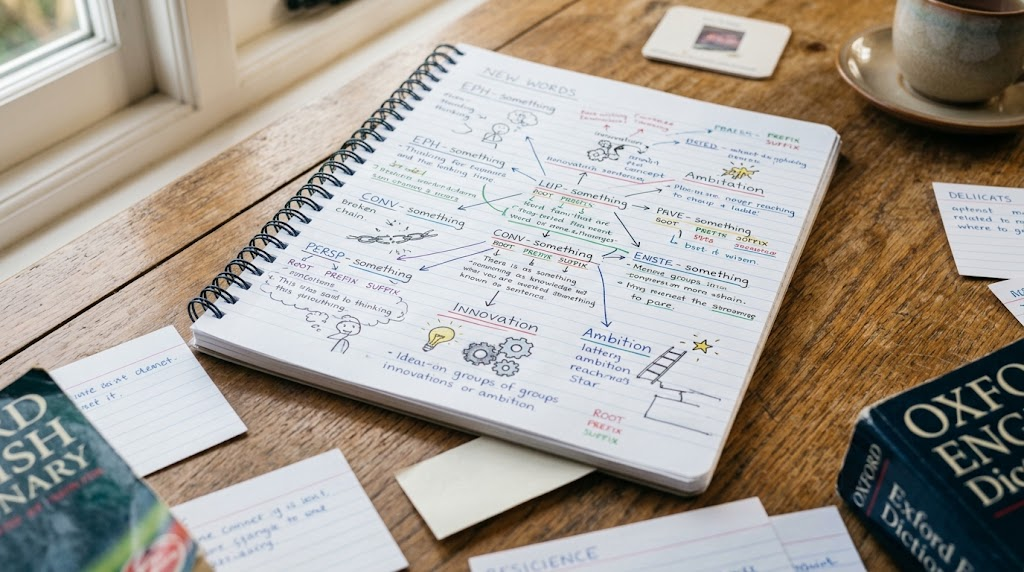
Native speakers rarely use a word by itself — they reach for it glued to specific other words, in combinations called collocations. It’s “make a decision,” not “do a decision.” It’s “reach an agreement,” “deeply concerned,” “highly unlikely.” Learn “decision” alone and you’re stuck guessing which verb belongs next to it. Learn the phrase, and the grammar comes bundled in.
This matters even more with phrasal verbs, where the meaning shifts entirely depending on what follows the verb. “Find out,” “give up,” “look after,” “run into,” and “carry on” are each their own unit of meaning; memorizing “find” and “out” separately tells you almost nothing about what “find out” actually means. The same logic applies to fixed pairings like “depend on” or “interested in” — learning the preposition attached to a word saves you from a whole category of small, persistent mistakes later.
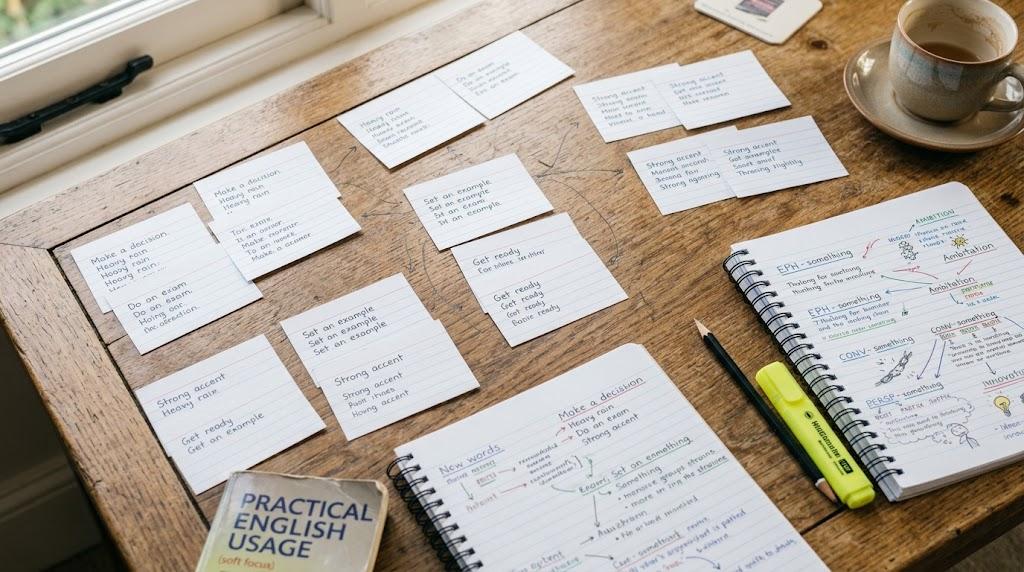
Worth a quick mention too: false friends and easily confused pairs — affect/effect, accept/except, advice/advise. These trip up learners at every level, not just beginners, and a short sentence contrasting each pair is usually all it takes to keep them straight. If you’re building study material for a class, our guide on key academic vocabulary definitions is a useful companion for subject-specific terms.
Active Recall vs. Spaced Repetition: They’re Not the Same Thing
These two get mentioned together so often that people assume they’re one technique. They’re not. Active recall is about how you review — you try to retrieve the answer before you see it, rather than passively rereading it. Spaced repetition is about when you review — you leave gradually increasing gaps between sessions instead of cramming everything into one sitting. Used together, they cover both the “how” and the “when,” which is why they’re consistently the two most effective habits in vocabulary study, and why memory researchers keep coming back to them; the American Psychological Association’s overview of memory is a good starting point if you want the research behind why spacing works so well.
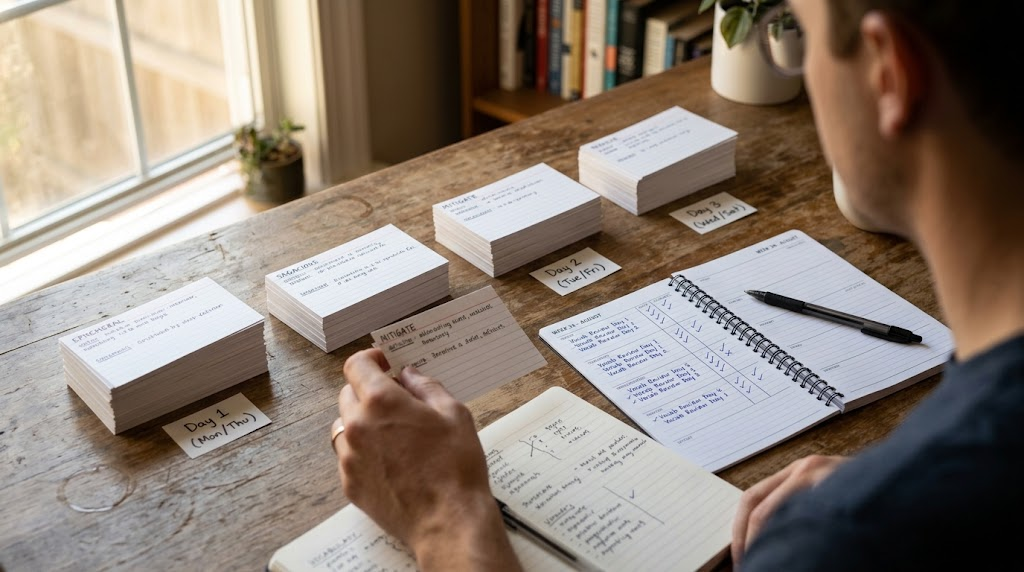
A reasonable review schedule looks like this: first review 10–15 minutes after you first meet the word, second review the next day, third review three days later, fourth about a week later, and a fifth two to three weeks out. Treat this as a sample starting point, not a fixed formula — adjust it once you notice which words you personally forget fast and which stick on the first pass.
What to Do When a Word Keeps Slipping Away
Some words are just stubborn. That’s normal, and forgetting one isn’t a sign you’re bad at this. If you always review a word while you still remember it easily, you’re mostly just confirming familiarity. The reviews where you struggle a little before retrieving the answer are usually the ones that actually move a word into long-term memory, so a bit of forgetting along the way isn’t failure — it’s part of the process.
If a word has slipped three or four times in a row, don’t just stare at it harder. Change the connection instead: build a slightly ridiculous mental image around it, write a genuinely personal sentence, find a common phrase that contains it, link it to a word you already know well, say it out loud a few times, or try using it in an actual conversation. Put it back into tomorrow’s review instead of today’s, or look for it again in a different article, video, or conversation.
And sometimes the right move is simply to leave it alone for a few days and come back later. Ten frustrated minutes fighting one word usually isn’t worth more than learning five other useful ones in that same time.
How to Memorize Vocabulary Fast Without Burning Out
“Fast” doesn’t mean cramming a hundred words tonight and forgetting ninety by Friday. A version that fits into about fifteen minutes: review yesterday’s words with quick recall and no notes, learn five new words with a plain-English meaning and one example sentence each, write your own sentence for each pulling from something in your actual day, cover the definitions and test yourself on all five, then say each word out loud in a sentence before you close the notebook.
Do that daily, keep reviewing older words on the spaced schedule above, and within a couple of weeks words start showing up in your own speech without you consciously reaching for them.
Don’t chain yourself to a strict daily quota, though. A fixed number every single day sounds disciplined, but vocabulary learning doesn’t run on a schedule that predictable — some days ten words sink in easily, other days two feel like a struggle. Missing a day and beating yourself up over a broken streak causes more people to quit than an actually slow week ever does.
How to Memorize Vocabulary Through Real Exposure
Deliberate list-work gets a word into short-term memory. Repeated, real-world exposure is what makes it permanent. Keep a dictionary or translation app handy, note down new words wherever you actually run into them — an article, a conversation, a show — and let the same word resurface naturally across different contexts over the following days.
Books, podcasts, and shows at your level do something list-based study can’t: they let a word you’ve already studied appear again in a slightly different setting each time, until it stops feeling memorized and starts feeling normal. Sticky notes on real objects work on the same principle, though it’s worth putting a verb on the note rather than just the noun — “open,” “close,” “turn on” teaches you more than another label for “fridge.” If you enjoy learning through play, our piece on daily word games and cognitive skills covers a lighter way to fold in extra exposure between formal study sessions.
Turning Recognized Words Into Words You Actually Use
A lot of learners get stuck at one stage: they recognize hundreds of words while reading, but only comfortably produce a small fraction in conversation. That gap between passive and active vocabulary closes through deliberate use, not more studying — writing a short paragraph with five recent words on purpose, choosing a new word over a simpler one even when it feels forced, or narrating your day in your head with vocabulary you just learned.
It’s worth remembering, too, that “knowing” a word isn’t one single thing — it has depth. You can recognize “reluctant” when reading, know its basic meaning, know how to pronounce it, know a common phrase it appears in, understand it when someone says it out loud, and finally use it yourself without thinking — six different levels of knowing the same word. Most vocabulary study stops at the first two. Aiming for the last one is what actually makes a word yours.

How to Tell If You Actually Know a Word
It’s easy to assume a word is “learned” just because it looks familiar. A quick, honest check is more useful. You probably know a word for real if you can explain its meaning without looking, recognize it when someone says it at natural speed, pronounce it correctly yourself, build your own sentence with it on the spot, use it with the right preposition or collocation, recognize its related forms (like “decide” and “decision”), and still use it naturally a few days later without having reviewed it that same day. If a word fails two or three of those checks, it’s not done yet — send it back through review rather than crossing it off your list.
The Vocabulary Learning Cycle
Put together, the stages above form a loop rather than a one-time event: notice a useful word, understand its meaning and basic usage, connect it to a sentence or image or word family, retrieve it without looking, use it in speech or writing, meet it again in a different context, review it after a delay, and eventually stop consciously remembering it at all — you just know it. A word that skips straight from “looked up” to “memorized” without passing through connection, retrieval, and use rarely survives past the first week.
Common Vocabulary Memorization Mistakes
Learning too many words at once wastes effort — ten done properly beats forty done badly. Rereading instead of testing builds familiarity, not memory. Memorizing only a translation leaves out meaning, usage, and pronunciation. Skipping pronunciation means a word rarely gets used out loud. Never reviewing old words lets vocabulary quietly disappear, even after you were sure you’d learned it. And setting a rigid daily quota creates pressure, which is usually what makes people quit.
FAQ
How can I memorize vocabulary quickly?
Learn a small batch at a time, study each word inside a full sentence rather than alone, test yourself instead of rereading, and review on a spaced schedule instead of just once.
How many vocabulary words should I learn a day?
There’s no fixed number — beginners often start with 5–10, more experienced learners can handle more, but your review load matters more than how many new words you add.
What’s the difference between active recall and spaced repetition?
Active recall is how you review — trying to retrieve the word before checking the answer. Spaced repetition is when you review — spacing sessions out over increasing gaps. They work best together.
Is it better to memorize single words or full phrases?
Phrases, where you can. They come with grammar and natural usage already built in, which a lone word never does.
Why do I keep forgetting vocabulary after studying it?
Usually because you’re rereading instead of testing yourself, or you’re not coming back to the word again after the first time you learned it. Forgetting a word once or twice isn’t failure — struggling a little before you retrieve it is often what makes the next review stick.
The Bottom Line
There’s no shortcut that skips the effort entirely, but there is a version of studying vocabulary that respects your time and doesn’t leave you burnt out after a week: small, mixed lists instead of rigid themed ones, sentences instead of bare definitions, pronunciation and spelling built in from the start, active recall paired with spaced review, and a plan for the words that just won’t stick the first few times. That’s really the whole answer to how to memorize vocabulary in a way that lasts. Do it consistently for a couple of weeks, and words stop being things you “sort of remember.” They just start showing up, unprompted, exactly when you need them.