

If your school report card shows a single digit instead of a percentage or a letter, you’re probably dealing with a 6 point grading scale. It’s more common than most people realize — plenty of schools, and even some universities abroad, grade this way instead of the usual A-through-F system.
In this guide, we’ll break down what each number actually means, show you the full chart with percentages and GPA equivalents, walk through how to convert a score by hand, and cover where this scale shows up around the world.
Quick Answer
| Grade | Percentage | Meaning | Passing? |
| 1 | 93–100% | Excellent | Yes |
| 2 | 85–92% | Good | Yes |
| 3 | 77–84% | Above Average | Yes |
| 4 | 70–76% | Average | Yes |
| 5 | 60–69% | Below Average | Depends on school |
| 6 | Below 60% | Failing | No |
Note: Exact cutoffs vary by institution. The table above reflects a standard conversion template, but your specific school or curriculum might shift these numbers slightly.
What Is a 6 Point Grading Scale?

A 6 point grading scale grades student work on a numbered scale from 1 to 6, where each number stands in for a performance level instead of a letter or a straight percentage.
The direction of the scale depends heavily on where you live:
- The Reversed Scale: Some schools flip the direction — 1 as the top grade, 6 as the bottom — which is common in Germany and parts of Europe.
- The Standard Scale: Others run it the opposite way, with 6 as the best possible score, which shows up more often in US homeschool curricula and standards-based grading systems.
Why do schools bother with this instead of just using percentages? It’s faster to grade against a short rubric, it reduces the temptation to argue over a single percentage point, and it maps cleanly onto competency-based teaching, where the goal is showing whether a student “meets,” “exceeds,” or “doesn’t yet meet” a standard.
How Does the 6 Point Grading Scale Work?
Each number on the scale typically corresponds to a description of performance rather than a raw score. A common US version — the kind you’ll see in standards-based classrooms and some homeschool programs like Abeka — looks roughly like this:
- 6 – Exceptional, mastery well beyond the standard
- 5 – Proficient, meets the standard fully
- 4 – Approaching proficiency, close to the standard
- 3 – Developing, partial understanding
- 2 – Beginning, limited understanding
- 1 – No evidence of understanding
Meanwhile, the German-style version most international students encounter runs the other direction — 1 is sehr gut (very good) and 6 is ungenügend (insufficient). Same idea, opposite numbering. That’s the single biggest source of confusion with a 6 point grading scale: you genuinely can’t assume which direction it runs until you check the school’s own key.
6 Point Grading Scale Chart
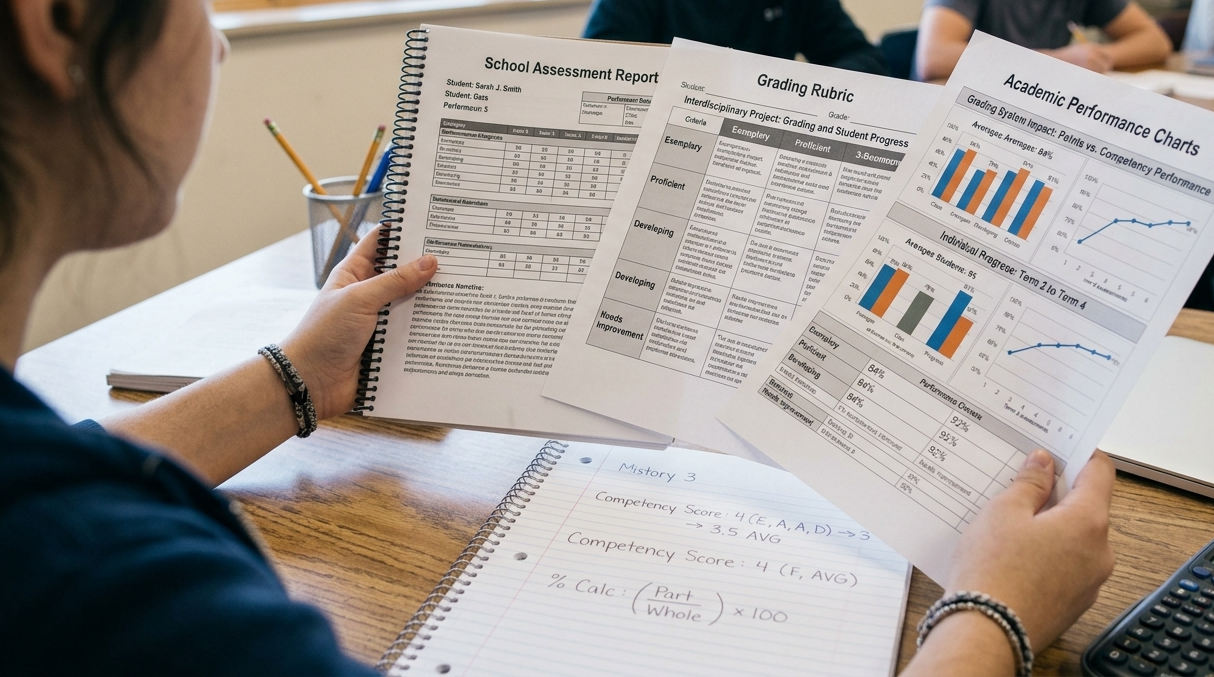
Here’s a fuller breakdown, using the version where a higher number is better — the format most US teachers and homeschool programs default to:
| Score | Percentage | Letter Grade | Description | GPA Equivalent |
| 6 | 93–100% | A | Excellent / Mastery | 4.0 |
| 5 | 85–92% | B | Good / Proficient | 3.0–3.7 |
| 4 | 77–84% | C | Satisfactory | 2.0–2.7 |
| 3 | 70–76% | D | Below Average | 1.0–1.7 |
| 2 | 60–69% | D- | Minimal | 0.7 |
| 1 | Below 60% | F | Failing | 0.0 |
Some programs shift these cutoffs slightly — Abeka’s version, for example, tends to set its passing line a bit differently than a public-school standards-based rubric would. If your child’s report card doesn’t quite match the numbers above, that’s normal; always check the specific key your school publishes rather than assuming one universal standard applies.
6 Point Grading Scale Percentages
Breaking each score down individually reveals the typical performance bands:
- Score of 6 usually lands in the 93–100% range — top-tier work, no real gaps.
- Score of 5 covers roughly 85–92% — solid, proficient work with only minor errors.
- Score of 4 sits around 77–84% — decent grasp of the material, but noticeable room to improve.
- Score of 3 falls near 70–76% — the material is only partially understood.
- Score of 2 drops to about 60–69% — significant gaps in understanding.
- Score of 1 means below 60% — essentially, the standard wasn’t met.
If you’re trying to reverse-engineer this from an existing percentage grade — say your child brought home an 82% and you want to know where that lands on the 6-point key — the fastest way is running it through a calculator rather than eyeballing a chart. It’s a similar situation to converting something like 16 out of 20 into a percentage — the number itself doesn’t tell you much until you know which scale your school is actually using.
6 Point Grading Scale Calculator
The math behind converting to and from a 6 point grading scale is pretty simple once you see it laid out:
- To convert a percentage to a 6-point score: Find where the percentage falls in the chart above, and match it to the corresponding number.
- To convert a 6-point score back to a percentage: Take the midpoint of that score’s range. A score of 5 (85–92%) would typically be reported as roughly 88–89% if a percentage equivalent is needed for a transcript.
Worked Example: A student scores an 84% on a test. Looking at the chart, that falls in the 77–84% band, which lands them a 4 on the 6-point scale — a solid “satisfactory” result.
Doing this repeatedly across a stack of assignments gets old fast, especially once you’re averaging multiple scores together.
To make your conversions effortless, you can use the dynamic interactive tool below. Simply pick your scale direction, input your raw score, and instantly view your calculated letter grade and percentage range.
If you’re combining several assignments with different weights — like homework, quizzes, and a final exam — our dedicated weighted grade calculator handles that math for you automatically, ensuring your final average stays perfectly accurate.
How to Convert a 6 Point Grading Scale
Here are the standard conversions to keep in mind when tracking scores:
- 6 → Percentage: Roughly 93–100%, depending on the exact scale in use.
- 6 → GPA: Typically a 4.0 on a standard US scale, though some schools cap it slightly lower.
- 6 → Letter Grade: Usually an A, occasionally an A- if the school’s cutoffs run stricter.
The trickiest part isn’t the math — it’s confirming which direction your specific school’s 6 point grading scale runs before you convert anything. A “6” on a German report card and a “6” on a US standards-based rubric mean completely opposite things.
6 Point vs 10 Point Grading Scale
| Feature | 6 Point Scale | 10 Point Scale |
| Range | 1–6 | 0–100 (grouped in 10s) |
| Precision | Lower — broad performance bands | Higher — finer distinctions |
| Common Use | Standards-based grading, international systems | Most US public schools and universities |
| Best For | Competency-based assessment | Traditional percentage grading |
The 10 point scale (the familiar A=90-100, B=80-89 setup) gives more granularity, which is why most US schools default to it. A 6 point scale trades that precision for simplicity — useful when the goal is communicating whether a student met a standard, not pinpointing an exact percentage.
6 Point vs 7 Point Grading Scale
A 7 point scale simply adds one more tier, often used to separate “exceeds expectations” from “exceptional” at the top end, or to add a distinct “does not meet standard” category at the bottom. Functionally, it behaves the same as the 6 point version — just with slightly finer bands. If your school uses a 7 point system instead, the conversion logic above still applies; you’ll just have one extra row in your tracking sheet.
Universities and Schools That Use a 6 Point Scale

This isn’t just a US homeschool thing — a 6 point grading scale shows up in a handful of education systems worldwide:
- Germany: Uses a 6-point scale in primary and lower secondary education, running from 1 (sehr gut) to 6 (ungenügend). Upper secondary students later transition to a 15-point Abitur scale, making the 6-point system a stepping stone.
- Sweden: Has used variations of point-based grading in different eras of its education system, though the modern layout has since moved toward letter-based grades.
- International Schools: Many adopt a 6-point rubric specifically for standards-based report cards, separate from whatever scale the local public system uses.
- US Homeschool Curricula: Abeka, among others, uses its own version of a 6-point structure for younger grades before shifting to traditional percentage grading in higher levels.
It’s worth noting that university-level grading is an entirely different animal. For instance, the University of Canterbury’s published grading scale runs on an 11-point letter system rather than a plain 1–6 scale — a good reminder that “6 point” scales are mostly a K-12 phenomenon rather than a global university standard.
Abeka 6 Point Grading Scale
Abeka, a popular homeschool curriculum provider, uses its own version of a 6-point grading key for certain grade levels. The exact cutoffs can shift depending on the specific course and grade level. If you are using Abeka materials, the safest move is checking the answer key or teacher’s edition that came with your specific curriculum set rather than assuming it matches a general public school chart.
Advantages and Disadvantages
Advantages
- Faster to Grade: Less back-and-forth over minor one or two percentage points.
- Clearer for Younger Students: Easier to interpret (“a 5 means you did well”).
- Aligned to Standards: Fits naturally with standards-based and competency-based teaching models.
Disadvantages
- Less Precision: Lacks the fine detail of a full 100-point percentage system.
- Cross-Border Confusion: Confusing when comparing across schools or countries that number the scale backwards.
- Transcript Friction: Harder to convert cleanly for college applications, which typically expect a standard GPA or letter grade.
Real-World Examples
- Elementary Homework: A student scores a 5 on a standards-based writing rubric — proficient, meeting grade-level expectations perfectly.
- Middle School Science Quiz: A 4 out of 6 — decent understanding, but a few concepts still need review before the unit test.
- German Primary School Report Card: A 2 (gut) — the second-highest possible mark, translating to “good” performance.
- Homeschool Assessment (Abeka-style): A 6 on a spelling test — full marks, zero errors.
Frequently Asked Questions
What is a 6 point grading scale?
It’s a grading system that scores work on a scale of 1 to 6 instead of a percentage or A–F letter, with each number representing a specific performance level.
Is a 6 point grading scale higher or lower than a 10-point scale?
Neither — they measure different things. A 10-point scale usually refers to percentage bands (90–100, 80–89, etc.), while a 6-point scale uses a much smaller range of whole numbers.
What is a B on a 6 point grading scale?
Typically a score of 5, corresponding to roughly 85–92%, though this varies depending on your school’s custom settings.
Is a 6 point grading scale used in college?
Rarely. Most colleges and universities use a 4.0 GPA scale or letter grades, though some international institutions use their own point-based metrics.
How do you convert a 6 point grading scale to a percentage?
Match the score to its percentage band on the chart — a 6 typically equals 93–100%, a 5 equals 85–92%, and so on.
What does 5.6 on a 7 point grading scale equal?
On a 7-point scale, a 5.6 generally falls in the upper-middle range, roughly equivalent to a B or B+, though exact cutoffs depend on the specific school’s key.
Why do some schools use a 6 point scale instead of percentages?
It is faster to grade, reduces disputes over single points, and aligns well with standards-based or competency-based assessment models.
Is a 6.0 GPA good?
On most US 4.0-based systems, a 6.0 isn’t a standard GPA value. It usually points to a weighted scale (common for AP/honors courses) where a 6.0 represents an exceptionally high, near-perfect weighted average.
How rare is a 6.0 GPA?
Very rare. Hitting the top of a weighted 6.0 scale means earning straight A’s in the most heavily weighted advanced courses available, which only a small percentage of students achieve.
What is the 6 scale grading system used for?
Mostly K-12 standards-based grading, certain homeschool curricula, and primary/lower-secondary education in countries like Germany.
Conclusion
A 6 point grading scale isn’t complicated once you know which direction it runs and what each number actually stands for. However, it does require checking your specific school’s key rather than assuming one universal chart applies everywhere. Whether you’re translating an Abeka report card, a German school grade, or a standards-based rubric back into a familiar percentage, the same logic holds: match the score to its band, then convert from there.