

Business intelligence in education is no longer something reserved for large universities with complex analytics departments. Over time, it has quietly made its way into small private schools, community colleges, and district-level offices. Not because it sounds innovative, but because many institutions are exhausted by guesswork.
At its core, business intelligence in education involves collecting data from different systems, organizing it, and using it to guide decisions that directly affect students, staff, and operations. Attendance records, enrollment trends, assessment scores, budget data, faculty workload reports—all of this information already exists. The real difference lies in whether it is being viewed in a structured, connected way.
For years, many education leaders relied heavily on experience and intuition. Experience still matters. But as budgets tighten and accountability grows, intuition alone begins to feel risky. That is usually when dashboards, reports, and structured analytics enter the conversation.
Key Applications and Benefits of Business Intelligence in Education
Student Performance Tracking
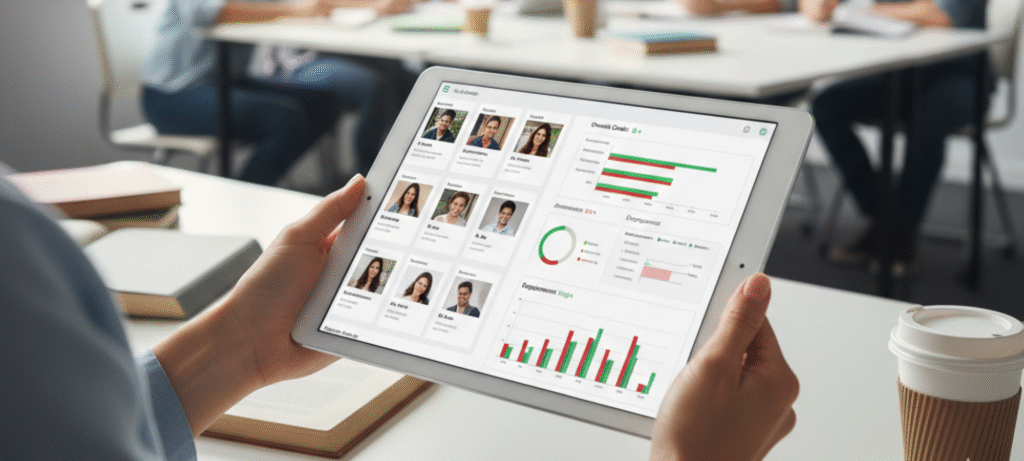
One of the most immediate benefits of business intelligence in education is improved visibility into student progress. Instead of waiting for end-of-term outcomes, institutions can monitor engagement patterns, attendance consistency, grade trends, and behavioral indicators as they happen.
In practice, this allows schools to identify at-risk students weeks earlier than before. That time difference is critical. Early intervention is rarely dramatic. More often, it looks like a timely conversation, a tutoring adjustment, or a schedule change. Small actions, applied early, tend to matter most.
Operational Efficiency
Education systems are complex organizations. Enrollment impacts staffing. Staffing affects budgets. Budgets determine which programs survive.
When administrators can analyze enrollment forecasts, class-size ratios, and resource allocation in one place, decisions become less reactive. Patterns emerge. Underutilized programs become visible. Overextended departments stand out. Planning replaces scrambling.
Enhanced Decision Making
Moving away from assumptions can feel uncomfortable. In some cases, data challenges long-held beliefs. But structured reporting changes how decisions are discussed.
Curriculum planning, hiring, and long-term strategy begin to rely less on opinion and more on visible evidence. Meetings shift in tone. Conversations become more focused, less personal, and easier to resolve.
Compliance and Reporting
Schools and universities must report to regulators, accreditation bodies, and funding agencies. Manually producing compliance reports is time-consuming and error-prone.
Business intelligence systems automate recurring reports, track grant requirements, and monitor faculty ratios. This reduces administrative workload and lowers stress during audits, while improving accuracy.
Predictive Analytics

When historical data is organized properly, forecasting becomes possible. Institutions can anticipate enrollment shifts, budget cycles, and retention trends before they occur.
Predictive models do not remove uncertainty. But they reduce blind spots. Leaders can test scenarios before committing resources, rather than reacting after problems surface.
How Business Intelligence in Education Works in Practice
The term sounds technical, but the concept is practical. Business intelligence connects systems that already exist.
Student Information Systems, Learning Management Systems, financial platforms, and HR databases each hold part of the institutional story. Business intelligence tools bring those fragments together and present them through dashboards designed for decision-makers.
Common platforms used in education include Microsoft Power BI, Tableau, Google Data Studio, and SPSS. Each serves different needs depending on institutional scale and technical capacity.
Institutions such as Western Governors University often discuss how data-driven reporting supports institutional planning. Research communities like ResearchGate regularly publish studies examining how analytics influence higher education strategy. The discussion has moved well beyond theory.
Business Intelligence in Higher Education
Universities often adopt business intelligence earlier than smaller institutions because their data environments are more fragmented. Admissions teams track applicant funnels. Finance teams manage grant spending. Academic departments analyze course completion rates.
Without integration, leaders see isolated snapshots. With business intelligence in higher education, patterns become visible. Correlations emerge between first-year engagement and long-term retention. Financial aid adjustments can be linked to enrollment yield. These insights shape high-stakes decisions.
Implementation, however, is rarely smooth. Data quality issues surface quickly. Inconsistent naming, duplicate records, and missing data force institutions to confront long-standing data hygiene problems. That process alone can be transformative.
Use of Business Intelligence and Data Analytics in Education
The use of business intelligence and data analytics in education extends beyond dashboards. It influences teaching, program design, and institutional accountability.
Faculty review assessment trends across cohorts and adjust pacing. Program directors compare outcomes across campuses. Deans evaluate which initiatives produce measurable improvement.
There is also tension. Some educators worry about over-quantifying learning. Not everything meaningful fits neatly into a chart. That concern is valid. Business intelligence should support professional judgment, not replace it. Data highlights patterns. Interpretation remains human.
Connection to Professional Development and Certification
As institutions adopt analytics systems, skill gaps become visible. Administrators pursue training in reporting, compliance, and data interpretation.
Some explore programs like Appraisal Continuing Education Indiana when working within regulatory frameworks tied to state oversight. Although the field is specific, the underlying principle is the same. Structured continuing education depends on reliable reporting systems.
Similarly, emerging credential pathways such as Online Environmental Education Certificates rely on enrollment analytics and outcome tracking. Certificate programs must demonstrate value to remain sustainable, and business intelligence supports that transparency.
Challenges Institutions Rarely Discuss
Implementing business intelligence in education is as much cultural as it is technical. Faculty may feel monitored. Staff may worry that inefficiencies will be exposed.
Leadership must communicate intent clearly. Data should support improvement, not surveillance.
Cost remains a barrier. Enterprise tools require licensing, training, and maintenance. Smaller institutions often begin with spreadsheets before scaling. That gradual approach works, but without planning, it can lead to fragmented systems.
Data privacy is non-negotiable. Student records are sensitive. Compliance with data protection laws must evolve alongside analytics capability.
People Also Ask
What Are the Four Pillars of Business Intelligence?
The four commonly referenced pillars are data collection, data storage, data analysis, and data visualization. In education, this translates to gathering information from multiple systems, structuring it, analyzing trends, and presenting insights through dashboards.
How Is Business Intelligence Used in Education?
Business intelligence in education supports student performance tracking, enrollment forecasting, budget management, compliance reporting, and curriculum planning by connecting academic and administrative data.
Which Degree Is Best for Business Intelligence?
Degrees in data analytics, information systems, statistics, or computer science are common pathways. In education settings, leadership backgrounds combined with data literacy are especially valuable.
Is Business Intelligence the Same as Data Analytics?
They overlap but are not identical. Data analytics focuses on examining datasets. Business intelligence includes the systems and processes that deliver insights to decision-makers in usable formats.
FAQs
Is Business Intelligence Suitable for Small Schools?
Yes. Smaller schools often begin with limited dashboards focused on attendance or academic performance. Systems can expand gradually as needs grow.
Does Business Intelligence Replace Academic Judgment?
No. It provides structured evidence. Educators still interpret context, student backgrounds, and qualitative factors.
How Long Does Implementation Take?
Institutions with clean data systems may deploy dashboards within months. Others require extended data cleanup before meaningful insights appear.
What Skills Are Needed to Manage BI in Education?
Data literacy, visualization skills, operational understanding, and communication are essential. Technical knowledge matters, but translating insights into action matters more.
Final Thought
Business intelligence in education is neither a miracle cure nor a passing trend. It reflects a shift in how institutions relate to information they have always collected.
Some schools embrace that shift quickly. Others move cautiously. Most land somewhere in between. Data can illuminate blind spots, but it can also reveal uncomfortable truths about equity, resource allocation, or outcomes.
The real question may not be whether institutions should adopt business intelligence, but whether they are prepared to respond honestly to what the data shows once they do.