

If you run a SaaS platform and you’re evaluating embedded lending, the first question isn’t “what is embedded lending” — you already know that. The real question is: which features actually matter when you’re picking an API, and which ones are just marketing copy?
The key features of an embedded lending API for SaaS include automated underwriting, white-label UI components, built-in KYC and AML compliance, open banking integration, flexible repayment structures, and developer-friendly documentation. But knowing the list isn’t enough. Knowing what to look for inside each feature — and what separates a production-ready API from one that causes problems six months in — is where the real evaluation happens.
This guide covers exactly that. No definitions you didn’t need. Just the features, what they should actually do, and the questions you should ask every vendor before you sign anything.
What Is an Embedded Lending API for SaaS?

An embedded lending API lets a SaaS platform offer loans directly inside its product — without building financial infrastructure from scratch. The API handles origination, underwriting, compliance, servicing, and repayment. The platform embeds the experience natively so users never leave the dashboard they already work in.
The SaaS platform brings the data, the user relationships, and the distribution. The API brings the lending infrastructure. Both sides benefit. The platform earns origination fees or revenue share. Users get faster, more contextual access to capital than any bank can offer.
SaaS platforms across eCommerce, accounting software, POS systems, logistics, and healthcare are already doing this. The infrastructure is available. The question is which embedded lending API is actually built to support it properly.
Why SaaS Platforms Add Embedded Lending
Three reasons drive most decisions here.
Retention. A user with an active loan balance on your platform is not switching to a competitor. The financial relationship creates stickiness that features alone cannot match.
Revenue. Origination fees, interest spread participation, and revenue sharing arrangements generate income that compounds with loan volume. It’s a meaningful diversification of the subscription model.
Data advantage. SaaS platforms already hold transaction histories, invoice records, and operational data that traditional banks cannot access. That data makes underwriting faster and more accurate — which means better approval rates and lower default risk.
This is the same underlying logic that drives platforms to add non-core revenue lines through other channels. Platforms that understand how to use existing user relationships to generate new revenue streams — whether through affiliate marketing native ads or embedded financial products — are consistently outperforming single-revenue-model competitors.
Core Features of an Embedded Lending API for SaaS
1. Automated Underwriting With Real-Time Data
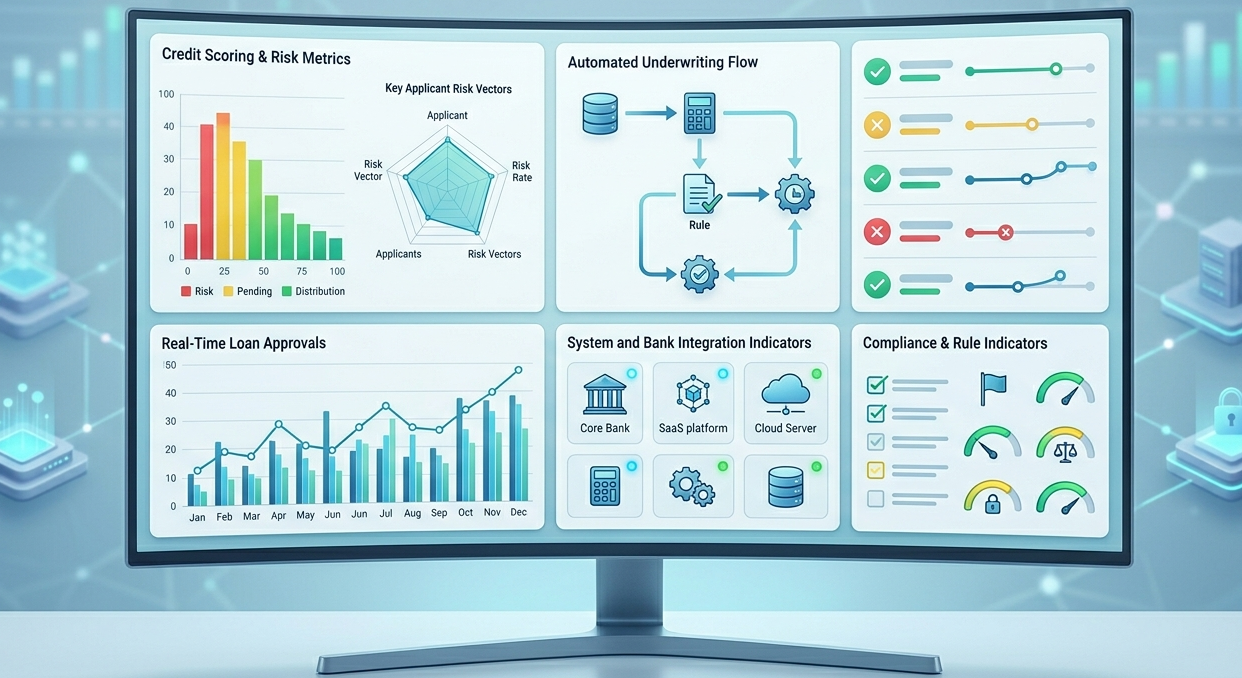
The most important feature in any embedded lending API for SaaS is automated underwriting that uses platform-native data.
Manual document uploads, credit bureau-only scoring, or 24-hour review cycles are not embedded lending. They are traditional lending with an API wrapper. The entire value of embedding lending inside a SaaS product comes from the fact that the platform already has the financial data needed to make accurate credit decisions instantly.
A proper underwriting engine pulls transaction history, revenue trends, invoice payment patterns, and cash flow signals directly from the SaaS platform. It runs algorithmic scoring in real time. Standard applications should get decisions in seconds.
The best APIs also support alternative credit scoring models that use behavioral and operational signals — customer retention rates, payment velocity, platform usage patterns — in addition to traditional financial data. This expands the addressable borrower pool and improves accuracy for business segments that traditional credit scoring consistently misprices.
2. White-Label UI Components and Branded Lending Flows
Every part of the lending experience — loan offer display, application form, e-signature screen, borrower dashboard — needs to be fully white-labeled and match your platform’s design system.
Partial white-labeling, where the vendor’s brand appears at any point in the flow, creates a trust gap at a critical financial decision moment. Drop-off rates at unexpected third-party brand appearances are measurable and significant.
Look for modular SDKs that let your frontend team embed components without heavy custom development. Customizable logos, color tokens, typography, and messaging throughout the entire journey. The credit experience should feel like it was built by your product team, not bolted on from outside.
3. Built-In KYC and AML Compliance
Compliance is not optional and it is not something the SaaS platform should be managing manually.
Know Your Customer verification, Anti-Money Laundering monitoring, sanctions screening, and jurisdiction-appropriate disclosure generation are legal requirements in every regulated lending market. An embedded lending API for SaaS that leaves any of this to the platform team is creating compliance exposure that can become serious quickly.
What built-in compliance actually looks like: automated identity verification at the point of application running in the background, ongoing AML transaction monitoring, dynamic disclosure generation that produces correct terms based on loan type, amount, and borrower geography, and documented audit trails for every compliance check.
Ask vendors directly which jurisdictions they are licensed in, who holds the lending license, and what their process is when regulatory requirements change. These questions should get specific, documented answers.
4. Open Banking Integration
Internal platform data is strong for established users. For newer accounts or businesses with limited transaction history on the platform, open banking fills the gap.
Direct API connections to bank accounts — Plaid in North America, TrueLayer across Europe, regional equivalents elsewhere — pull verified income data, cash flow patterns, and account balance history with borrower consent in seconds. No document uploads. No manual verification.
This directly affects underwriting coverage. Platforms without open banking integration approve a smaller percentage of their user base. Platforms with it underwrite more borrowers accurately, which expands loan volume and revenue.
5. Real-Time Decision Engine
Loan decisions should be fast. An applicant who waits 24 hours has already looked at alternatives.
The decision engine should handle standard applications automatically with clear, documented criteria. But transparency matters as much as speed. The platform needs visibility into why decisions are made — what signals triggered approval, what caused a decline, what the risk model is actually evaluating.
Black-box decisioning creates problems when users dispute outcomes, when approval rates shift unexpectedly, or when a regulator asks questions. Understand the logic before you integrate.
6. Flexible Repayment Structures
Fixed monthly installments work for some borrowers. Revenue-based repayment — where a percentage of daily or weekly sales is collected until the loan is repaid — works better for businesses with variable or seasonal cash flow.
An embedded lending API for SaaS should support multiple repayment models natively. Installment loans, revenue-based financing, BNPL structures, and hybrid arrangements. The more flexibility the repayment layer offers, the larger the addressable market and the better the default performance across different borrower profiles.
Auto-debit integration with existing payment settlement flows is essential. Manual repayment collection creates reconciliation problems. Automatic deduction from the settlement stream the platform already processes removes that entirely.
7. Loan Servicing APIs
This is where most embedded lending API comparisons stop short — and where a lot of integrations run into problems.
Loan servicing covers everything after origination: payment processing, schedule tracking, early repayment handling, delinquency management, statement generation, dispute resolution. It runs for the entire loan term, which can be 12 to 24 months.
If the servicing layer doesn’t expose real-time data to the platform — current balance, next payment date, payment history, days past due, payoff amount — the borrower experience degrades after the initial loan is funded. Users who can’t see their loan status inside the platform they use daily become frustrated, and that frustration lands on the SaaS product, not the underlying lender.
Real-time servicing APIs are non-negotiable for any platform that wants the lending experience to remain high-quality across the full loan lifecycle.
8. Embedded Borrower Dashboard
The borrower should be able to manage their loan without leaving your platform.
Pre-built, white-labeled dashboard components showing active loans, repayment schedules, payment history, available refinancing, and payoff options. Fully embeddable. No redirecting users to an external portal.
Borrowers who manage their loan inside the product they use daily have materially lower delinquency rates and higher repeat borrowing rates. The dashboard is not cosmetic — it directly affects portfolio performance.
9. Webhooks and Real-Time Event Notifications
Every meaningful loan lifecycle event should fire a webhook to your system: application submitted, decision made, loan funded, payment processed, payment failed, delinquency triggered, loan repaid.
Your platform needs to receive these in real time to update records, trigger user notifications, and flag accounts that need attention. Polling is not a substitute.
Evaluate webhook reliability carefully in sandbox before committing. Check delivery order, retry behavior, duplicate handling, and what happens when your endpoint is temporarily unavailable. Webhook bugs discovered in production at scale are genuinely painful to resolve.
10. Developer-First Documentation and Sandbox Environment
The documentation quality predicts the integration experience better than any sales demo.
What strong documentation looks like: complete REST API reference with working code examples in multiple languages, an interactive sandbox that mirrors production behavior closely, Postman collections, clear error codes with remediation guidance, SDK support for your team’s primary languages, and a changelog that reflects how the API evolves.
Spend twenty minutes in the developer docs before any other evaluation step. If finding the webhook reference or understanding the authentication flow requires a support ticket, that friction is a preview of what the full integration will feel like.
11. Bank-Level Security and Data Encryption
AES-256 encryption at rest and in transit. SOC 2 Type II certification — treat this as a hard requirement. PCI DSS compliance where payment card data is involved. GDPR for European borrowers. CCPA for California. Tokenized data handling throughout so sensitive financial data is never exposed in plaintext.
Ask three specific questions of every vendor: where is data stored geographically, who has internal access to it, and what is the data handling process if the integration terminates. Specific written answers. Vague responses are meaningful information.
12. Analytics and Loan Performance Reporting
The lending program is generating revenue. The reporting should reflect that with clarity.
Approval rates by user segment. Average loan size and origination volume. Portfolio delinquency and default rates. Revenue earned through fees and spreads. Breakdowns by loan type, repayment structure, and time period.
Without this data the platform is running a financial product without the visibility needed to optimize it — or to make the case internally or to investors for expanding it.
13. API Scalability and Uptime
Lending APIs that degrade under load or experience downtime create financial product reliability problems that are very hard to explain to users mid-application.
Read SLA terms carefully and compare them against actual historical uptime data from the vendor’s status page. Contractual 99.9% uptime still allows 8.7 hours of potential downtime per year. Understand incident escalation procedures. Confirm rate limit structures so you know what happens under peak transaction volumes.
14. Multi-Currency and Multi-Jurisdiction Support
If the platform operates across multiple markets, evaluate global support early — not after initial integration is complete.
Multi-currency origination, jurisdiction-specific compliance configurations, localized disclosure templates, region-appropriate underwriting models. These are architectural considerations that are significantly harder to add post-integration than to confirm upfront.
15. Revenue Sharing and Monetization Terms
Know exactly how the platform makes money before signing.
Origination fee percentage per funded loan. Interest spread participation. Flat referral fee per disbursement. Ongoing income across the loan term. Model these against realistic loan volume projections before committing to an integration investment.
Revenue sharing terms should be documented, clearly defined, and not subject to unilateral change by the vendor. This is the commercial foundation of the entire program and deserves the same scrutiny as any other business contract.
Embedded Lending API Architecture Overview
Understanding the stack helps when evaluating vendors and scoping integration work.
The frontend layer consists of embeddable UI components — offer widgets, application flows, borrower dashboards — sitting inside the SaaS platform. The API gateway handles authentication, rate limiting, and request routing. The underwriting engine processes platform data and open banking inputs to produce credit decisions. The banking integration layer manages loan funding and repayment settlement. The servicing engine handles the post-origination lifecycle. The compliance layer runs KYC, AML, and disclosure generation throughout.
Each layer should expose clean, documented APIs with full platform visibility. Any layer that operates as a black box introduces operational risk that shows up at the worst time.
How to Choose the Right Embedded Lending API for SaaS
Use this checklist when comparing providers side by side.
Does underwriting use platform-native data or primarily external credit bureaus? What repayment models are supported natively? Is white-labeling complete or partial? What compliance certifications are current and verifiable? Which jurisdictions and currencies are actively supported today? What does the developer sandbox actually include? How are webhooks delivered, retried, and logged? What does the revenue sharing model look like against your projected volumes? What is the contractual SLA and what does the historical uptime record show?
Vendors who answer these questions clearly and in writing move forward. Vendors who are vague or promise to follow up with detail deserve more scrutiny, not less.
SaaS Use Cases for Embedded Lending
eCommerce platforms offering merchant cash advances against monthly sales volume. Accounting and ERP software offering working capital tied to verified invoice data. POS systems funding same-day advances based on the transaction record already inside the platform. Healthcare practice management tools offering patient financing at the point of care scheduling. Logistics platforms advancing payment to carriers against confirmed load records. B2B marketplaces offering trade credit to buyers based on order history.
The pattern is consistent: the SaaS platform already holds the financial data, the user already trusts the product, and the loan appears at a contextually appropriate moment in the workflow. Expanding platform capabilities through well-chosen API integrations — whether for lending features or other product buildouts — follows the same strategic logic as evaluating outsourcing SaaS development for non-core infrastructure. The question is always which approach gets you to market fastest with the lowest long-term technical and compliance risk.
Common Challenges to Plan For
Default risk is real. Aggressive promotion of lending products to users who are not strong credit candidates creates portfolio problems. Good underwriting helps but platform marketing decisions matter too.
Compliance failures carry serious consequences. A missed KYC check or a disclosure generated for the wrong jurisdiction is regulatory exposure. Evaluate the compliance layer of any embedded lending API with the same rigor you apply to everything else.
Integration timelines are consistently underestimated. Production integration with real data, edge cases, high transaction volumes, and proper staging environments takes longer than sandbox demos suggest. Build a realistic schedule with buffer for testing and staged rollout.
Future of Embedded Lending APIs in SaaS
Underwriting models are improving significantly. AI-driven risk assessment using non-traditional signals — customer retention metrics, product engagement patterns, supplier network stability — is producing more accurate pricing for business segments that traditional credit scoring misvalues.
Real-time contextual lending is becoming standard. Capital offered and disbursed within minutes of a triggering event inside the SaaS workflow — a confirmed purchase order, a completed delivery, a signed contract — rather than a separate application flow the user navigates to.
For a foundational overview of the embedded lending landscape, Stripe’s embedded lending guide covers the category clearly. For the regulatory compliance side, the CFPB’s digital financial products guidance outlines the framework any serious embedded lending integration needs to account for.
Final Thoughts
The key features of an embedded lending API for SaaS are not complicated to list. Automated underwriting, white-label UX, compliance infrastructure, open banking, flexible repayment, real-time servicing, developer tooling, security, analytics, and clear monetization terms. The list is not the hard part.
The hard part is evaluating those features with enough depth to know which vendors actually deliver them in production — and which ones look good in a demo and create problems six months after launch.
Treat this as a product decision, not just a technical integration. The platforms that get embedded lending right are the ones that ask hard questions early.