If you’ve started searching for online needlepoint classes, you’ve probably noticed the real problem isn’t finding one. It’s figuring out which type actually fits how you learn. A free YouTube video is a completely different experience from a live Zoom class with a kit mailed to your door, and picking the wrong format is usually why people quit after one canvas.
This guide compares the formats, explains what needlepoint actually involves, breaks down realistic price ranges, and gives you a simple plan for your first month of stitching.
What Is Needlepoint?
Needlepoint is a form of canvas-based needlework, where thread is stitched through a stiff, open-weave canvas rather than worked freely on fabric the way surface embroidery is. Most designs are built from a simple diagonal stitch called the tent stitch, with color changes doing most of the work of creating the picture. It’s traditionally used for things like pillows, ornaments, eyeglass cases, and upholstery, and it’s actually one of the oldest forms of canvas work, with roots going back thousands of years. If you want more on how the technique and materials developed over time, Britannica’s overview of needlepoint is a solid starting point.
Online Needlepoint Classes: What You’ll Actually Learn
A good class does more than film someone stitching. It should walk you through the materials, show you how to hold and work the canvas, and teach you (this is the part beginners often underrate) how to start and end your thread without a visible knot. That’s usually the part that trips people up longest.
Most courses start with the tent stitch, then branch into half-cross, continental, and basketweave (also called diagonal tent). A solid beginner class usually covers:
- Reading a needlepoint canvas
- Choosing the right tapestry needle
- Picking thread that suits your canvas
- Anchoring and ending thread cleanly
- Keeping tension even across a row
- Switching colors without a mess on the back
- Fixing the mistakes almost everyone makes early on
- Basic blocking and finishing
You don’t need a class that throws two dozen stitches at you in week one. A handful learned properly beats a long list learned badly.
How to Do Needlepoint: Beginner Basics
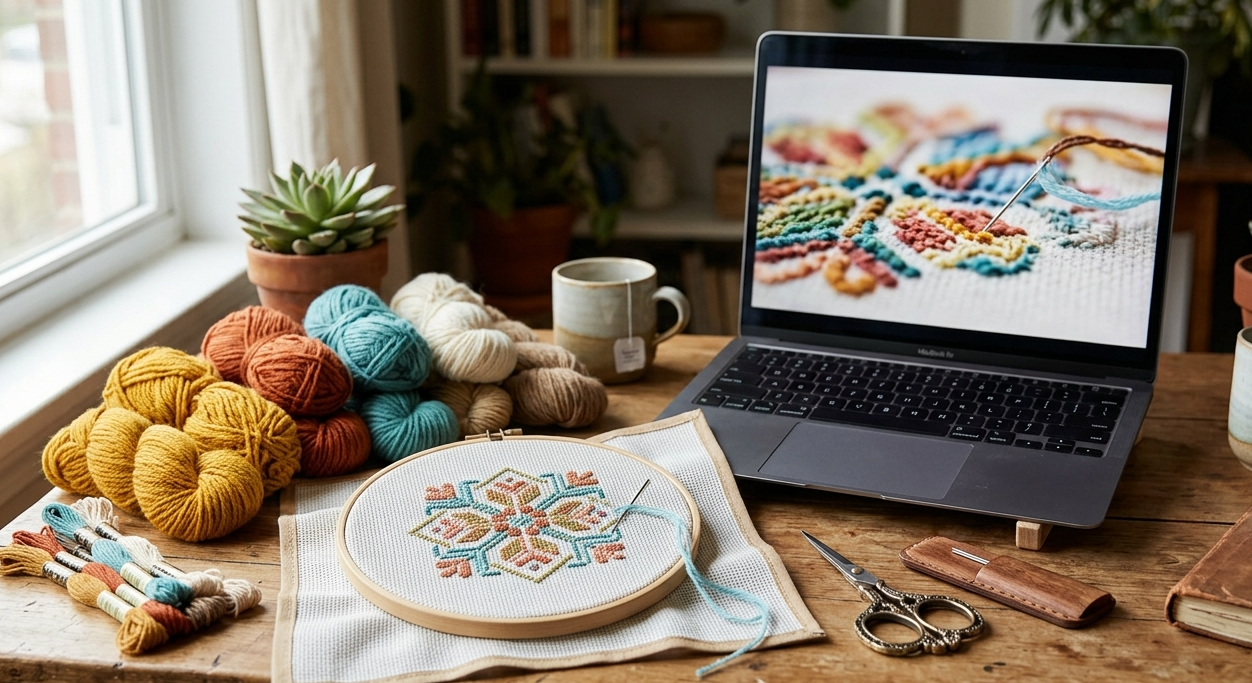
If you’re wondering how to do needlepoint before you’ve even picked a class, here’s the short version. You’ll need a canvas, a tapestry needle, and thread sized to your canvas mesh. Thread is anchored on the back with a short tail held in place by your first few stitches, no knots involved. The basic tent stitch is worked as a small diagonal stitch across one intersection of canvas threads, and it’s the stitch nearly every beginner project is built around. Once that feels natural, continental and basketweave are variations on the same movement that add durability and reduce canvas distortion.
For needlepoint for beginners specifically, the goal in the first few sessions isn’t speed or a finished piece. It’s getting your hands used to consistent tension and stitch direction, since that’s what makes a finished canvas look clean rather than uneven.
Needlepoint Classes Online: Which Format Is Right for You?
Not every online course works the same way, and the format matters more than most people assume before they buy.
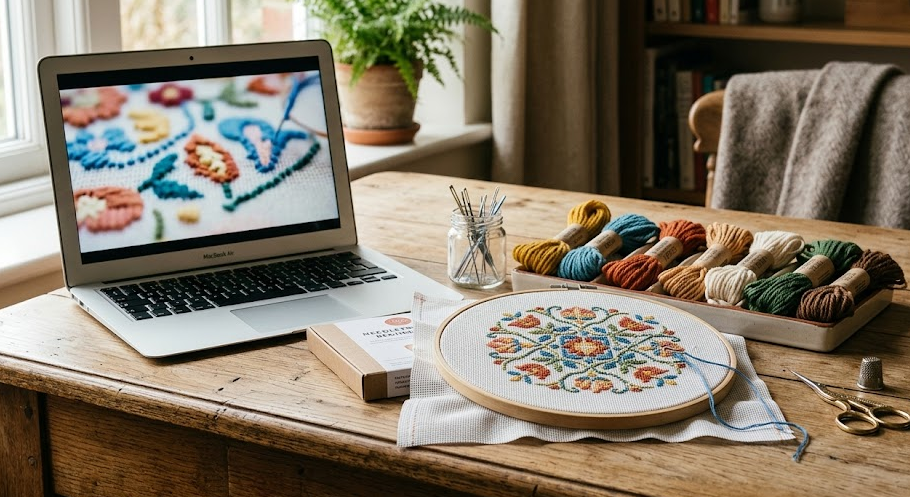
Self-paced classes are pre-recorded, so you can pause mid-stitch and rewatch a section as many times as you need. That matters more in needlepoint than in most hobbies. You’re not just watching, you’re trying to match your hands to what’s on screen. If your schedule is unpredictable, this usually works best.
Live virtual classes let an instructor actually see your canvas and tell you what’s going wrong in real time. That kind of feedback is hard to replace, especially once you’ve got the basics down and want to fix a specific habit, like uneven tension.
Kit-included classes ship you canvas, thread, and a needle along with the lessons. This solves the biggest beginner headache, figuring out what to buy, because the materials are already matched to the pattern.
Free tutorials cost nothing and cover the basics well, but you’re piecing together your own progression instead of following a structured one. Fine for testing the hobby, less fine if you want a clear path.
| Class Type | Best For | Instructor Feedback | Materials Included | Typical Cost |
|---|---|---|---|---|
| Free videos | Testing the hobby | No | No | Free |
| Self-paced course | Flexible learners | Usually no | Sometimes | Low–medium |
| Live virtual class | Beginners who want help | Yes | Sometimes | Medium–high |
| Kit-based class | Complete beginners | Depends on class | Yes | Medium–high |
| Advanced workshop | Experienced stitchers | Often yes | Varies | Medium–high |
Online Needlepoint Classes for Beginners
Needlepoint breaks down into small, learnable pieces more easily than most crafts, which is part of why it works so well as a first-time online hobby. A reasonable order to learn in looks like this:
- Get familiar with the materials
- Learn how the canvas is structured
- Thread and anchor your needle
- Practice a basic tent stitch
- Learn to end a thread cleanly
- Practice switching colors
- Try continental or basketweave
- Finish one small project
- Move into decorative stitches once that feels natural
Start small. A key fob, a small ornament, or a design with only two or three colors gives you enough practice without burning you out before you’ve finished.
Best Online Needlepoint Classes for Different Learners
There’s no single “best” online needlepoint class. The right one depends on how you learn and what you already know. Rather than pointing you at one specific provider (offerings, prices, and availability change often enough that a name-and-price table here would likely be outdated by the time you read it), here’s how to match the format to your situation:
Best for complete beginners: a kit-included, self-paced course. You get materials matched to the lesson and can move at your own speed while you’re still learning basic hand movements.
Best for independent learners: free video tutorials, especially if you already know you learn well from watching and repeating without much structure.
Best for people who need feedback: a small live virtual class. Being able to show your canvas to an instructor mid-stitch fixes problems faster than any recorded lesson can.
Best for a low-commitment first try: a single free tutorial series covering just the tent stitch. If you enjoy it, upgrade to something more structured.
Best for experienced stitchers: specialized live or self-paced workshops focused on a single technique (beading, shading, or a specific decorative stitch) rather than another general beginner course.
Best for finishing: a dedicated finishing class, taken only after you’ve completed at least one or two stitched projects (more on this below).
When you’re actually comparing specific classes, search current listings directly and check the class description for skill level, format, and what’s included, since that information changes often enough that it’s worth confirming at the time you enroll rather than relying on a snapshot from months ago.
Are There Free Online Needlepoint Classes?
Yes. YouTube and similar platforms have plenty of free demonstrations covering materials, the tent stitch, and individual techniques. What free resources usually lack is structure. You might learn one stitch here and a different technique somewhere else without a clear progression. If you’re mainly trying to figure out whether needlepoint is for you before spending anything, free tutorials are genuinely enough to start.
Can Adults Learn Needlepoint Online?
Yes, and adult learners often do well with online needlepoint classes, since the whole thing depends on patience and repeated fine-motor practice rather than a classroom pace. If you’re picking this up as an adult rather than following a school-style curriculum, it helps to know that self-directed, video-based learning works differently for grown-ups than it does for kids, and a few practical notes on how adults learn best online can help you pick a format that actually sticks instead of one you abandon after a week.
How Much Do Online Needlepoint Classes Cost?
Prices vary a lot by format, and they shift often enough that you should always check the current listing rather than rely on any number printed in an article. As a rough guide:
| Format | Approximate Range | What You’re Paying For |
|---|---|---|
| Free tutorials | $0 | Video only, no feedback |
| Beginner self-paced course | Low, one-time fee | Structured lessons, no live contact |
| Live virtual class | Moderate | Instructor interaction, real-time feedback |
| Kit + class | Moderate to higher | Canvas, thread, needle, plus instruction |
| Advanced project workshop | Higher | Specialized instruction and a bigger project |
A useful way to think about it: $0 gets you information but no structure. A low-cost self-paced course gets you structured beginner instruction. Paying more usually buys live feedback, included materials, or both, and that’s worth it if you’ve tried free resources and stalled out, not necessarily if you’re still deciding whether you’ll stick with the hobby.
What Supplies Do You Actually Need?
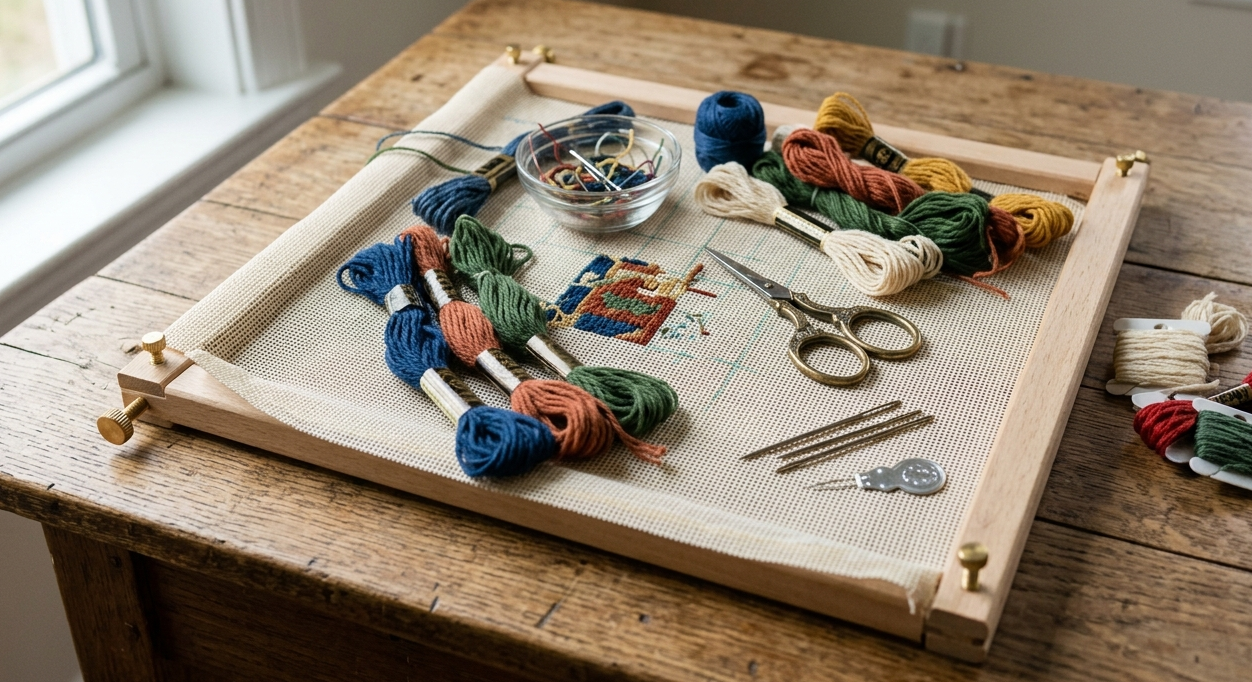
Less than you’d think. For a first project you’ll need a canvas, a tapestry needle, appropriate thread, small scissors, and a frame or hoop if your canvas calls for one. If you’re using a kit-based class, most of these decisions are already made for you, which is one reason kits are such a low-stress entry point for a first project.
How to Choose the Right Online Needlepoint Class
The most expensive class isn’t automatically the best one. A few things matter more than price:
- Skill level match. A class labeled “advanced” often assumes you already know the fundamentals, so look for one that spells out exactly what it covers.
- Teaching format. Recorded lessons you can replay, or a live instructor you can ask questions. Neither is universally better; it’s about how you learn.
- What’s included. Some classes are video-only, others ship a full kit. Compare total cost, not just the sticker price.
- Project difficulty. A first project with a dozen colors and three specialty stitches is a red flag for a beginner course.
- Instructor background. Shop owners, designers, and long-time stitchers tend to bring practical knowledge a generic script doesn’t.
- Reviews and access terms. Check how long you keep access to a self-paced course and whether there’s a refund policy before you buy.
Criteria Worth Checking Before You Enroll
When evaluating online needlepoint classes, the criteria that matter most are beginner suitability, how the lessons are structured, whether you get any instructor access, what materials are included, how difficult the first project is, the price relative to what’s included, and whether finishing instruction is part of the package or a separate purchase. Run any class you’re considering through that list before you buy.
How Long Does It Take to Learn Needlepoint?
There’s no fixed timeline, but a beginner can typically get comfortable with the basic tent stitch and steady tension after a few sessions of regular practice, and finish a small first project within a month. Some other skills people pick up as adults take much longer to feel natural, like certain instruments and languages, but needlepoint has a fairly short runway from “never touched a canvas” to “finished something you’re proud of,” mainly because the core movement doesn’t change much between projects.
Online Needlepoint Classes vs. Learning at a Local Shop
Online learning doesn’t have to be an either-or choice against a local needlepoint shop. A shop lets you physically handle different canvases and threads before buying, and many run informal classes or stitching meetups. Online classes give you flexibility instead: no driving, and you can rewatch a lesson as many times as you need.
If you have access to both, use an online course to learn the fundamentals and visit the local shop when you need help picking materials or getting something professionally finished.
American Needlepoint Guild and Other Learning Routes
The American Needlepoint Guild is worth knowing about as a separate route alongside commercial online needlepoint classes. It’s a membership organization offering both independent study and instructor-led distance learning for stitchers who want a more structured, community-based path rather than a single standalone course. It’s a different kind of offering from a one-off paid class, more useful for someone who wants ongoing instruction and a stitching community than for a quick first lesson.
Online Needlepoint Finishing Class: Is It Worth Taking?
Stitching a canvas and finishing it into something usable are two different skills. An online needlepoint finishing class teaches you how to turn a completed canvas into:
- Ornaments
- Pillows
- Key fobs
- Belts
- Stockings
- Framed pieces
- Free-standing accessories
The distinction matters: stitching the canvas is not the same as finishing it. Finishing usually involves shaping, backing, sewing, and sometimes mounting the piece, skills that are genuinely easier to learn from someone demonstrating them than from a written guide.
If you’re completely new to needlepoint, finishing doesn’t need to be your first class. Get comfortable stitching first. A finishing class makes a lot more sense once you’ve got one or two completed projects sitting around.
Common Beginner Mistakes to Avoid
- Starting with a complicated canvas. Small and simple is more forgiving.
- Switching stitch direction mid-project. It looks splotchy from the front.
- Pulling thread too tight. This distorts the canvas and is surprisingly hard to undo.
- Using thread that’s too long. Anything much past 22 inches tends to fray and tangle.
- Ignoring the back of the canvas. A messy back usually means a messier front too.
- Trying every stitch at once. You don’t need ten techniques for a good first project.
A 30-Day Needlepoint Learning Plan
If you’re starting from zero, you don’t need a rigid schedule, just a rough shape to the first month:
- Week 1: Get comfortable with your materials, then practice threading and anchoring your needle. Spend real time on the basic tent stitch.
- Week 2: Once the tent stitch feels natural, try continental and basketweave, and practice ending a thread without a knot.
- Week 3: Pick a small project with two or three colors and start stitching it start to finish.
- Week 4: Finish the project, learn basic blocking, and decide whether you want to explore decorative stitches or move toward a finishing class next.
Frequently Asked Questions
Are online needlepoint classes good for beginners?
Yes. They’re a convenient way to learn basic stitches, thread handling, and a first project from home, with enough free and paid options to match almost any budget.
Can I learn needlepoint online for free?
Yes. Free tutorials can teach most of the fundamentals. What they usually lack is a clear progression or personal feedback, which is where paid or live classes come in.
What are the best online needlepoint classes?
It depends on how you learn. A kit-included self-paced course suits most complete beginners, free tutorials suit independent learners testing the hobby, and live classes suit anyone who wants real-time feedback.
Are there online needlepoint classes for adults?
Yes, and most needlepoint classes are designed with adult learners in mind by default, since the hobby is largely learned by adults rather than in schools.
Can I find online needlepoint classes near me?
Since online classes aren’t location-dependent the way local workshops are, you can generally enroll regardless of where you live. If you also want hands-on help, search separately for a needlepoint shop near you that offers in-person instruction alongside your online learning.
How long does it take to learn needlepoint?
There’s no fixed answer, but a beginner can typically get comfortable with the basic tent stitch within a couple of weeks of regular practice and finish a small first project within a month.
What should I learn first?
Start with your materials, then threading and anchoring your needle, then the basic tent stitch. Ending a thread and changing colors comes next, before anything more advanced.
Are needlepoint classes online better than local classes?
Neither wins outright. Online gives you flexibility and replayable lessons; local gives you hands-on help and a place to see materials before buying. Your situation should decide.
Do online needlepoint classes include supplies?
Sometimes. Always check the class description, since kit-based courses usually include canvas, thread, needles, and instructions, but plenty of others are video-only.
What is an online needlepoint finishing class?
A course focused specifically on turning a completed canvas into a finished item, like a pillow or ornament. It’s a separate skill from stitching, more useful once you’ve already finished a project or two.
Can I learn needlepoint without a teacher?
Yes, plenty of stitchers are entirely self-taught using free videos and trial and error, though a structured class usually shortens the learning curve.
Final Thoughts
The best online needlepoint classes don’t just show you where to put the needle. They leave you able to keep going once the lesson’s over. If you’re brand new, start small, learn the fundamentals properly, and don’t worry about mastering every stitch on day one. Free tutorials are a fine way to test the waters; live or structured online needlepoint classes make more sense once you know you want to stick with it. Either way, the fastest route to actually enjoying needlepoint is picking one format, starting a small project, and letting the rest come with practice.
About This Guide
This guide was put together from published class information, guild resources, and general craft references rather than first-hand stitching experience, and it’s meant as a starting point for comparing formats rather than a final word on any specific provider. Class formats, prices, and what’s included can change, so check directly with a provider before enrolling.