

Opinion writing for first graders is often the first moment when children realize that their thoughts matter on paper not just spelling words correctly, not just writing a sentence, but expressing what they think.
I have watched six-year-olds sit up a little straighter when they hear, “Today you get to tell me what YOU think.” The energy in the classroom shifts. Writing is no longer about copying from the board. It is about deciding whether dogs are better than cats or if recess should be longer and first graders have very strong feelings about both.
At this age, opinion writing looks simple on paper: a clear statement, a few reasons, and a closing sentence. In practice, though, it takes guidance. First graders need structure, language support, and reassurance that there is no single right answer.
What Opinion Writing Really Means in First Grade
In first grade classrooms, opinion writing is about helping children state a belief or preference and support it with reasons. It is not a formal essay or a persuasive argument. It is learning to say something like:
“I think summer is the best season because I can swim and eat ice cream.”
That small word because carries a lot of weight. Without it, children tend to stop at “I like pizza.” Teaching them to extend their thought is where growth happens.
When students understand that classmates can have different opinions, writing becomes more engaging. They listen, compare ideas, and sometimes even change their minds mid-sentence. That is part of developing critical thinking.
Key Strategies for First Grade Opinion Writing
Structure Comes First
At this stage, structure matters more than creativity. Once clarity is established, freedom follows.
- Opinion → Reasons → Conclusion: Students first state their belief, then give one to three supporting reasons, and finally restate their opinion in a closing sentence.
Using Sentence Starters
Sentence starters help hesitant writers begin. Examples include:
- I think…
- I feel…
- My favorite…
- I believe…
These simple prompts can turn a blank page into a starting point.
Expanding Reasons
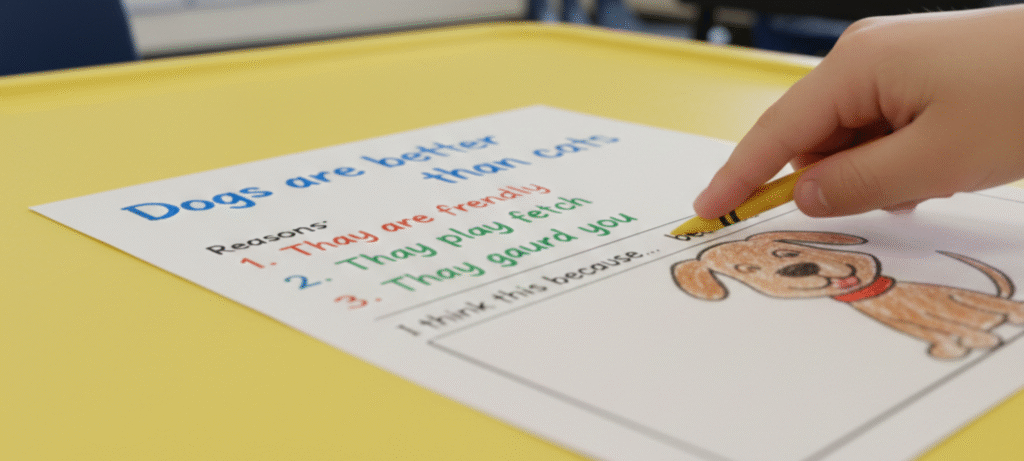
Many children write, “I like dogs because they are nice,” and stop. Teachers can gently guide them to explain further: Why are they nice? What makes them special? The word because acts as a bridge between opinion and reasoning.
Choosing Familiar Topics
Topics should connect to students’ daily experiences. Examples include:
- Favorite foods
- Best games
- Pets
- School rules
- Seasons
Familiarity makes ideas clearer. Questions like “Should we have homework?” can spark surprisingly thoughtful responses.
Graphic Organizers
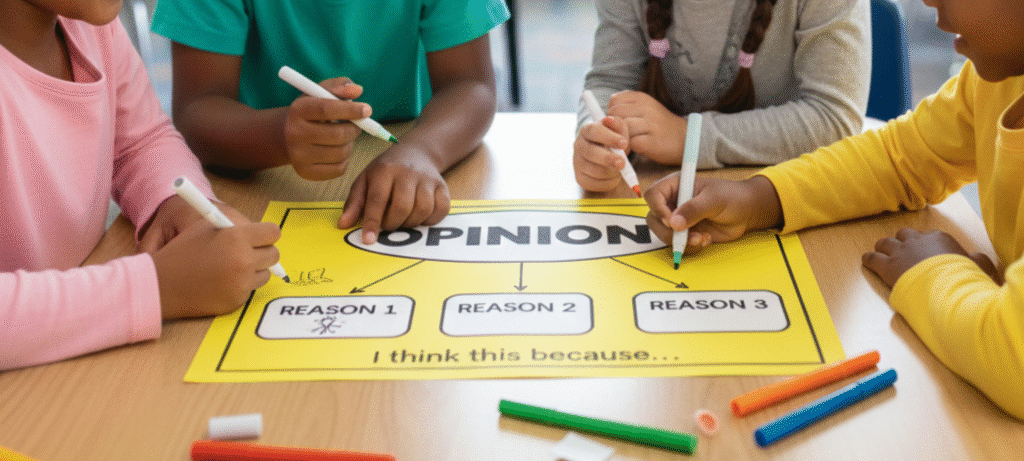
A simple web organizer with one central bubble for the opinion and three surrounding bubbles for reasons works well. It encourages planning before writing and prevents overwhelm.
Resources like Education.com offer planners and sentence frames that scaffold thinking, not limit it. Classroom blogs such as Lucky Little Learners break the process into manageable steps for young students.
Sample Topics That Engage First Graders
- The best season of the year
- Should recess be longer
- Is it better to have a cat or a dog
- What is the best playground equipment
- Should students help make classroom rules
Children take these topics seriously. One student once argued passionately that winter is superior because, “you can wear cozy socks.” Simple, honest, and supported.
Common Mistakes Teachers See
- Restating the topic instead of giving an opinion: e.g., “Dogs and cats are pets” is a fact, not an opinion.
- Listing reasons without explanation: Short phrases instead of full sentences. Modeling helps students stretch their ideas.
- Skipping conclusions: Students often stop after listing reasons. Encouraging a closing sentence reinforces structure.
How Opinion Writing Builds Long-Term Skills
Opinion writing in first grade lays the foundation for persuasive and analytical writing later. Students learn:
- To organize ideas
- To support claims
- That writing has a beginning, middle, and end
It also builds confidence. When their ideas are displayed or shared aloud, children understand that their voice matters. This mindset carries over into all subjects.
In another article, Business Intelligence in Education, we explored how data helps educators track student growth. Structured opinion writing is one of those early patterns that predict later writing strength.
Connecting Opinion Writing to Other Academic Growth
Writing instruction also intersects with professional and regulated learning standards. For instance:
- Programs like Appraisal Continuing Education Indiana emphasize structured reasoning and clear documentation.
- Online programs like Online Environmental Education Certificates expect learners to articulate viewpoints.
Early practice with opinion writing supports these later skills.
People Also Ask
What is opinion writing in 1st grade?
It involves teaching children to express what they think or feel about a topic and provide simple reasons, including an opinion statement, supporting details, and a concluding sentence.
What are good topics for opinion writing?
Topics connected to daily life work best: favorite foods, best seasons, classroom rules, pets, playground activities, books.
How do you teach kids opinion writing?
Start with modeling, use sentence starters, provide graphic organizers, encourage the word because, and maintain consistent structure until students internalize it.
What are examples of opinions?
- Ice cream is the best dessert.
- Recess should be longer.
- Dogs are better than cats.
- Homework is important.
- Summer is the most fun season.
FAQs
How many reasons should first graders give?
One to three reasons are sufficient. Quality is more important than quantity.
Should spelling be graded strictly?
Focus first on idea development and structure. Spelling guidance is important, but it should not restrict expression.
Can opinion writing include drawings?
Yes. Pictures often help children clarify thinking before writing sentences.
How often should opinion writing be practiced?
Short, regular sessions work better than infrequent long assignments. Consistency builds familiarity and confidence.
Final Thought
Opinion writing for first graders is not about creating polished essays. It is about helping children recognize that their thinking has shape. That a belief can be stated clearly. That a reason strengthens it.
Sentences may be messy. Reasons may wander. Some children change their opinion mid-writing. That is normal.
What matters most is that children learn to put their voice on paper. Once they realize they can do that, it becomes very hard to take that power away.